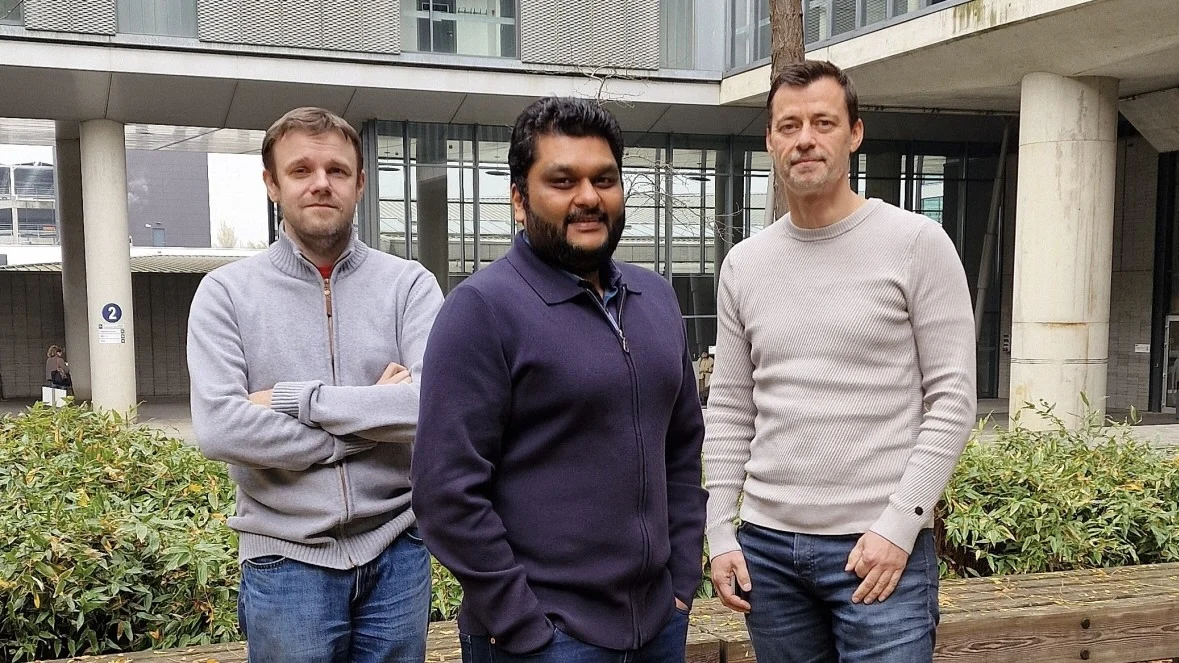
The Leuven Cancer Institute shared on LinkedIn
“‘A tumor is a heavily protected fortress. We want to identify and target every layer of its defences.’
Immunotherapy is often described as one of the greatest breakthroughs in modern cancer care. Yet many patients still do not benefit from these treatments. The Leuven-based RETROFIT R&D platform aims to change that. ‘Within five years, we hope to offer new treatment options to patients who currently have no effective therapies available.’
Over the past decade, immunotherapy has transformed the way cancer is treated. Yet for a substantial proportion of patients, these therapies still fail to deliver lasting benefit. Some tumors can evade the immune system and develop resistance to treatment. Through RETROFIT, a multidisciplinary team of researchers at KU Leuven and UZ Leuvenaims to tackle this challenge. By combining artificial intelligence, patient-derived data, advanced laboratory models and innovative antibody technologies, they hope to accelerate the development of new immunotherapies.
‘For some patients, the results are truly remarkable, but there are still many who do not respond to these treatments,’ says Professor Abhishek D. Garg, Head of the Laboratory for Cell Stress and Immunity at KU Leuven. ‘That is because tumors rarely develop resistance through a single mechanism. Instead, multiple resistance mechanisms are often active at the same time.’
According to Professor Garg, current immunotherapies frequently target only one biological pathway. However, once resistance develops, several biological barriers usually come into play simultaneously.
‘You can think of a tumor as a heavily protected fortress. Conventional immunotherapy helps the immune system breach the first defensive wall. But some aggressive tumors are protected by multiple layers of defence. As soon as you overcome one barrier, another emerges. With RETROFIT, we aim to map those barriers and tackle them simultaneously.’
Like many people, I have experienced the impact of cancer within my own family. The most frustrating moment is when there are no treatment options left. If RETROFIT can create new possibilities for patients who currently have none, that is my greatest motivation. – Professor Garg
An idea years in the making
Although RETROFIT was only recently launched officially, the concept originated years ago during extensive discussions between Professor Garg and Professor Stefan Naulaerts, Head of the Computational Oncology Lab at KU Leuven.
‘When Stefan was still a postdoctoral researcher in my lab, we had almost daily conversations about the future of cancer research,’ recalls Professor Garg. ‘We recognised that increasing amounts of patient data would become available. At the same time, we wondered how we could convert those data into knowledge that would genuinely benefit patients.’
The original vision was highly ambitious.
‘Advances in artificial intelligence, the emergence of spatial omics technologies, institutional support, and our collaboration with Nick Geukens of PharmAbs, the KU Leuven Antibody Center, enabled us to realise the platform much faster than we had anticipated. What initially looked like a ten- to fifteen-year trajectory ultimately took around six years thanks to Nick, Maarten Dewilde, Susan Schlenner, and the rest of the team we assembled along the way.’
What fascinates me is the learning process. How can we use AI to better understand complex biological systems? Ultimately, it is not about the technology itself, but about improving patient care. – Professor Naulaerts
Innovation goes beyond science
‘Many innovations never make it beyond the gap between fundamental research and real-world impact,’ says Nick Geukens, innovation manager at KU Leuven. ‘Scientific excellence alone is not enough to bring new therapies to patients.’
Geukens views programmes such as the Industrial Research Fund (IOF) as a crucial bridge between research and implementation.
‘This type of funding allows researchers to take those first steps that are often too applied for fundamental research grants, yet still too early for conventional investors or industrial partners.’
Thanks to this support, the RETROFIT team was able not only to demonstrate scientific feasibility but also to work on intellectual property, valorisation strategies and future therapeutic applications.
‘From the outset, we tried to look beyond the science itself. How do you translate a strong scientific vision into a sustainable platform that ultimately reaches patients? That question was just as important as the science.’
From patient to laboratory and back again
One of RETROFIT’s most innovative aspects is its commitment to reverse translational research. Traditionally, researchers start with a hypothesis in the laboratory and only years later determine whether it benefits patients. RETROFIT partly reverses that process. The concept is embedded in the platform’s name: REverse TRanslation for next-generation OF ImmunoTherapy. At the same time, the name refers to the English verb to retrofit, meaning to improve an existing system by incorporating new technologies or capabilities. That dual meaning captures the essence of the platform: continuously connecting patient data, artificial intelligence and laboratory experimentation in a lab-in-the-loopframework.
‘Rather than spending years in the laboratory before assessing clinical relevance, we begin with clinical observations and patient data,’ explains Professor Garg. ‘We then use those insights to design smarter experiments.’
This approach is made possible by the unprecedented availability of biological and clinical data.
‘Fifteen years ago, this would have been impossible. Today, we have access to an extraordinary volume of patient-derived data. Thanks to artificial intelligence, we can organise and analyse that information much more effectively to determine which research questions matter most.’
The impact of RETROFIT already extends beyond the platform itself. A striking example is Professor Garg’s award-winning research on immunotherapy for kidney cancer, conducted in collaboration with Professor Benoit Beuselinck (UZ Leuven). The project recently received the prestigious SWISS BRIDGE Award 2026.
‘The AI technology used in that project was originally developed within the foundations of RETROFIT. Although the study itself was separate from the platform, it demonstrates how technologies developed within RETROFIT can already have a direct impact on research and patient care.’
AI as a research assistant
Artificial intelligence forms one of the cornerstones of RETROFIT. Yet Professor Naulaerts cautions against oversimplification.
‘Many people assume that AI is simply about processing large amounts of data and automatically generating answers. Unfortunately, that is an oversimplification. AI requires high-quality datasets, accurate annotations and continuous validation before it can be used for drug discovery. In its current state, AI is mainly a force multiplier. If you have good understanding of the domain you work in and ask the right questions, AI will significantly boost your productivity. If not, the gains can be quite marginal.’
According to Professor Naulaerts, RETROFIT’s real strength lies in the combination of AI and experimental research.
‘We do not use AI to replace researchers. We use it as a research assistant. It helps us identify patterns, generate hypotheses and prioritise the most promising research directions.’
The potential time savings are enormous.
‘Researchers are confronted with countless possible combinations and research questions. If AI can reduce thousands or even millions of possibilities to a small number of high-potential candidates, researchers can focus their expertise far more effectively.’
RETROFIT takes this one step further.
‘The models do not merely make predictions. Those predictions are tested in the laboratory, and the results are then used to improve the models and their architecture. In this way, we create a guidance system that gradually helps in better interpretation of cancer biology.’
Why Leuven?
According to all three interviewees, the emergence of a platform such as RETROFIT in Leuven is no coincidence.
‘Leuven offers an exceptional ecosystem,’ says Professor Garg. ‘UZ Leuven provides access to patients, clinical expertise and clinical trials. KU Leuven contributes technological platforms, expertise in artificial intelligence, drug development and advanced omics technologies.’
Organisations such as the Leuven Cancer Institute (LKI) also play a vital role. ‘On a campus of this scale, you need connective structures. LKI helps researchers, clinicians and other experts find one another and collaborate.’
Professor Naulaerts shares this view. ‘The technology itself is not unique. What is unique is Leuven’s ability to bring together all of that expertise around a common objective. That is what enables ideas to move more quickly from concept to clinical impact.’
The international community is beginning to take notice as well. According to Geukens, RETROFIT distinguishes itself through its combination of patient-driven discovery, artificial intelligence, deep clinical datasets, antibody engineering and a strong translational focus.
‘There are undoubtedly excellent initiatives internationally, but very few places bring all these capabilities together within a single integrated ecosystem.’
‘What motivates me is seeing an idea grow from a scientific concept into something that genuinely improves patients’ lives. Working at the intersection of science, innovation and healthcare remains incredibly inspiring.’ – Nick Geukens
A funding gap for medical AI
The opportunities offered by medical AI are immense, but the researchers also see a significant challenge.
‘Artificial intelligence is often presented as a solution to many healthcare challenges,’ says Professor Garg. ‘However, developing reliable medical AI requires substantial investments, expertise and time.’
According to him, a critical funding gap remains.
‘The innovations we are working on often fall between two funding worlds. They are too applied for traditional fundamental research funding, yet still too early for industrial investors.’
Professor Naulaerts agrees.
‘If we want to remain competitive at the European and international level, we need more structural support for medical AI research and innovation. Building reliable models requires far more than access to data alone. For example, models have to be grounded in reality and made interpretable before they can be ready to support clinical decision-making.’
Yet Europe also possesses a major strategic asset.
‘We have access to high-quality clinical data, well-characterised patient cohorts and strong hospital networks,’ says Professor Garg. ‘These are precisely the ingredients needed to develop trustworthy medical AI. Such datasets are internationally valuable because new therapies ultimately need to be validated across diverse patient populations, including European and other Western or Asian populations.’
He sees this as an important opportunity.
‘Europe does not necessarily need to compete with countries such as China or the United States on scale alone. We can take a leading role by making better use of our unique combination of patient data, clinical expertise and scientific excellence. But achieving that requires targeted investment in medical AI.’
The researchers believe this could give Europe a distinctive position internationally.
‘The foundations are there. We have outstanding hospitals, excellent researchers and unique patient datasets,’ concludes Professor Naulaerts. ‘These are strengths we should continue to build upon.’
From research to impact
For Geukens, success is not measured by number of publications or patents alone.
‘Success means that patients who currently have no treatment options available may one day have access to new therapies.’
Within five years, all three researchers hope RETROFIT will have achieved major milestones.
Geukens envisions a leading European platform for discovering and developing next-generation immunotherapies. Professor Naulaerts hopes to demonstrate how “reliable AI” can become an indispensable partner for researchers. Professor Garg looks even further ahead.
‘I hope that within five years RETROFIT will be recognised not only nationally but also across Europe as a leading ecosystem. Not because recognition is the goal, but because that visibility will attract new collaborations, expertise and opportunities for patients.'”
RETROFIT Platform shared this post, adding:
“Thanks Leuven Kankerinstituut for this wonderful coverage of the philosophy and vision behind our recently launched RETROFIT R&D Platform at KU Leuven Research and Development and KU Leuven!”
You can also read:
KEYNOTE-564: One Year of Immunotherapy, Five Years of Survival Benefit
When Immunotherapy Defies Expectations: Five Remarkable Cancer Cases