
Can one year of immunotherapy after surgery translate into a lasting survival benefit? The five-year results of the phase III KEYNOTE-564 trial, published in Annals of Oncology by Naomi B. Haas, Thomas B. Powles, Toni K. Choueiri, and colleagues, provide further evidence supporting adjuvant pembrolizumab in clear cell renal cell carcinoma (ccRCC).
With a median follow-up of approximately 70 months, pembrolizumab continued to demonstrate improvements in both disease-free survival (DFS) and overall survival (OS) compared with placebo. Importantly, these benefits were maintained approximately four years after the end of study treatment, reinforcing the long-term clinical value of adjuvant immune checkpoint inhibition.
KEYNOTE-564: Study Design
KEYNOTE-564 (NCT03142334) is a randomized, double-blind, placebo-controlled phase III trial evaluating adjuvant pembrolizumab in patients with ccRCC at increased risk of recurrence following nephrectomy, with or without metastasectomy. Eligible patients had undergone surgery within 12 weeks before randomization and had received no previous systemic therapy for renal cell carcinoma.
A total of 994 patients were randomly assigned in a 1:1 ratio to receive:
- Pembrolizumab (n = 496): 200 mg intravenously every three weeks for up to 17 cycles (approximately one year).
- Placebo (n = 498): administered according to the same schedule.
Treatment continued until completion of the planned cycles, disease recurrence, unacceptable toxicity, or other discontinuation criteria were met.
The primary endpoint was investigator-assessed DFS, and the key secondary endpoint was OS. Safety was a secondary endpoint, while distant metastasis-free survival (DMFS) and time to recurrence (TTR) were evaluated through post hoc exploratory analyses.
The current publication presents the fourth prespecified interim analysis, with a minimum follow-up of five years and a data cutoff of September 25, 2024. As both DFS and OS had already met statistical significance in previous analyses, no additional formal hypothesis testing was performed.
Five-Year Results: Survival Benefits Extend Beyond Treatment
After a median follow-up of 69.5 months, adjuvant pembrolizumab continued to demonstrate sustained clinical benefit. All participants had completed or discontinued study treatment by December 2020, allowing the investigators to assess whether the benefits of checkpoint inhibition persisted several years after treatment ended.
Disease-Free Survival
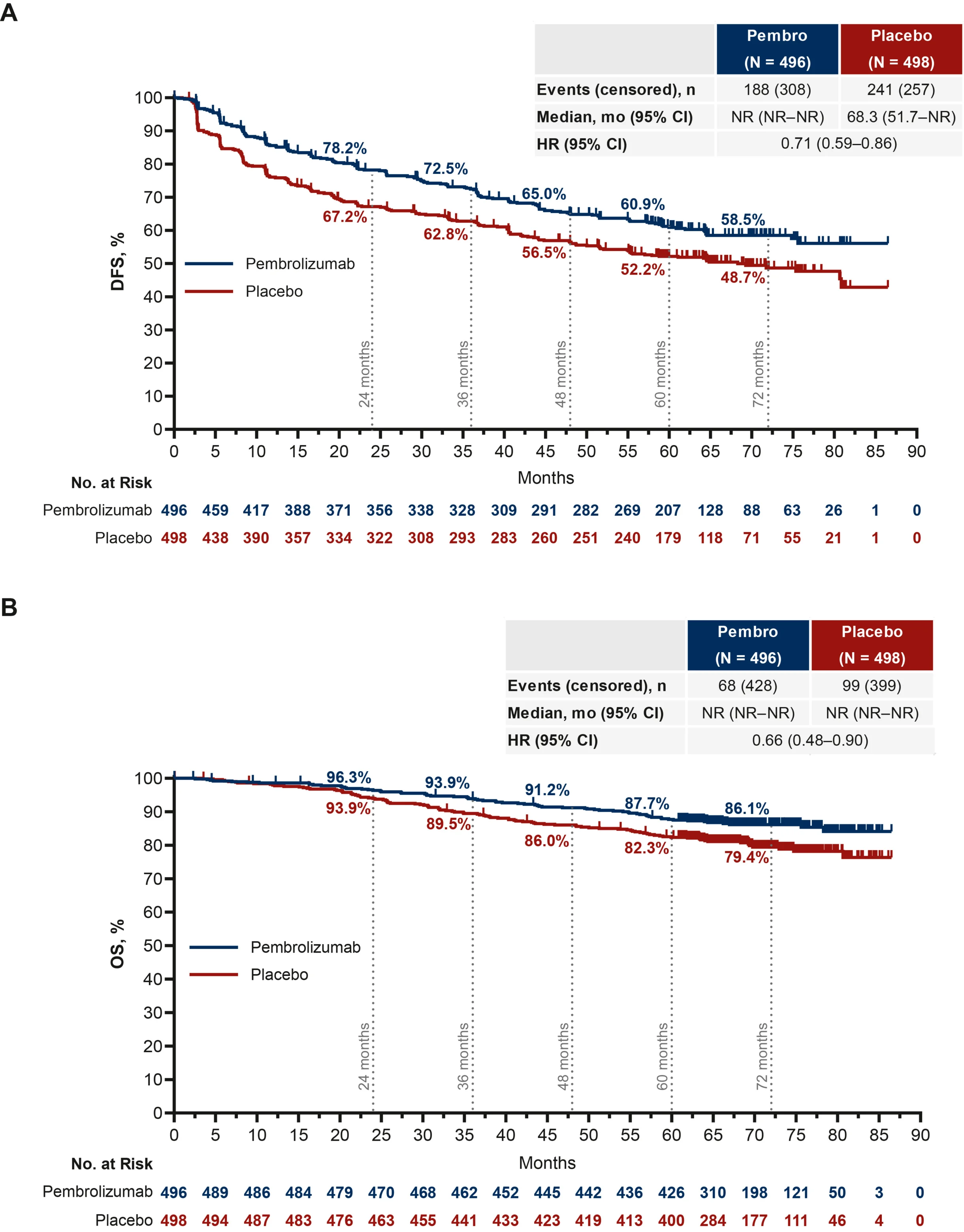
Pembrolizumab was associated with a 29% lower hazard of disease recurrence or death compared with placebo, translating into an absolute improvement of 8.7 percentage points in estimated five-year DFS.
- Median DFS: Not reached vs. 68.3 months.
- Five-year DFS rate: 60.9% vs. 52.2%.
- Hazard ratio: 0.71 (95% CI, 0.59–0.86).
- DFS events: 188 (37.9%) vs. 241 (48.4%).
Overall Survival
The overall survival benefit previously established in KEYNOTE-564 remained evident with extended follow-up. Pembrolizumab was associated with a 34% lower hazard of death, with an absolute improvement of 5.4 percentage points in estimated five-year OS.
- Median OS: Not reached in either group.
- Five-year OS rate: 87.7% vs. 82.3%.
- Hazard ratio: 0.66 (95% CI, 0.48–0.90).
- Deaths: 68 (13.7%) vs. 99 (19.9%).
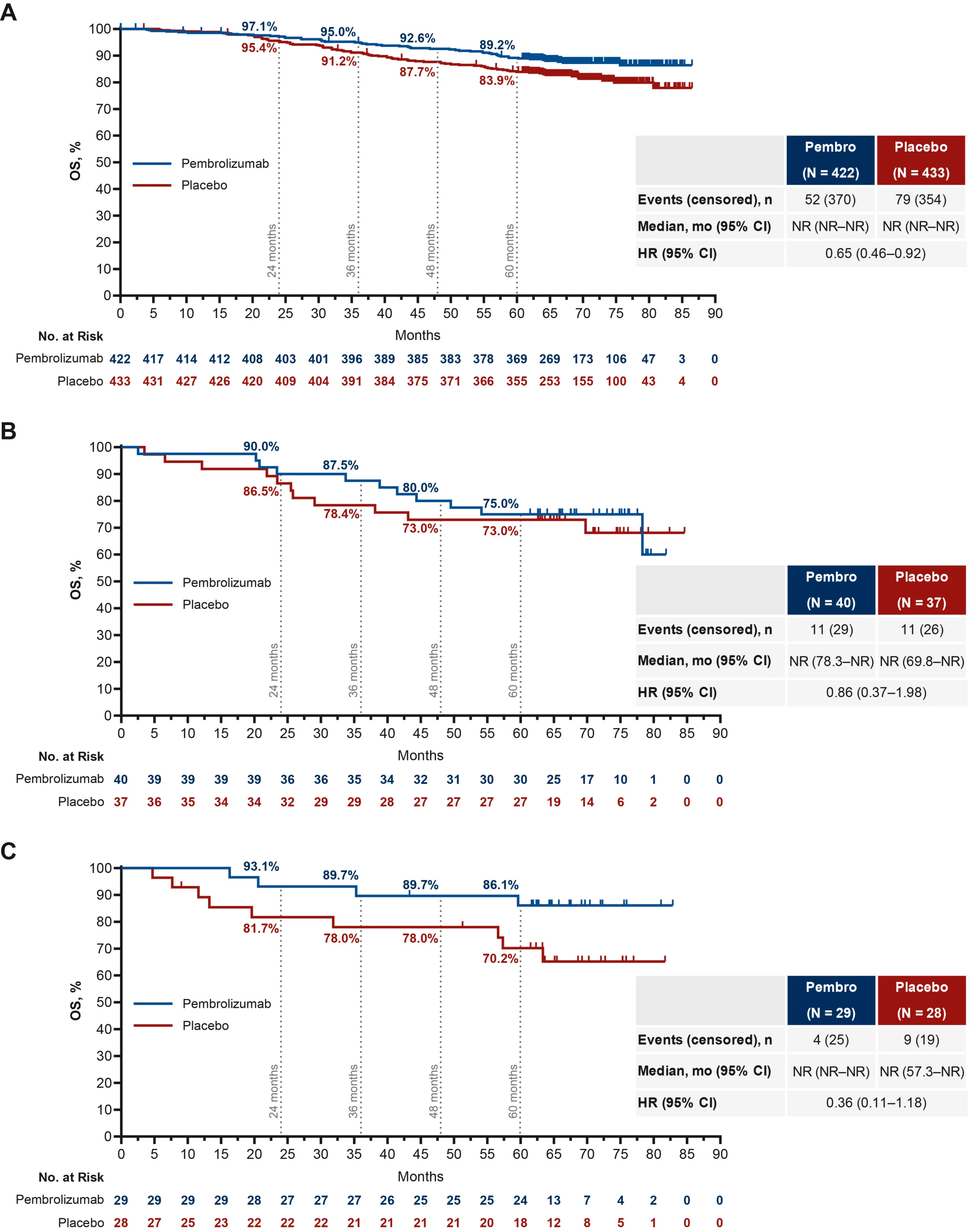
The magnitude of benefit remained consistent with previous analyses. Favorable outcomes were also observed across several key prespecified and exploratory subgroups, including disease risk categories, tumor grade, and the presence or absence of sarcomatoid features.
These subgroup findings should be interpreted with appropriate caution, particularly in smaller patient populations. Nevertheless, the sustained overall survival benefit remains one of the most clinically important findings of KEYNOTE-564, demonstrating that adjuvant pembrolizumab can do more than delay disease recurrence.
Beyond DFS: Reducing Recurrence and Delaying Distant Metastases
The rationale for adjuvant immunotherapy is to generate an antitumor immune response against residual malignant cells that may remain after apparently complete surgical resection. Although these cells may be undetectable on conventional imaging, they can eventually lead to local recurrence or distant metastatic disease.
Exploratory analyses of KEYNOTE-564 provided further insight into the impact of pembrolizumab on these outcomes.
Time to Recurrence
Documented disease recurrence occurred less frequently among patients receiving pembrolizumab than among those receiving placebo.
- Disease recurrence: 34.5% vs. 45.4%.
- Median time to recurrence: Not reached vs. 80.9 months.
- Hazard ratio: 0.69 (95% CI, 0.57–0.84).
Distant Metastasis-Free Survival
Pembrolizumab was also associated with a 27% lower hazard of developing distant metastases or dying from any cause.
- Median DMFS: Not reached vs. 80.7 months.
- DMFS events: 35.1% vs. 44.2%.
- Hazard ratio: 0.73 (95% CI, 0.60–0.89).
Although these were exploratory endpoints, the results were consistent with the established DFS and OS benefits. Together, they provide further evidence that adjuvant pembrolizumab can delay both disease recurrence and metastatic progression.
What Happens When Renal Cell Carcinoma Recurs After Adjuvant Pembrolizumab?
As immune checkpoint inhibitors become established in earlier stages of cancer treatment, managing recurrence after previous immunotherapy exposure represents an increasingly important clinical challenge. This is particularly relevant in renal cell carcinoma, where immunotherapy-based combinations play a central role in the treatment of metastatic disease.
The extended follow-up of KEYNOTE-564 provides insights into subsequent treatment patterns among 171 patients with documented recurrence in the pembrolizumab group and 226 in the placebo group.
Subsequent treatments in the pembrolizumab versus placebo groups included:
- Any systemic therapy: 64.3% vs. 68.1%.
- VEGF/VEGFR-targeted therapy: 59.1% vs. 58.8%.
- Anti-PD-1/PD-L1 therapy: 28.7% vs. 48.2%.
- Local therapy alone, including surgery and/or radiotherapy: 19.3% vs. 13.3%.
- No subsequent therapy reported: 16.4% vs. 18.6%.
VEGF/VEGFR-targeted agents were the most frequently used systemic treatments following recurrence in both groups. However, subsequent PD-1/PD-L1 blockade was less frequently administered in patients previously exposed to adjuvant pembrolizumab.
Another notable observation was the higher proportion of patients in the pembrolizumab group who received local therapy alone following recurrence. The investigators suggested that this may reflect limited disease burden and favorable disease characteristics in some patients.
These findings are descriptive rather than comparative. Patients could receive multiple systemic treatments, subsequent treatment information may have been incomplete, and the trial was not designed to establish the optimal treatment strategy after recurrence.
Nevertheless, the results highlight an important unanswered question: should patients who relapse during or shortly after adjuvant pembrolizumab be treated differently from those who experience recurrence several years after completing immunotherapy?
The timing of recurrence, previous immunotherapy exposure, and potential mechanisms of resistance represent important considerations for future clinical research.
Long-Term Safety: No New Safety Signals Reported
The balance between efficacy and toxicity is particularly important in the adjuvant setting, where patients have no detectable residual disease following surgery and some may already be cured without additional systemic treatment.
At the fourth interim analysis, the safety profile of pembrolizumab remained consistent with previous reports. No new serious treatment-related adverse events had been reported for at least three years.
The most common grade 3 or higher adverse events of any cause in the pembrolizumab group, collected during treatment and up to 30 days afterward, included:
- Hypertension: 2.9%.
- Increased alanine aminotransferase: 2.3%.
- Diarrhea: 1.8%.
The median duration of grade 3 or higher adverse events of any cause was 42 days with pembrolizumab compared with 20 days with placebo.
Importantly, routine adverse-event collection was limited to protocol-defined periods following treatment completion or discontinuation. Therefore, the absence of new reported safety signals does not exclude persistent or delayed immune-related toxicities.
This remains a relevant consideration when discussing adjuvant immunotherapy with patients, particularly given that some immune-related adverse events may require prolonged or lifelong management.
The Next Challenge: Identifying Who Really Needs Adjuvant Immunotherapy
The five-year results of KEYNOTE-564 reinforce pembrolizumab as a standard of care for eligible patients with ccRCC at increased risk of recurrence. However, establishing a survival benefit at the population level does not mean that every eligible patient derives the same individual benefit.
At five years, 52.2% of patients in the placebo group remained alive and disease-free. This finding highlights one of the central challenges of adjuvant immunotherapy: identifying patients who are likely to benefit from treatment while avoiding unnecessary exposure in those who may already be cured by surgery.
Future investigations into predictive biomarkers, circulating tumor DNA (ctDNA), and molecular residual disease could help refine patient selection. Whether these approaches can reliably identify patients who require adjuvant pembrolizumab or those who may safely undergo surveillance remains to be established through prospective clinical studies.
Equally important is determining the optimal treatment for patients whose disease recurs despite previous checkpoint inhibition, including whether the interval between adjuvant treatment and recurrence can help guide subsequent immunotherapy decisions.
Conclusion
With the longest reported follow-up of an adjuvant immunotherapy trial in renal cell carcinoma to date, KEYNOTE-564 demonstrates that the clinical benefits of a finite course of pembrolizumab can persist for several years after treatment completion.
The sustained improvements in disease-free and overall survival strengthen the role of immune checkpoint inhibition in the management of clear cell renal cell carcinoma at increased risk of recurrence.
KEYNOTE-564 has established the value of adjuvant pembrolizumab. The next challenge is making that benefit more personalized: determining who needs immunotherapy, who can safely avoid it, and how best to treat patients whose disease returns despite prior PD-1 blockade.
Read Full Article Here