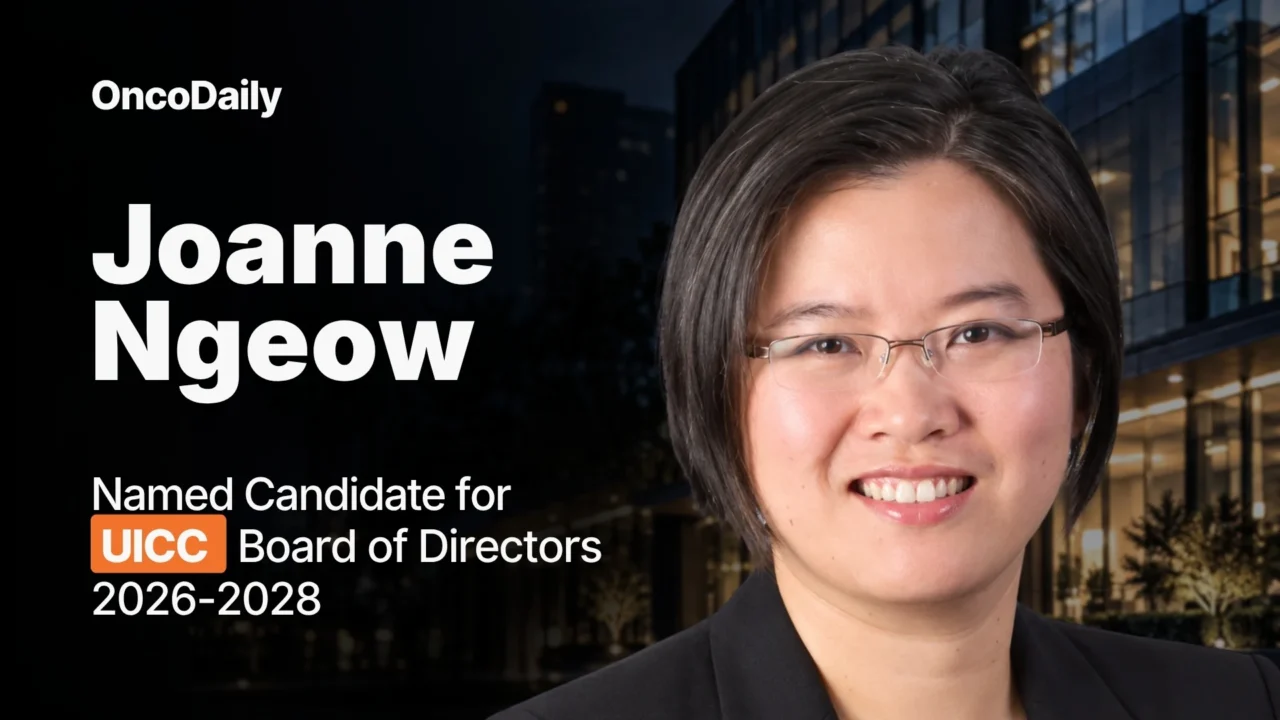
Joanne Ngeow, Head of the Cancer Genetics Service at the National Cancer Centre Singapore and Associate Professor of Genomic Medicine at Nanyang Technological University Singapore, has been named a candidate for the UICC Board of Directors for the 2026–2028 term.
Based in Singapore, Dr Ngeow is a medical oncologist, clinician-scientist, and genomic medicine specialist whose work focuses on hereditary cancer syndromes, precision medicine, cancer prevention, and equitable access to genomic diagnostics.
The new UICC Board will be elected by UICC full-member organisations during the 2026 UICC General Assembly, which will take place virtually on October 20, 2026. Electronic voting will open on October 13 and close at 14:30 CEST on October 20.
Joanne Ngeow’s Work in Cancer Genetics and Precision Medicine
Dr Ngeow leads the Cancer Genetics Service at the National Cancer Centre Singapore, where she integrates cancer genomics into routine oncology care.
Her clinical and research work focuses particularly on hereditary cancer syndromes and translational cancer genomics, with an emphasis on identifying people at increased cancer risk and developing strategies for prevention and early detection.
She implemented universal mismatch repair deficiency testing for colorectal and endometrial cancers across SingHealth and leads Singapore’s National Precision Medicine Clinical Implementation Pilot for hereditary cancer.
Her research examines gene–environment interactions in cancer predisposition and approaches to delivering genomic medicine equitably across diverse Asian populations.
Why Joanne Ngeow Is Running for the UICC Board
Dr Ngeow said her decision to seek a position on the UICC Board is driven by the need to ensure that advances in genomics and precision medicine benefit patients across different health systems.
“I wish to join the UICC Board to help shape an equity-driven global agenda for cancer prevention and early detection.”
She highlighted the uneven availability and affordability of genomic testing and advanced diagnostics, particularly across Asia and other regions where cancer burdens are substantial.
As a clinician-scientist working in Asia, she said she hopes to bring perspectives from populations that have historically been underrepresented in genomic research and cancer-control strategies.
“I hope to amplify perspectives from regions where the cancer burden is high but access to genomics and advanced diagnostics is uneven.”
Making Precision Medicine More Accessible
A major focus of Dr Ngeow’s candidacy is ensuring that precision medicine becomes sustainable within health systems rather than remaining limited to specialised centres.
Her experience includes working with ministries of health, payers, advocates, and industry on reimbursement and health technology assessment for genomic tests.
She said sustainable access requires not only technological advances but also evidence and policy frameworks that allow health systems to adopt and reimburse new diagnostics.
If elected, she would focus on supporting countries in developing these frameworks, particularly in low- and middle-income settings.
Connecting Research, Policy, and Patient Care
Dr Ngeow’s experience spans clinical oncology, research, health policy, implementation, and healthcare financing.
She serves on the Medical Technology Advisory Committee of Singapore’s Ministry of Health, contributing to evidence appraisal and reimbursement decisions involving novel diagnostics and therapeutics.
She is also an international chair within the InSiGHT consortium, contributing to the development of global standards in hereditary gastrointestinal cancer.
These roles have given her experience working across research institutions, healthcare systems, government, payers, and professional networks.
“My candidacy for the UICC Board is grounded in three intersecting strengths: clinical leadership, implementation science in precision medicine, and a sustained commitment to equity and reimbursement for cancer innovation.”
Strengthening the Cancer Workforce
Dr Ngeow has also focused on building the workforce required to deliver modern cancer genetics services.
Through the development of genetic counsellor-led services and national career pathways, she has worked to strengthen capacity for hereditary cancer risk assessment and genomic care.
She said workforce development would remain an important component of her proposed contribution to UICC, alongside broader health system strengthening.
Her goal is to help countries develop the expertise and infrastructure needed to translate advances in genomic medicine into accessible cancer prevention and care.
Watch Dr Joanne Ngeow’s video message outlining her experience, priorities, and vision as a candidate for the UICC Board of Directors for the 2026–2028 term.
UICC Board Elections 2026
The 2026 UICC election will determine 14 members of the Board of Directors for the 2026–2028 term.
UICC full-member organisations will vote during the virtual General Assembly on October 20, 2026, following the opening of electronic voting on October 13.
The elected Board will help guide UICC’s work in cancer prevention, early detection, health equity, health systems strengthening, precision oncology, and global cancer control.
Read further on OncoDaily: Sri Navaratnam Named Candidate for UICC Board of Directors 2026–2028