Young Kwang Chae, Professor of Medicine at Northwestern University Feinberg School of Medicine, shared on X:
“Historic Milestone in Precision Oncology!
We are witnessing a paradigm shift in cancer medicine. Garsimo et al. have just published what stands as the FIRST-EVER AI-based ADC biomarker paper in history.
For years, pathologists and oncologists struggled with TROP2-targeted ADCs like datopotamab deruxtecan (Dato-DXd). While ~90% of NSCLC tumors express TROP2, conventional visual IHC scoring (H-score) completely failed to predict who actually responds.
Why? Because total surface abundance doesn’t capture the dynamic biology ADCs rely on: receptor internalization.
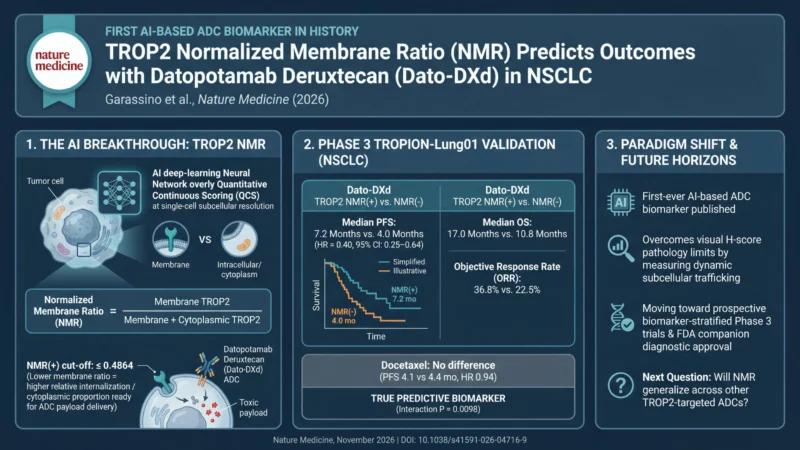
Enter TROP2 NMR (Normalized Membrane Ratio) via AI deep-learning Quantitative Continuous Scoring (QCS): lower NMR ratio means a higher proportion of TROP2 is internalizing into the cytoplasm – primed to pull the ADC payload inside the cell to destroy the tumor.
The Striking Clinical Results (TROPION-Lung01 Phase 3 Validation)
When validating in patients with non-squamous NSCLC without actionable mutations: Median PFS (Dato-DXd): 7.2 months in NMR(+) vs. 4.0 months in NMR(-) (HR = 0.40, 95% CI: 0.25–0.64)!
Median OS (Dato-DXd)
- 17.0 months vs. 10.8 months!
- ORR: 36.8% vs. 22.5%
The Control Arm (Docetaxel): Zero predictive difference (mPFS 4.1 vs. 4.4 mo, HR = 0.94; interaction p= 0.0098). This proves NMR is a true predictive biomarker, not just prognostic!
Evaluation and Critical Perspective
This paper marks the dawn of computational biomarker pathology. Standard visual microscopy can’t count intracellular trafficking ratios at single-cell scale – AI can. It transforms how we evaluate targetability across all ADCs, moving from ‘is the target there?’ to ‘is the cell internalizing the drug?’
What Lies Ahead
Will the Next ADC Trial with This Biomarker Be Enough?
The Regulatory Hurdle: While retrospective validation on TROPION-Lung01 is stellar (HR 0.40), the FDA’s Breakthrough Device Designation is already being put to the test in ongoing prospective trials—including Phase 3 studies (AVANZAR, TROPION-Lung10) and the NMR-selected PATAGONIA trial. Will these prospective readouts replicate the HR 0.40 magnitude and be enough for full AI-driven CDx approval and a shift in standard of care?
ADC-Wide Generalizability
Does TROP2 NMR apply to other TROP2 ADCs (e.g., sacituzumab govitecan, sacituzumab tirumotecan), or is it tightly tied to Dato-DXd’s specific antibody-linker-payload kinetics?
Clinical Integration
How quickly can hospital pathology labs deploy QCS computational algorithms globally?
This is just the beginning of AI-guided antibody-drug conjugate therapy. A landmark achievement in oncology!”
Title: Normalized membrane ratio of TROP2 as a predictor of clinical outcomes with datopotamab deruxtecan in non-small-cell lung cancer
Authors: Marina C. Garassino, Myung-Ju Ahn, Markus Schick, Ansh Kapil, Luis Paz-Ares, Aaron Lisberg, Melissa L. Johnson, Maurice Pérol, Toshio Shimizu, Rebecca Heist, Alexander Spira, Isamu Okamoto, Nicolas Girard, Robin Cornelissen, Elvire Pons-Tostivint, Min Hee Hong, Ricardo Zwirtes, Rachel Chiaverelli, Marlon Rebelatto, Matthew Sung, Chuyu Deng, James Harper, Danielle Carroll, Hadassah Sade, Jacob Sands
Read the full article in Nature Medicine.
You can also read:
Dato-DXd in Lung Cancer: International Experts Define New Strategies to Manage ADC Toxicities