






Yan Leyfman, Medical Correspondent at OncLive, Freelance, shared on LinkedIn:
“MRD negativity is powerful in multiple myeloma – but is its prognostic meaning the same for every patient?
Measurable residual disease (MRD) after autologous stem cell transplantation (ASCT) is strongly associated with outcomes in multiple myeloma. But the biology behind MRD persistence – and the risk it carries – may be just as important as the result itself.
In a study of 814 patients who achieved at least a very good partial response after ASCT, 48% achieved MRD negativity by next – generation flow cytometry.
Several findings stand out:
- t(11;14) predicted MRD positivity. Patients with this cytogenetic abnormality had approximately twice the odds of remaining MRD positive after ASCT.
- MRD status mattered overall. MRD – positive patients had nearly twice the risk of progression or death and a higher risk of death compared with MRD – negative patients.
- But t(11;14) challenged the broader pattern. Despite lower MRD – negative rates, patients with t(11;14) who remained MRD positive had a 5 – year PFS of 58% – not statistically different from the 63% observed in MRD – negative patients.
- High – risk cytogenetics sharpened the picture. Among MRD – positive patients, 5 – year PFS was 53% without two or more high – risk cytogenetic abnormalities (HRCAs), compared with just 17% with two or more. Even among MRD – negative patients, multiple HRCAs remained associated with inferior PFS.
Higher residual clonal plasma cell burden among MRD – positive patients was also associated with worse outcomes.
The key insight: MRD is not a standalone risk category. Its prognostic significance depends on the underlying disease biology, cytogenetic risk, and potentially the magnitude of residual disease.
These findings do not establish that MRD positivity is harmless in t(11;14) myeloma – or that treatment decisions should change based on this subgroup alone. But they highlight why MRD assessment and cytogenetic risk need to be interpreted together.
As myeloma care moves toward increasingly individualized treatment strategies, the question may be not only whether residual disease remains, but which disease is left behind.”
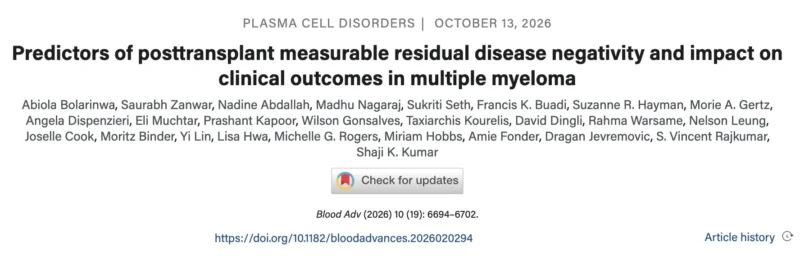
Title: Predictors of posttransplant measurable residual disease negativity and impact on clinical outcomes in multiple myeloma
Authors: Abiola Bolarinwa, Saurabh Zanwar, Nadine Abdallah, Madhu Nagaraj, Sukriti Seth, Francis K. Buadi, Suzanne R. Hayman, Morie A. Gertz, Angela Dispenzieri, Eli Muchtar, Prashant Kapoor, Wilson Gonsalves, Taxiarchis Kourelis, David Dingli, Rahma Warsame, Nelson Leung, Joselle Cook, Moritz Binder, Yi Lin, Lisa Hwa, Michelle G. Rogers, Miriam Hobbs, Amie Fonder, Dragan Jevremovic, S. Vincent Rajkumar, Shaji K. Kumar
Other articles featuring Yan Leyfman on OncoDaily.