Vitor Abreu de Góes, Postdoctoral Research Fellow at City of Hope Medical Center, shared on X:
“Happy to announce that our study assessing the global availability of 1,413 Prostate Cancer clinical trials is now out in JCO Global Oncology.
This is part of an overarching effort with my colleagues Koral Shah and George Zhang to describe differences in GU clinical trial availability. Our analysis looked into:
- How are prostate cancer trials distributed across the world?
- Do factors such as GNI or the local burden of prostate cancer influence trial availability?”
Countries were classified according to the World Bank income classification as high-, upper-middle–, lower-middle–, and low-income countries (HICs, UMICs, LMICs, and LICs). Trials were then categorized based on the income level of participating countries:
- HIC-only: conducted exclusively in HICs
- Non-HIC: conducted exclusively in UMICs, LMICs, and/or LICs
- Mixed-income: conducted in HICs and at least one UMIC, LMIC, and/or LIC․
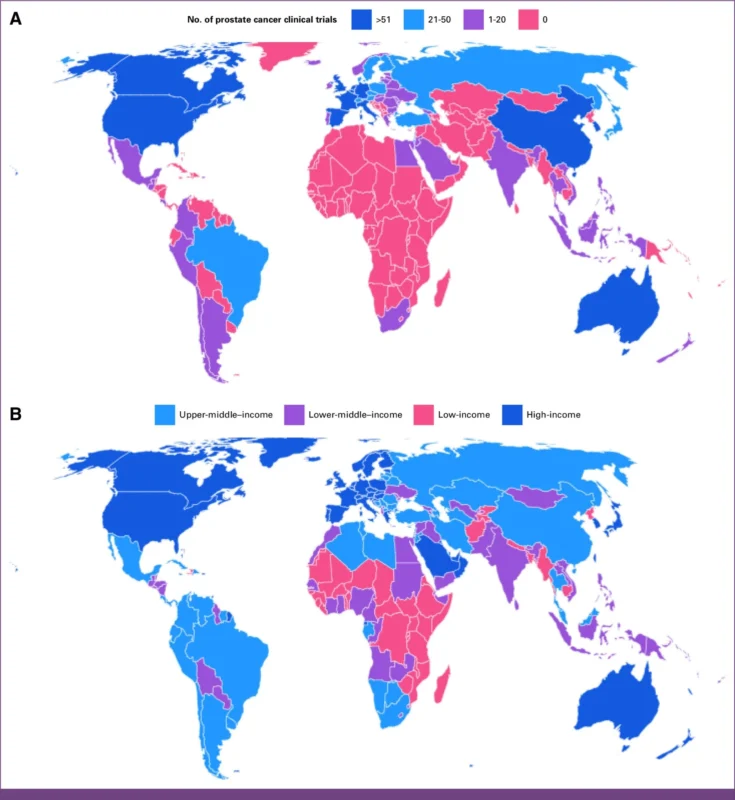
Clinical trial availability was disproportionately concentrated in higher-income countries.
- 80.4% of trials were conducted exclusively in HICs
- 15.9% were conducted exclusively outside HICs
- 3.6% were mixed-income trials.
Trial availability was also associated with higher GNI and national health expenditure. But it was not with prostate cancer incidence or mortality.
Most trials were primarily sponsored by academia (68.8%), followed by industry (26.8%) and governmental agencies (4.4%). Notably, mixed-income trials were heavily sponsored by pharma (96.1%) Academic sponsorship was more common among HIC-only and non-HIC trials. Overall, up to 40% of trials had some form of industry funding.
Pharma-funded trials tended to be more international and more focused on metastatic disease (72.0% vs 32.3%). They were more likely to investigate systemic therapies (76.3% vs 29.4%), while surgery and radiation were more commonly studied in non-pharma-funded trials.
These findings suggest that pharma sponsorship may help expand participation from under-represented countries in global research. At the same time, greater reliance on pharma for international collaboration highlights how industry priorities can shape the global research landscape.
Key takeaways:
- Prostate cancer trials remain disproportionately concentrated in HICs, despite a greater disease burden in lower income countries.
- Pharma sponsorship may help expand global trial access, but often focuses on strategies less applicable to resource-limited settings.
- More investigator-initiated trials, regional partnerships, and locally relevant trial designs are needed to advance equitable prostate cancer care.
Title: Evaluating Global Disparities in the Availability of Prostate Cancer Clinical Trials
Authors: Vitor Abreu de Góes, Miguel Zugman, Koral Shah, Daniela V. Castro, Xiaochen Li, Teebro Paul, Jaya Goud, Samuel Dickter, Lea Dickter, Salvador Jaime-Casas, Hedyeh Ebrahimi, Benjamin Mercier, Ruchi Agarwal, Joann Hsu, Nazli Dizman, Alexander Chehrazi-Raffle, Abhishek Tripathi, Sumanta Kumar Pal, Regina Barragan-Carrillo.
Read the full article.
You might find this interesting:
PSMAddition: [177Lu]Lu-PSMA-617 Improves Radiographic PFS in PSMA-Positive mAPMN/S Prostate Cancer