Sebastian Schmidt, Head of Medical Affairs Computed Tomography at Siemens Healthineers, shared on LinkedIn:
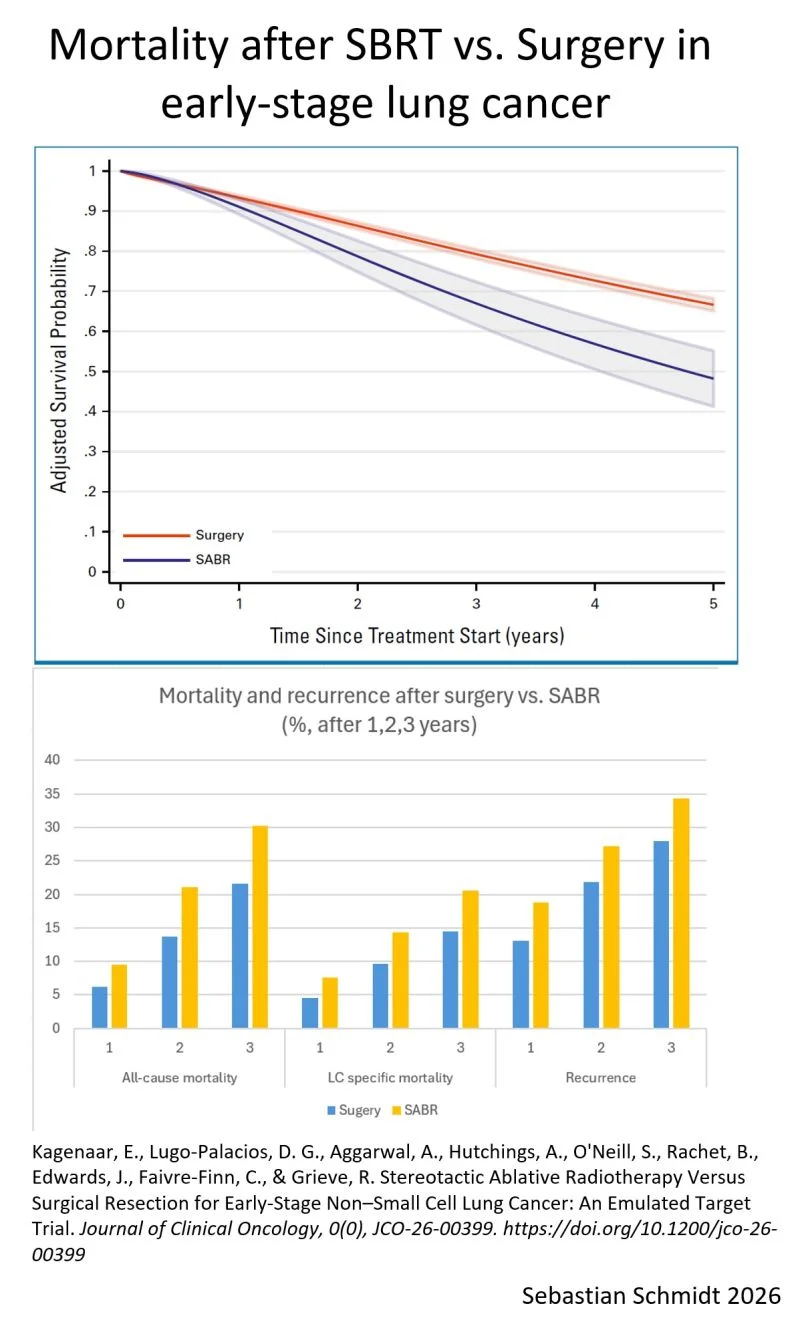
“Surgery vs. SBRT in early stage lung cancer – is there finally an answer to this unsolved question?
Spoiler: No, unfortunately not yet. On first sight, the charts look convincing, but there are caveats.
A recent publication in Journal of Clinical Oncology of the American Society of Clinical Oncology (ASCO), coming from the United Kingdom, looked at a much-debated question: Should SABR (British English for stereotactic ablative radiotherapy, aka SBRT) be first-line therapy for early-stage lung cancer, or limited to patients not fit for surgery.
In most countries, surgery is the first-line treatment for early lung cancer. The only exception I know are the Netherlands, where SBRT is seen as first-line treatment and used very frequently.
The reasons why this question is so tricky is that randomized clinical trials largely failed: Too few patients were willing to be randomized to treatment, recruitment was too low. There is one larger RCT running, the VALOR trial, we are waiting for the results.
In retrospective analyses, the risk of selection bias is high: SBRT is largely selected for patients not fit for surgery and generally more sick (simply spoken). This (and other) studies of course used statistical approaches to compensate for this, still this fact limits the strength of conclusions. So while the charts look pretty clear here, I would not expect a change in clinical practice in this – current practice anyway prefers surgery.
A second caveat would be that ‘early stage’ here is different from ‘screen detected’ – the cases in this study were collected 2015-2020, before broad start of screening, so largely incidentally detected cancers – these tend to be larger than screen-detected (mix of T1/T2 vs more T1a, which is relevant difference.
Within these caveats, this is a very good study – they used an ’emulated trial’ approach and smart ways to compensate for (known) confounders. And it has the strength of rea-world-date: This is a large, real-world population, not a highly selected clinical trial population.
Still, I personally would prefer to wait for results of the running RCT before forming an opinion – VALOR is quite progressed and should report results in the foreseeable future (feel free to comment, Drew Moghanaki).
In any case it is great to have a variety of treatment options for early-stage cancer, and the study confirms the need for early detection – the survival curve is simply much, much higher than what we see in late-stage drug trials.
What I would find very interesting: Data from the Netherlands. As NL tends to use SBRT as default, the selection bias there would be opposite to UK. If someone knows a good publication on this, I would appreciate a hint.”
Title: Stereotactic Ablative Radiotherapy Versus Surgical Resection for Early-Stage Non–Small Cell Lung Cancer: An Emulated Target Trial
Authors: Eva Kagenaar, David G Lugo-Palacios, Ajay Aggarwal, Andrew Hutchings, Stephen O’Neill, Bernard Rachet, John Edwards, Corinne Faivre-Finn, Richard Grieve
You can also read:
This can be interesting:
Beyond Tumor Stage: Nature Cancer Study Maps the Hidden Cellular Drivers of Lung Cancer Metastasis