
Lung Cancer Europe shared on LinkedIn:
“For early lung cancer, stereotactic radiotherapy kept pace with surgery for the first year. Then the survival lines split.
Researchers at the London School of Hygiene and Tropical Medicine used England’s national cancer registry to look at 12,546 people diagnosed with early-stage non-small cell lung cancer between 2015 and 2020 who were suitable for either treatment. They applied the principles of a randomised trial to this real-world data, known as an emulated target trial.
Three years after treatment, an estimated 30.3% had died of any cause after stereotactic radiotherapy, compared with 21.6% after surgery. For people aged 80 and over, there was no clear difference between the two.
Why use registry data? Randomised trials comparing the two treatments closed early because they couldn’t recruit enough people, and the trials still running are unlikely to include many people over 80.
The journal’s accompanying editorial is titled ‘When Practice Outpaces Evidence‘.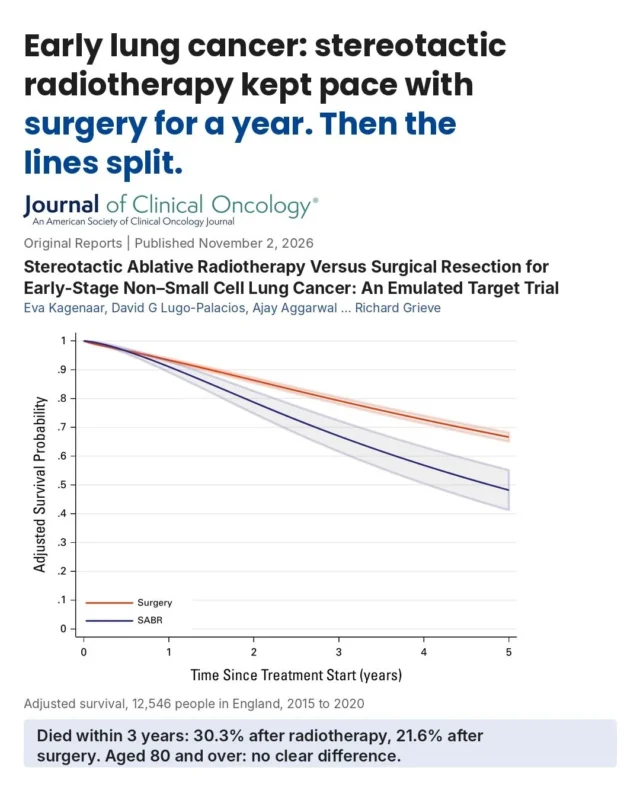
The authors conclude that surgery should remain the preferred option for people suitable for both, with stereotactic radiotherapy a curative alternative, particularly for older people.
Both are curative treatments. These findings support decisions made with each person, by a multidisciplinary team, with access to both options wherever they live in Europe.
Authors include Eva Kagenaar, Corinne Faivre-Finn and Ajay Aggarwal.”
Title: Stereotactic Ablative Radiotherapy Versus Surgical Resection for Early-Stage Non–Small Cell Lung Cancer: An Emulated Target Trial.
Authors: Eva Kagenaar, David G Lugo-Palacios, Ajay Aggarwal, Andrew Hutchings, Stephen O’Neill, Bernard Rachet, John Edwards, Corinne Faivre-Finn, Richard Grieve.
You can also read: SABR Versus Surgery in Early-Stage NSCLC: New JCO Study Supports Surgical Resection, With Important Questions for Older Patients.