A large English population-based study published in the Journal of Clinical Oncology suggests that surgical resection remains the preferred curative-intent treatment for medically suitable patients with early-stage non-small cell lung cancer (NSCLC). Using a target trial emulation involving 12,546 patients, investigators found significantly higher adjusted three-year all-cause mortality following stereotactic ablative radiotherapy (SABR) compared with surgery. However, the difference was smaller and statistically inconclusive among patients aged 80 years or older, highlighting the importance of individualized treatment selection.
Published online on November 2, 2026, the study was conducted by Eva Kagenaar, MSc, and colleagues from the London School of Hygiene & Tropical Medicine and collaborating UK institutions.
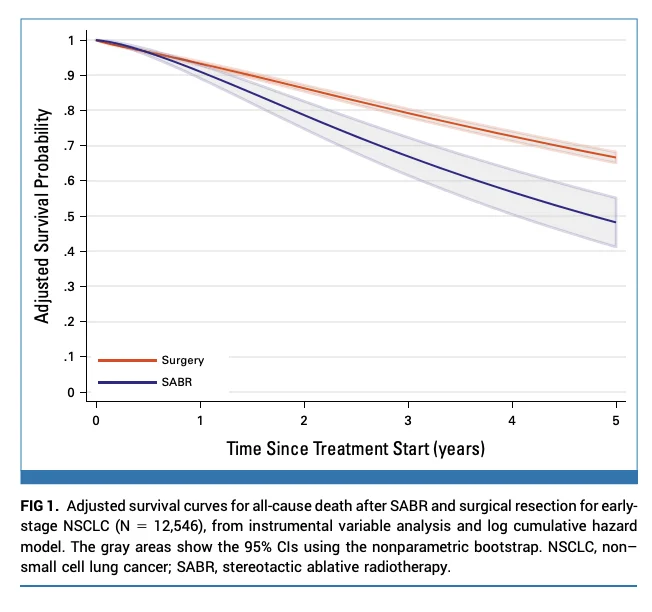
The analysis included patients with T1–2N0M0 NSCLC diagnosed between 2015 and 2020 who received either curative-intent SABR or surgical resection. After adjustment using an instrumental variable methodology, estimated three-year all-cause mortality was 30.3% following SABR compared with 21.6% after surgery, representing an absolute risk difference of 8.8 percentage points (95% CI 1.4–16.2; p=0.02).
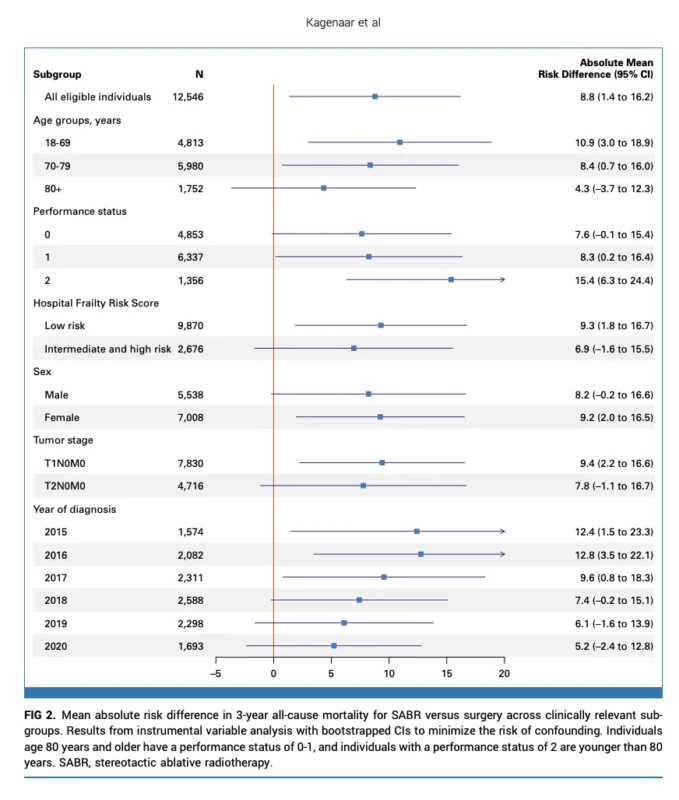
Lung cancer-specific mortality also numerically favored surgery, although the difference did not reach statistical significance. Among patients aged 80 years or older, the adjusted absolute difference in three-year all-cause mortality was 4.3 percentage points (95% CI −3.7 to 12.3; p=0.62).
These findings reinforce surgery’s position as the preferred treatment for appropriate operative candidates while supporting SABR as an important nonsurgical option for patients in whom age, comorbidities, operative risk, or personal preferences influence treatment decisions.
Nevertheless, the study remains observational, and its findings should not be interpreted as definitive randomized evidence of treatment superiority or equivalence.
The Longstanding Debate: Can SABR Replace Surgery?
For patients diagnosed with early-stage NSCLC without lymph node involvement, curative-intent local treatment offers an opportunity for long-term survival. Surgical resection has traditionally represented the principal treatment strategy for medically operable patients.
Lobectomy with appropriate nodal assessment remains an established approach, while anatomic sublobar resection can be appropriate for selected small, peripheral tumors. However, improvements in radiotherapy planning and delivery have made SABR an increasingly important alternative.
Also known as stereotactic body radiotherapy (SBRT), SABR delivers highly conformal, ablative radiation doses to a defined tumor volume over a limited number of treatment sessions. The technique avoids general anesthesia, surgical incisions, and the immediate risks associated with pulmonary resection.
It is particularly valuable for patients with impaired pulmonary function, cardiovascular disease, advanced age, or other conditions that make surgery unsuitable. The central controversy concerns whether SABR can produce outcomes comparable with surgery in patients who are medically eligible for either treatment.
Several randomized studies, including ROSEL, STARS, SABRTooth, and ACOSOG Z4099/RTOG 1021, were unable to complete recruitment or were considered infeasible. Earlier observational comparisons have also produced conflicting findings, often because patients selected for SABR were older and had substantially greater comorbidity burdens than those undergoing surgery.
As a result, uncertainty has persisted despite the expanding use of stereotactic radiotherapy. The new study addresses this evidence gap through a methodological approach designed to approximate the structure of a randomized clinical trial using routinely collected patient data.
Study Design: Emulating a Randomized Trial Using National Registry Data
The investigators used linked data from England’s National Cancer Registry, Hospital Episode Statistics, the National Radiotherapy Data Set, and national mortality records. The study included adults with T1–2N0M0 NSCLC diagnosed between January 2015 and December 2020 who underwent surgery or SABR within six months of diagnosis.
Eligibility criteria were designed to identify patients considered potentially appropriate for either local treatment. Patients aged 18–79 years were eligible with Zubrod performance status 0–2, while patients aged 80 years or older were required to have performance status 0–1.
Individuals with a recent metastatic malignancy or previous thoracic radiotherapy were excluded. The primary endpoint was three-year all-cause mortality. Secondary outcomes included lung cancer-specific mortality, recurrence, mortality at earlier follow-up intervals, and hospital readmission within 90 days.
Rather than relying exclusively on conventional regression or propensity-score matching, the investigators employed an instrumental variable analysis. The instrument was based on the proportion of eligible patients receiving SABR instead of surgery within each clinical referral network during the preceding six months.
This approach used variation in historical treatment preferences across multidisciplinary referral networks to help reduce confounding by indication. The rationale was that local practice patterns could influence whether a patient received SABR or surgery without directly determining the patient’s prognosis.
However, instrumental variable analysis depends on important assumptions, including that referral-network preferences are not independently associated with unmeasured differences in care quality or patient outcomes. These assumptions cannot be completely verified, meaning that residual bias remains possible.
More Than 12,500 Patients Included
A total of 12,546 patients met the eligibility criteria. Of these, 10,247 patients (81.7%) underwent surgical resection, while 2,299 (18.3%) received SABR. Lobectomy was the predominant surgical procedure, accounting for approximately 76% of surgical treatment.
The most frequently used SABR regimen was 55 Gy in five fractions, followed by 54 Gy in three fractions and 60 Gy in eight fractions. Although the study aimed to approximate eligibility for either treatment, there were important baseline differences between groups.
Patients receiving SABR were older, with a median age of 74.9 years compared with 71.8 years among those undergoing surgery. Performance status was also less favorable in the SABR population. A performance status of 2 was recorded in 26.0% of SABR recipients compared with 7.4% of surgical patients.
Chronic obstructive pulmonary disease was present in 45.8% versus 26.0%, respectively. Ischemic heart disease was also more frequent among patients receiving SABR, at 26.5% versus 16.5%. These differences illustrate why a simple comparison of survival between the two groups could be misleading.
They also underscore the clinical reality that SABR is often selected for patients considered at higher risk of complications from surgery.
Primary Endpoint: Surgery Associated With Lower Three-Year Mortality
Before adjustment, three-year all-cause mortality was 39.4% among patients receiving SABR and 19.8% among those undergoing surgery. The corresponding unadjusted absolute difference was 19.6 percentage points.
However, this comparison was strongly influenced by differences in age, comorbidities, frailty, and performance status. Following instrumental variable adjustment, estimated three-year all-cause mortality remained higher after SABR:
30.3% with SABR versus 21.6% with surgical resection. The adjusted absolute risk difference was 8.8 percentage points (95% CI 1.4–16.2; p=0.02). Expressed as estimated three-year overall survival, the corresponding proportions were 69.7% following SABR and 78.4% following surgery.
The difference was also evident at two years. Adjusted all-cause mortality reached 21.1% with SABR compared with 13.7% after surgery, an absolute difference of 7.4 percentage points (95% CI 0.9–13.8; p=0.02).
At one year, the adjusted mortality difference was smaller and not statistically significant. These findings suggest that the difference in outcomes becomes more apparent with longer follow-up. Importantly, the results do not mean that every patient would gain the same absolute survival benefit from surgery.
The estimated effect reflects the study population and the assumptions underlying its statistical model. Nevertheless, the direction of the adjusted findings supports maintaining surgical resection as the preferred treatment when patients are appropriate operative candidates.
Lung Cancer-Specific Mortality: A Favorable but Inconclusive Difference
The investigators also examined whether differences in overall mortality could be attributed specifically to lung cancer. At three years, adjusted lung cancer-specific mortality was 20.6% following SABR compared with 14.5% after surgery.
The absolute difference was 6.1 percentage points (95% CI −0.6 to 12.9; p=0.07). Although the numerical results favored surgery, the confidence interval crossed zero. Consequently, the analysis did not demonstrate a statistically significant difference in lung cancer-specific mortality.
This distinction matters because all-cause mortality reflects both cancer-related and noncancer deaths. Patients with early-stage lung cancer often have substantial smoking-related pulmonary and cardiovascular comorbidities that affect long-term survival independently of cancer control.
The authors also noted that competing mortality risks could influence the interpretation of cancer-specific outcomes, particularly among older, frailer patients. The findings therefore support a difference in overall mortality but provide less definitive evidence concerning the precise contribution of cancer-specific death.
Recurrence Outcomes Also Numerically Favored Surgery
Recurrence was another important secondary endpoint. After adjustment, estimated three-year recurrence was 34.3% following SABR compared with 27.9% after surgery. The absolute difference was 6.5 percentage points (95% CI −1.7 to 14.6; p=0.12).
Although recurrence estimates were numerically higher in the SABR group, the difference was not statistically significant. The interpretation of this endpoint is complicated by the use of routinely collected healthcare data.
Recurrence was identified using diagnostic codes, subsequent treatments, new tumor registrations, and other recorded clinical events. This approach is practical for large population-based research, but it is less precise than protocol-defined imaging review in a prospective clinical trial.
The study also could not consistently distinguish all patterns of local, regional, and distant recurrence with the detail available from dedicated oncology trial assessments. Therefore, the recurrence findings should be regarded as supportive but not definitive evidence of comparative tumor control.
Patients Aged 80 Years or Older: An Important Clinical Exception?
One of the most clinically relevant observations emerged from the analysis of patients aged 80 years or older. This subgroup included 1,752 patients, all with performance status 0–1. Among these individuals, the adjusted absolute difference in three-year all-cause mortality between SABR and surgery was 4.3 percentage points (95% CI −3.7 to 12.3; p=0.62).
This was smaller than the 8.8-percentage-point difference observed in the overall population. By contrast, patients aged 18–69 years demonstrated an adjusted difference of 10.9 percentage points, while those aged 70–79 years had an estimated difference of 8.4 percentage points.
The findings suggest that the relative clinical trade-off between surgery and SABR may change with increasing age and competing mortality risk. Older patients may have less physiological reserve and greater vulnerability to postoperative complications.
For such patients, avoiding invasive surgery may offer meaningful benefits even when surgery provides greater disease control in the overall population. However, the absence of a statistically significant difference in the group aged 80 years or older does not establish equivalence or noninferiority.
The confidence interval was wide and remained compatible with a potentially clinically important disadvantage for SABR. Accordingly, the subgroup findings support individualized decision-making rather than a recommendation that SABR should routinely replace surgery after a particular age threshold.
Chronological age alone should not determine treatment. Pulmonary function, frailty, comorbidity burden, tumor location, surgical risk, and patient preferences remain central considerations.
Hospital Readmissions Highlight the Short-Term Treatment Trade-Off
SABR offers the advantage of avoiding an invasive surgical procedure, and the study examined hospital readmission as a pragmatic measure of treatment-related burden. Within 90 days, unadjusted readmission occurred in 22.2% of patients receiving SABR and 30.9% of surgical patients.
Following adjustment, the estimated rates were 23.3% and 30.2%, respectively. The adjusted absolute difference was − 6.9 percentage points (95% CI −14.3 to 0.4). Although readmissions were numerically less frequent after SABR, the confidence interval included no difference.
Furthermore, hospital readmission is not equivalent to a prospectively adjudicated measure of treatment toxicity. The reasons for readmission may include both treatment-related complications and other medical events.
Nevertheless, the findings illustrate an important clinical trade-off. SABR may reduce short-term hospitalization and treatment burden, while surgery was associated with better longer-term survival in the overall analysis. A comprehensive treatment decision must therefore account for both survival outcomes and the immediate consequences of treatment.
Sensitivity Analyses Support the Main Findings
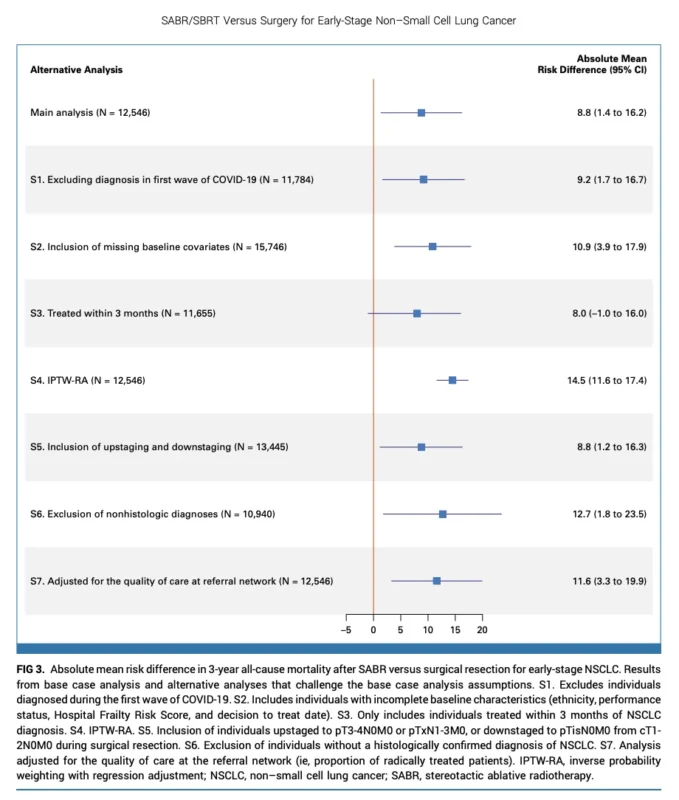
The investigators conducted several alternative analyses to assess the robustness of their conclusions. Excluding patients diagnosed during the first COVID-19 wave produced an adjusted three-year mortality difference of 9.2 percentage points.
Including patients with missing baseline characteristics produced a difference of 10.9 percentage points. Restricting treatment to within three months of diagnosis yielded an estimated difference of 8.0 percentage points, although its confidence interval crossed zero.
An alternative inverse probability-weighted regression analysis estimated a larger difference of 14.5 percentage points. Additional analyses accounting for changes in pathological stage, lack of histological confirmation, and referral-network quality produced results generally consistent in direction with the primary analysis.
The findings suggest that the observed advantage associated with surgery was not confined to a single model specification. However, sensitivity analyses cannot eliminate all unmeasured confounding. The instrumental variable assumptions remain central to interpreting the primary findings.
Could Improvements in SABR Change Future Comparisons?
The study also examined outcomes according to calendar year. The adjusted mortality difference between SABR and surgery became numerically smaller over the study period.
It was approximately 12.4 percentage points in 2015 compared with 5.2 percentage points in 2020. The investigators suggested that improvements in SABR delivery, treatment planning, accreditation, quality assurance, and clinical experience may have contributed to this trend.
However, the analyses were observational, and the confidence intervals for more recent years were wide. The study therefore does not definitively establish that modern SABR has become equivalent to surgery. This is important because the analyzed patients were treated between 2015 and 2020, while radiotherapy technologies and clinical pathways have continued to evolve.
Prospective comparisons incorporating contemporary SABR delivery, minimally invasive surgery, and modern patient selection will be necessary to determine whether treatment differences have narrowed further.
Why Randomized Evidence Is Still Necessary
Despite its methodological strengths, the study does not resolve the debate between surgery and SABR in medically operable early-stage NSCLC. Target trial emulation can improve the quality of observational comparisons by defining eligibility criteria, treatment strategies, outcomes, and analytical approaches in advance.
Instrumental variable analysis may also reduce bias from unmeasured confounding. However, neither method guarantees the balance achieved through successful randomization. In the present study, some clinically important variables were unavailable or incompletely recorded, including detailed tumor location, precise pulmonary function, and the severity of certain comorbid conditions.
The absence of histological confirmation in a substantial proportion of SABR-treated patients introduces another source of uncertainty. Staging also differed because surgical patients commonly underwent pathological assessment, whereas SABR recipients were generally classified using clinical and imaging information.
The study did not collect patient-reported outcomes or detailed quality-of-life measures that might clarify the trade-offs between invasive surgery and nonsurgical treatment. Furthermore, the analysis compared broad treatment strategies rather than establishing the relative effectiveness of individual surgical approaches against particular SABR regimens.
Ongoing randomized studies, including VALOR and STABLE-MATES, are intended to address the remaining evidence gap. Until mature randomized data become available, large, carefully designed observational studies can provide clinically useful evidence but should not be treated as a replacement for randomized comparisons.
Implications for Multidisciplinary Treatment Selection
The findings are broadly consistent with contemporary international recommendations supporting surgery for medically operable stage I NSCLC. The 2025 ESMO Clinical Practice Guideline recommends offering surgery to patients with operable stage I–II NSCLC who are willing to accept procedure-related risks.
SABR remains an established curative-intent treatment for medically inoperable patients and a reasonable alternative in selected individuals who decline surgery or have borderline operative suitability. The new analysis strengthens the rationale for preserving surgical resection as the preferred approach among fit patients.
However, it also highlights the importance of avoiding a simplistic treatment hierarchy. For an otherwise healthy patient with a peripheral early-stage tumor and acceptable cardiopulmonary reserve, surgery may provide important advantages, including pathological staging and definitive tumor removal.
For an older patient with limited pulmonary reserve or significant comorbidities, the potential burden of surgery may outweigh its expected survival advantage. The decision should therefore be established through multidisciplinary assessment involving thoracic surgeons, radiation oncologists, pulmonologists, and medical oncologists.
Patients should receive balanced information about anticipated survival outcomes, treatment morbidity, follow-up requirements, and the possibility of additional treatment after recurrence. The goal is not to identify one universally superior modality, but to choose the most appropriate curative-intent strategy for each patient.
OncoDaily Takeaway
The new Journal of Clinical Oncology target trial emulation provides important population-based evidence supporting surgical resection as the preferred curative-intent treatment for medically suitable patients with T1–2N0M0 NSCLC.
Among 12,546 patients, adjusted three-year all-cause mortality was 30.3% following SABR compared with 21.6% after surgery, corresponding to an absolute difference of 8.8 percentage points. Lung cancer-specific mortality and recurrence also numerically favored surgery, although neither secondary endpoint reached statistical significance.
Among patients aged 80 years or older, the adjusted mortality difference was smaller and statistically inconclusive, supporting careful consideration of SABR as an alternative in selected older individuals. However, this subgroup result does not establish treatment equivalence.
The study’s strengths include its large population, prespecified target trial framework, instrumental variable analysis, and sensitivity analyses. Its limitations remain those of observational research, particularly incomplete clinical detail and assumptions about unmeasured confounding.
The central clinical message is that surgery should remain the benchmark for fit patients with early-stage NSCLC, while SABR continues to provide an important curative-intent option when operative risk, age-related vulnerability, or patient preferences favor a nonsurgical approach.
The next priority is mature randomized evidence capable of clarifying comparative survival, cancer control, quality of life, and treatment burden in well-defined patient populations.
Sources
- Kagenaar E, Lugo-Palacios DG, Aggarwal A, et al. Stereotactic Ablative Radiotherapy Versus Surgical Resection for Early-Stage Non–Small Cell Lung Cancer: An Emulated Target Trial. Journal of Clinical Oncology. Published online November 2, 2026. DOI: 10.1200/JCO-26-00399