Rasha Aboelhassan, Council Member at International Association for the Study of Lung Cancer, Senior Oncology Consultant at Nasser Institute Hospital, shared on LinkedIn:
“Clinical trial data must go deeper than primary PFS and standard toxicity tables.
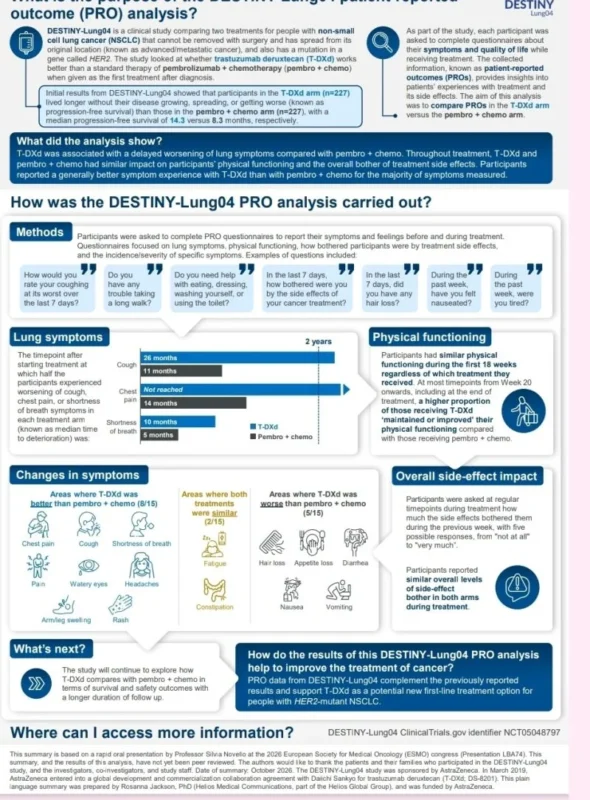
As shown in the DESTINY-Lung04 Patient-Reported Outcomes (PRO) analysis presented at ESMO, tracking granular symptoms and quality of life directly informs survival strategies:
- PFS alone is an incomplete metric: T-DXd extended median PFS over standard pembro + chemo (14.3 vs 8.3 months), but symptom tracking showed the practical impact of those months.
- Substantially delayed symptom decline: T-DXd doubled time-to-deterioration for shortness of breath (10 vs 5 months) and cough (26 vs 11 months), while chest pain deterioration was not reached versus 14 months.
- Sustained physical functioning: From week 20 through end of treatment, more patients on T-DXd maintained or improved daily physical function.
- Actionable symptom maps: Granular data revealed where the therapy improved burden (8/15 domains, including fatigue and pain) and where early, targeted supportive management is required (e.g., nausea, diarrhea, hair loss).
- QoL drives overall survival: Early detection of symptom decline prevents treatment interruptions, minimizes dose reductions, and keeps performance status intact for subsequent lines of therapy.
Longer survival requires sustainable survival-and granular PRO analytics make that possible.”
Later Dr. Aboelhassan also added:
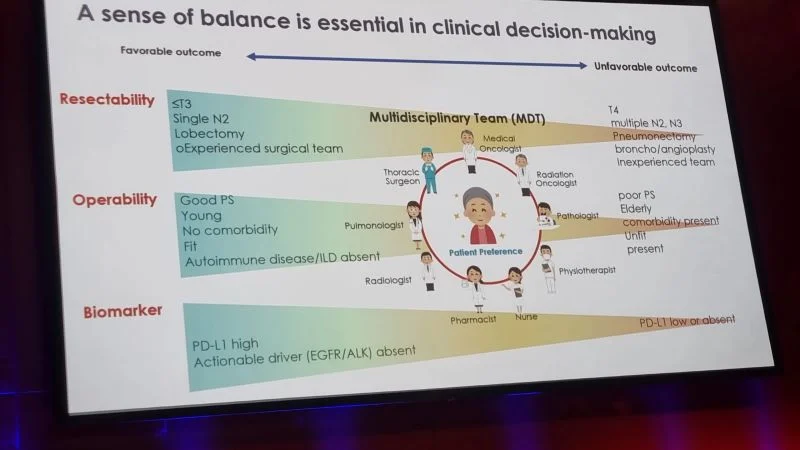
“One of the most important lessons I keep coming back to in lung cancer care is that being able to operate does not necessarily mean that we should.
Prof. Tetsuya Mitsudomi captured this principle powerfully:
‘The question is not: Can we resect? The question is: Does surgery add value?’
As we advance in thoracic oncology, I believe this is a question we must continually ask ourselves. Our responsibility is not simply to achieve a technically successful resection, but to make the best possible decision for each individual patient.
That means looking beyond the tumor to consider its biology, the patient’s fitness and preferences, the risks of treatment, and the outcomes we can realistically achieve.
It also means recognizing that the best decision is rarely made by one specialist alone. A well-functioning multidisciplinary team brings these perspectives together to determine the most appropriate strategy for each patient.
The goal is not to do more treatment. It is to deliver the right treatment, to the right patient, at the right time.
Ultimately, the measure of success is not whether we can operate, but whether our decision gives the patient the greatest chance of a meaningful outcome.”
You can also read: DESTINY-Lung04: T-DXd Delays Pulmonary Symptom Deterioration Without Greater Overall Treatment Bother in HER2-Mutant NSCLC.