The first-line efficacy advantage of trastuzumab deruxtecan in HER2-mutant non-small cell lung cancer appears to be accompanied by a broadly comparable patient-reported treatment burden versus pembrolizumab plus platinum chemotherapy.
New patient-reported outcome data from the phase III DESTINY-Lung04 trial, presented at ESMO Congress 2026, showed that first-line trastuzumab deruxtecan (T-DXd) delayed deterioration in several pulmonary symptoms while patients reported similar overall treatment-related side-effect bother compared with pembrolizumab plus chemotherapy.
The clearest difference involved cough. Median time to deterioration was 26.2 months with T-DXd versus 11.0 months with pembrolizumab plus chemotherapy, corresponding to an HR of 0.66 (95% CI 0.44–0.99).
Favorable numerical trends were also observed for dyspnea and chest pain. Median time to deterioration in dyspnea was 10.1 versus 5.1 months, while median time to deterioration in chest pain had not been reached with T-DXd compared with 14.3 months in the control arm.
At the same time, patients did not report substantially greater overall side-effect bother with T-DXd despite remaining on treatment considerably longer.
The findings add an important patient-centered perspective to DESTINY-Lung04, which previously established a major progression-free survival advantage for first-line T-DXd over the current chemoimmunotherapy standard in HER2-mutant advanced NSCLC.
DESTINY-Lung04 Has Already Established a First-Line Efficacy Advantage
HER2-mutant NSCLC represents a distinct molecular subgroup of non-squamous lung cancer and accounts for approximately 2%–4% of cases.
Until recently, HER2-directed treatment was primarily used after previous systemic therapy, while first-line treatment generally relied on platinum-pemetrexed chemotherapy combined with pembrolizumab. DESTINY-Lung04 directly challenged that strategy.
The global randomized phase III study enrolled 454 patients with unresectable locally advanced or metastatic non-squamous NSCLC harboring HER2 exon 19 or exon 20 mutations.
Patients had not received previous systemic treatment for advanced disease and were randomized to T-DXd 5.4 mg/kg every three weeks or pembrolizumab combined with platinum-pemetrexed chemotherapy. Patients with asymptomatic, stable, or previously treated brain metastases were eligible.
At the primary analysis, T-DXd reduced the hazard of progression or death by 37%, with median BICR-assessed PFS of 14.3 months versus 8.3 months with pembrolizumab plus chemotherapy. Objective response rate was 70.0% versus 44.5%, and median duration of response reached 13.4 versus 9.7 months.
The ESMO 2026 presentation moves beyond tumor measurements and asks whether this superior disease control translates into a treatment experience that patients themselves consider acceptable.
Patient-Reported Out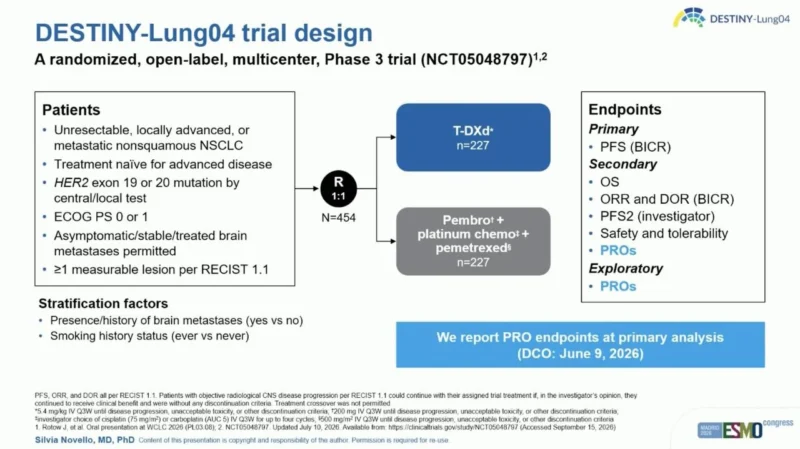 comes Matter in a Longer First-Line Treatment
Patient-reported outcomes become particularly important when one treatment substantially extends the time patients remain on therapy. In DESTINY-Lung04, median treatment duration was 12.3 months with T-DXd compared with 7.1 months with pembrolizumab plus chemotherapy.
A drug may improve PFS but still impose a cumulative symptomatic burden that affects daily functioning, treatment adherence, or willingness to remain on therapy.
The PRO analysis therefore evaluated several complementary aspects of the patient experience, including pulmonary symptoms, physical functioning, overall treatment-related side-effect bother, and individual symptomatic adverse events.
Pulmonary symptom deterioration was assessed using NSCLC-specific instruments covering cough, dyspnea, and chest pain. Physical functioning was measured with the EORTC QLQ-C30, while overall side-effect burden was captured using the Patient Global Impression of Treatment Tolerability.
The analysis also incorporated patient-reported symptomatic adverse events using EORTC and PRO-CTCAE measures.
Cough Deteriorated Considerably Later With T-DXd
The strongest pulmonary symptom result involved cough. Median time to deterioration was 26.2 months with T-DXd compared with 11.0 months with pembrolizumab plus chemotherapy. The HR was 0.66, indicating approximately a 34% lower hazard of cough deterioration during treatment.
This finding is clinically relevant in advanced lung cancer because cough is not merely an inconvenience. Persistent or worsening cough can affect sleep, physical activity, social interaction, and overall quality of life. The delayed deterioration also aligns with the greater tumor control observed with T-DXd.
However, patient-reported symptom benefit should not automatically be equated with a direct symptomatic pharmacologic effect of the ADC. Better disease control itself may contribute substantially to delayed worsening of lung cancer-related symptoms.
Dyspnea and Chest Pain Also Numerically Favored T-DXd
The same directional pattern was observed for other pulmonary symptoms, although the confidence intervals were wider. Median time to deterioration in dyspnea was 10.1 months with T-DXd versus 5.1 months with pembrolizumab plus chemotherapy, with an HR of 0.77 (95% CI 0.54–1.09).
For chest pain, median time to deterioration was not reached with T-DXd and was 14.3 months with the control regimen. The HR was 0.80 (95% CI 0.54–1.18).
These results should be described as favorable trends rather than definitive statistically confirmed differences because the confidence intervals crossed 1. Nevertheless, all three pulmonary symptom domains moved in the same direction.
Taken together, the data suggest that improved disease control with T-DXd did not come at the expense of earlier worsening in respiratory symptoms and may, for some patients, delay symptom deterioration.
Physical Function Was Maintained Across Both Strategies
The analysis also evaluated whether patients could maintain everyday physical functioning while receiving treatment. The proportion of patients with maintained or improved physical function was similar between treatment groups through approximately week 18.
From around week 20 onward, physical functioning was generally more favorable with T-DXd. At the end of treatment, 66.7% of patients receiving T-DXd had maintained or improved physical function compared with 57.7% receiving pembrolizumab plus chemotherapy.
This observation is notable because T-DXd-treated patients remained on therapy for substantially longer. A longer treatment duration creates more opportunity for cumulative toxicity, yet the PRO data did not show a progressive disadvantage in physical functioning.
The finding is descriptive, but it strengthens the broader impression that the PFS advantage was not achieved by imposing a markedly greater functional burden on patients.
Overall Side-Effect Bother Was Nearly Identical
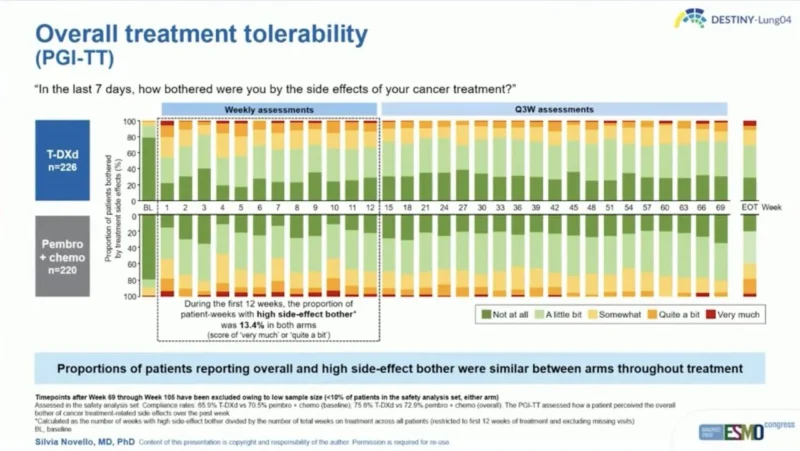
Perhaps the most clinically intuitive PRO measure asked patients a simple question: how much were they bothered by the side effects of their cancer treatment during the previous seven days? Across treatment, the distribution of responses was generally similar between the two groups.
During the first 12 weeks, the proportion of patient-weeks classified as having high side-effect bother was exactly 13.4% in both treatment arms. This is important because the toxicity profiles of the two regimens are very different.
Pembrolizumab plus platinum-pemetrexed combines immune-related toxicity with cumulative chemotherapy effects, whereas T-DXd has a characteristic ADC toxicity profile that includes gastrointestinal symptoms, cytopenias, and the clinically important risk of interstitial lung disease.
Despite these different profiles, patients did not perceive one treatment as producing substantially greater overall side-effect burden during most assessed time points.
The Symptom Profile Was Different Even When Overall Bother Was Similar
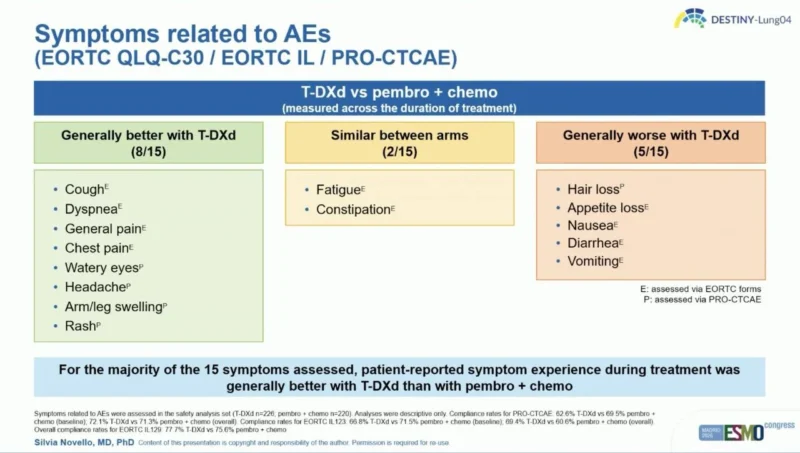
The similarity in global treatment bother does not mean that patients experienced the same symptoms. When 15 treatment-related symptom domains were examined, patient-reported experience generally favored T-DXd in eight, was similar in two, and favored pembrolizumab plus chemotherapy in five.
Symptoms generally reported more favorably with T-DXd included cough, dyspnea, general pain, chest pain, watery eyes, headache, arm or leg swelling, and rash. Fatigue and constipation were broadly similar between treatment groups.
By contrast, T-DXd was generally associated with worse patient-reported hair loss, appetite loss, nausea, diarrhea, and vomiting. This pattern provides a more useful clinical picture than a single composite tolerability score.
Patients considering T-DXd may experience less burden from some respiratory and systemic symptoms while encountering more gastrointestinal toxicity.
The overall treatment experience therefore reflects a trade-off between different symptom domains rather than universal superiority in tolerability.
PROs Do Not Remove the Importance of ILD
The favorable patient-reported findings require an important safety qualification. In the primary DESTINY-Lung04 safety analysis, adjudicated ILD or pneumonitis occurred in 20.8% of patients receiving T-DXd.
Most cases were grade 1 or 2, but five patients developed grade 3 events, one experienced grade 4 ILD, and four patients had grade 5 events. The grade 5 rate was approximately 1.8%.
This is essential when interpreting patient-reported tolerability. A relatively uncommon but potentially fatal toxicity can have major clinical importance without substantially changing average patient-reported symptom scores across an entire randomized population.
The PRO results therefore complement rather than replace clinician-reported safety. T-DXd can be perceived as broadly tolerable by many patients while still requiring rigorous surveillance for new respiratory symptoms and rapid evaluation of suspected ILD.
Grade ≥3 Treatment-Related Toxicity Was Similar Despite Longer T-DXd Exposure
The primary safety analysis also provides context for the PRO findings. Despite median treatment exposure of 12.3 months with T-DXd versus 7.1 months with pembrolizumab plus chemotherapy, grade 3 or higher treatment-related adverse events occurred at similar rates: 34.1% versus 33.6%.
Neutropenia was the most common grade ≥3 treatment-related adverse event in both groups, occurring in approximately 11.1% with T-DXd and 14.1% with chemoimmunotherapy.
This helps explain why overall treatment bother could remain comparable even with substantially longer T-DXd exposure.
However, the nature rather than simply the frequency of toxicity remains clinically important, particularly because ILD is qualitatively different from many reversible hematologic or gastrointestinal adverse events.
Overall Survival Is Still an Unresolved Question
DESTINY-Lung04 has clearly established superiority for PFS, but overall survival remains immature. At the June 2026 data cutoff, median OS was 29.3 months with T-DXd and 33.1 months with pembrolizumab plus chemotherapy, with an HR of 1.15.
Overall survival data were only 46.9% mature, and no formal hypothesis testing was performed at that analysis. Interpretation is complicated by imbalanced subsequent treatment.
Almost half of patients initially assigned to pembrolizumab plus chemotherapy subsequently received HER2-directed therapy, whereas fewer patients in the T-DXd group received HER2-targeted treatment after progression.
This crossover-like treatment pattern could reduce the ability of an intent-to-treat OS analysis to capture the full value of using T-DXd earlier.
Nevertheless, until mature survival analyses are available, DESTINY-Lung04 should be described as demonstrating a substantial first-line PFS advantage, not an established OS benefit.
The PRO Data Strengthen the First-Line Case Without Settling Every Question
The central question after the initial DESTINY-Lung04 efficacy presentation was whether moving T-DXd into first-line therapy would provide enough benefit to justify replacing an established pembrolizumab-platinum-pemetrexed regimen.
The PRO analysis strengthens that argument in one important respect. The additional months of disease control with T-DXd do not appear to come with a markedly worse patient-perceived overall treatment burden.
Pulmonary symptoms generally deteriorated later, physical function was preserved, and overall high side-effect bother was essentially identical between treatment groups. At the same time, the decision cannot be reduced to PFS and quality of life alone.
ILD remains a potentially serious and occasionally fatal treatment risk, and mature OS remains unavailable. That makes patient selection, pulmonary monitoring, education about early respiratory symptoms, and management expertise central to any future first-line implementation.
OncoDaily Takeaway
The ESMO 2026 patient-reported outcome analysis adds an important dimension to the phase III DESTINY-Lung04 results.
T-DXd had already improved median PFS from 8.3 to 14.3 months and increased response rate from 44.5% to 70.0% compared with pembrolizumab plus platinum-pemetrexed chemotherapy in first-line HER2-mutant advanced NSCLC.
The new PRO data suggest that this efficacy advantage was achieved without a corresponding increase in overall patient-perceived treatment burden.
Cough deterioration was delayed from 11.0 to 26.2 months, while dyspnea and chest pain also showed favorable trends. Physical functioning was broadly comparable early in treatment and generally favored T-DXd later, including at treatment discontinuation.
Most notably, high overall side-effect bother accounted for 13.4% of patient-weeks in both treatment groups during the first 12 weeks. The symptom experience was not identical. T-DXd was generally more favorable for several pulmonary and pain-related symptoms but worse for nausea, vomiting, diarrhea, appetite loss, and hair loss.
These patient-reported outcomes therefore strengthen the first-line case for T-DXd, but they do not diminish the importance of ILD surveillance.
The emerging DESTINY-Lung04 picture is increasingly clear: T-DXd delivers substantially longer disease control with a patient-reported treatment burden that is broadly comparable to chemoimmunotherapy—but with a distinct safety profile that requires active pulmonary monitoring.
Source
- Novello S, et al. First-line trastuzumab deruxtecan in patients with HER2-mutant NSCLC: Patient-reported outcomes from DESTINY-Lung04. Presented at ESMO Congress 2026, October 24, 2026. Clinical trial identifier NCT05048797.
- Primary DESTINY-Lung04 efficacy and safety results were previously presented at WCLC 2026.