
Raajit Rampal, Hematologist-Oncologist and Leukemia Specialist at Memorial Sloan Kettering Cancer Center (MSK), shared on X:
“Why do some pts with MPNs stay stable for decades while others progress?
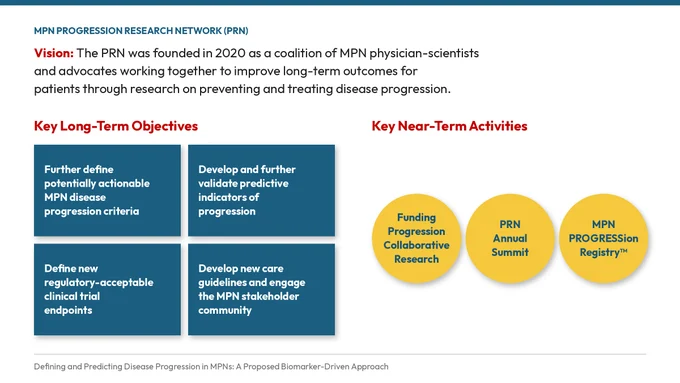
MPN Research Foundation launched the MPN Progression Research Network in 2020 to address this pressing issue. We now present a blueprint for dealing with progression from these efforts.
Title: Defining and predicting disease progression in myeloproliferative neoplasms: a proposed biomarker-driven approach
Authors: Raajit K. Rampal, Richard Winneker, Andrew Kuykendall, Laura C. Michaelis, Ghaith Abu-Zeinah, Steffen Koschmieder, Jan Philipp Bewersdorf, Zi Yun Ng, Gabriella Hobbs, Bridget Marcellino, Linda Resar, Joseph Scandura, Anand Patel, John Mascarenhas, Aaron Gerds, Douglas Tremblay, Shane Mayack, Andriy Derkach, Florian H. Heidel
For patients, progression to myelofibrosis, MDS/MPN or acute leukemia is often the biggest worry. Yet most ET/PV trials still focus on blood counts and clot prevention, not on stopping the disease from advancing.
Part of the problem is that ‘progression’ isn’t well defined. We argue for a broader definition. It should cover worsening symptoms, blood counts, spleen size and clotting events, not only transformation to MF or AML.
There are candidate clinical and biologic markers that exist (mutation profile, driver mutation VAF, cytokine levels). However, these markers require standardization and validation. We need to put focused effort on this.
Similarly, clinical trial endpoints must evolve to capture what we care about most: OS and PFS. These are difficult endpoints, but validated surrogate prognostic biomarkers can make this practical.
There’s a lesson from myeloma, where MRD negativity became an FDA-accepted surrogate endpoint. MPNs need an equivalent. For example, does a ≥50% drop in JAK2V617F VAF, or a 1-grade fibrosis improvement, predict progression-free survival?
Real-world data matter too. The MPN Progression Registry (NCT07362225) launched in Sept 2025 through MPN Research Foundation.
This is a direct-to-patient effort that seeks to capture longitudinal data from patients in the real world – encourage your patients to join!
Our call to action:
- Integrate clinical, molecular and inflammatory markers
- Run prospective trials with long follow-up
- Standardize assays and endpoints
- Engage regulators early
- Bring patients into trial design
This is a heavy lift, but we have many hands, including patients and their families.”
This might be interesting:
Acute Leukemia Global Survey 2026