
Piotr Wysocki, Head of the Oncology Department at University Hospital in Kraków, shared on LinkedIn:
Rare and Instructive OncoCase #5 Treatment-Refractory ER+/HER2+ mBC – Two Years of Disease Control After Being Deemed Ineligible for Further Therapy
Treatment-Refractory ER+/HER2+ Metastatic Breast Cancer: Prolonged Disease Control with Metronomic Multiagent Therapy
Clinical challenge
A 42-year-old woman was diagnosed with metastatic breast cancer in April 2023, approximately 10 months after giving birth to her first child.
Histopathology revealed invasive breast carcinoma NST, G2, ER-positive (90%), PR-low, HER2-positive (FISH-confirmed), with Ki-67 of 15-20%. Initial staging demonstrated extensive metastatic involvement of the liver, bones, and lymph nodes.
First-line treatment (July 2023-February 2024) consisted of docetaxel, trastuzumab, and pertuzumab, followed by maintenance dual HER2 blockade. Despite an initial radiological response, rapid hepatic progression occurred, followed by the development of numerous brain metastases in March 2024, requiring whole-brain radiotherapy (WBRT, 30 Gy in 10 fractions).
Second-line treatment (April-June 2024) consisted of tucatinib, trastuzumab, and capecitabine. Although imaging demonstrated partial regression of intracranial metastases, the patient’s clinical condition deteriorated substantially, preventing further treatment.
The rapid clinical failure of two consecutive HER2-directed regimens within approximately one year suggested highly aggressive tumor biology and early treatment resistance.
In June 2024, anticancer treatment was discontinued, and the patient was referred to hospice care.
Clinical reassessment and therapeutic strategy
When she was referred to our Department of Clinical Oncology at the University Hospital in Kraków in August 2024, she arrived in a wheelchair, accompanied by family members. Her ECOG performance status was 2-3, with significant neurological symptoms.
Leptomeningeal involvement could not be excluded. However, given her clinical condition and recent WBRT, we did not expect further diagnostic confirmation with MRI to alter management.
Her poor performance status precluded the use of intensive systemic therapy, including trastuzumab deruxtecan (T-DXd).
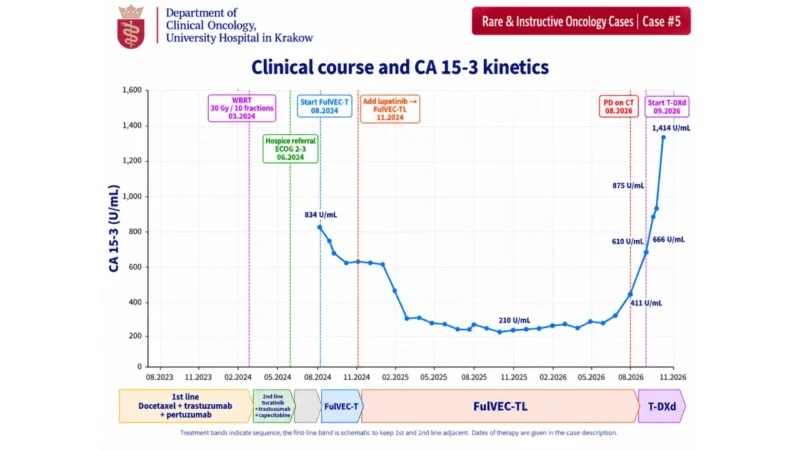
In August 2024, we initiated an individualized, metronomic systemic regimen (FulVEC-T), combining endocrine therapy, continued HER2 blockade, and metronomic chemotherapy.
The patient experienced rapid clinical improvement, with functional status recovering to ECOG 1 and a marked initial decline in serum CA 15-3 levels.
After about two months of treatment, the biochemical trend reversed, with CA 15-3 increasing despite no clinical or radiological evidence of disease progression.
In response, we intensified HER2 blockade by adding lapatinib, establishing, for the first time in our clinical practice, an unconventional six-drug systemic regimen (FulVEC-TL) integrating endocrine therapy, dual HER2 blockade, and metronomic cytotoxic treatment.
This individualized multidrug strategy was associated with nearly two years of disease control, during which the patient maintained good functional status and quality of life.
Over the course of treatment, several modifications to the multidrug regimen were made to manage treatment-related adverse events, particularly recurrent hematological toxicity. These adjustments allowed treatment continuation while adapting its intensity to the patient’s tolerability.
Treatment outcomes
Despite the initially unfavorable clinical condition, individualized treatment was associated with prolonged clinical and radiological disease control.
Serial imaging demonstrated regression of metastatic lesions in the brain, lungs, liver, peritoneum, and lymph nodes, with stable bone disease.
CA 15-3 decreased from 834 U/mL in October 2024 to 210 U/mL in November 2025, accompanied by sustained radiological disease control and markedly improved performance status.
In July 2026, approximately 23 months after initiation of individualized treatment and 25 months after hospice referral, CT imaging demonstrated disease progression, predominantly in the liver and peritoneum, with minor intracranial progression.
Importantly, despite radiological progression, the patient’s functional status remained substantially better than at initial presentation.
In September 2026, with ECOG 1 and no neurological symptoms, she was able to initiate treatment with trastuzumab deruxtecan (T-DXd) – a therapy that had been considered unsuitable at the time of hospice referral.
Clinical message
This case illustrates that rapid failure of standard HER2-directed therapies and clinical deterioration leading to hospice referral do not necessarily exclude the possibility of subsequent meaningful and prolonged disease control.
In selected patients with ER-positive/HER2-positive metastatic breast cancer who are unable to tolerate standard treatment intensity, individualized combinations of endocrine therapy, continued HER2 blockade, and metronomic chemotherapy may represent a potential therapeutic approach.
Although we cannot attribute the observed benefit to any single component of this unconventional multidrug regimen, the clinical course highlights the importance of adapting treatment intensity to the patient’s clinical condition rather than abandoning anticancer therapy altogether.
Perhaps the most important observation is that individualized treatment not only prolonged disease control but also restored the patient’s functional status enough to allow subsequent access to a standard, highly active therapy previously considered unsuitable.“
You can also read: