The six-year results of the phase III NATALEE trial, presented at ESMO 2026, mark a significant milestone in HR+/HER2− early breast cancer by demonstrating an overall survival benefit alongside sustained improvements in invasive disease-free survival.
Below is a roundup of key discussions, reflections, and clinical perspectives from leading oncologists analyzing what these data mean for patient care and treatment selection.
“A major milestone for adjuvant ribociclib in early breast cancer: overall survival benefit at 6 years!
Exciting results presented today at #ESMO2026 from the phase III NATALEE trial, providing further evidence for the long-term benefit of ribociclib plus endocrine therapy in patients with HR+/HER2− early breast cancer.
For the first time, NATALEE reports a positive overall survival (OS) benefit, alongside sustained improvements in invasive disease-free survival (iDFS).
Key findings at 6 years:
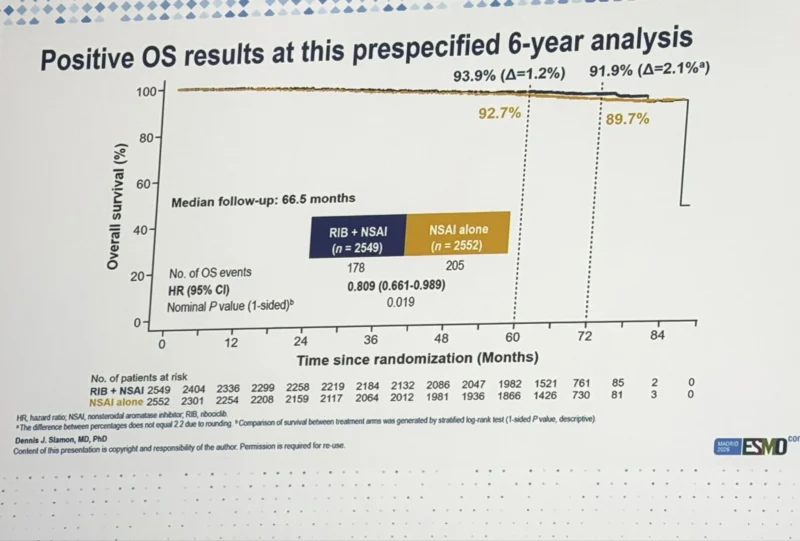
- Overall survival: HR 0.809 (95% CI: 0.661–0.989), corresponding to a 19.1% relative reduction in the hazard of death.
- 6-year OS: 91.86% vs 89.73% — an absolute improvement of 2.1%.
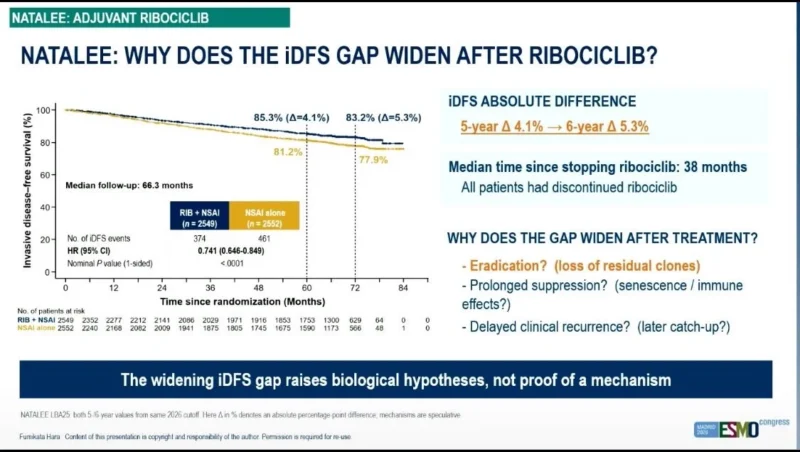
- Invasive disease-free survival: HR 0.741 (95% CI: 0.646–0.849), with an absolute benefit of 5.3% at 6 years (83.23% vs 77.92%).
- Benefits in distant disease-free survival and distant recurrence-free survival were also maintained.
- No new safety signals were identified.
What makes these results particularly compelling?
Patients had been off ribociclib for a median of approximately 38 months, yet the benefits continued to persist and deepen over time.
This is an important development in the adjuvant treatment landscape, where preventing recurrence is critical, but demonstrating an overall survival benefit remains the ultimate goal.
These findings further strengthen the evidence supporting ribociclib plus endocrine therapy for eligible patients with stage II/III HR+/HER2− early breast cancer.
The findings translate to approximately 19 patients treated to prevent one additional iDFS event by 6 years (1 ÷ 0.053), although iDFS includes events other than distant breast cancer recurrence. The 2.1% absolute OS benefit is encouraging, but it is smaller and needs interpretation alongside treatment toxicity, cost, and patient selection.
The question now: Can CDK4/6 inhibition plus optimal endocrine therapy replace chemotherapy in selected patients with high genomic risk?”
“ESMO 2026 – From Preventing Recurrence to Improving Survival: NATALEE Reaches an Important Milestone!
For years, we have been asking an important question in HR-positive/HER2-negative early breast cancer:
Can adding a CDK4/6 inhibitor to adjuvant endocrine therapy do more than reduce recurrence? Can it ultimately help our patients live longer?
Today in Madrid, the 6-year NATALEE results (LBA25), presented by Prof. Dennis Slamon, bring us an important step closer to answering that question.
After a median follow-up of approximately 66 months, the addition of three years of ribociclib to endocrine therapy demonstrated:
- Overall survival: 91.9% vs 89.7%, an absolute benefit of 2.1%, HR 0.809.
- Invasive disease-free survival: 83.2% vs 77.9%, an absolute improvement of 5.3%.
- Distant recurrence-free survival: 86.0% vs 81.6%, a 4.4% absolute improvement.
- Breast cancer-specific survival: 94.2% vs 91.6%, providing further support for the favorable survival signal.
One particularly encouraging observation?
The benefit continues to deepen even after patients have stopped ribociclib, with a median of 38 months since treatment discontinuation.
But beyond the impressive Kaplan-Meier curves, I believe there are several lessons worth reflecting on.
First: Preventing recurrence matters, but improving survival is our ultimate ambition.
These new findings add important survival evidence to the established recurrence-prevention benefit. The OS analysis is nominally positive, with formal statistical interpretation requiring attention to the prespecified testing plan.
Second: Adjuvant CDK4/6 inhibition is becoming increasingly important in early breast cancer.
Together with the mature monarchE data, NATALEE strengthens our confidence in the role of CDK4/6 inhibitors.
Third: Absolute benefits should guide our discussions with patients.
A 5.3% improvement in iDFS and a 2.1% improvement in OS are clinically relevant.
Three years of additional treatment requires adherence, monitoring, toxicity management and shared decision-making.
My personal reflection: As oncologists, our ambition is not simply to delay recurrence. It is to help more women complete their breast cancer journey, remain free of metastatic disease, and live longer with the best possible quality of life.
NATALEE represents an important contribution to that goal.
Congratulations to Prof. Dennis Slamon and the entire NATALEE investigator team for this significant achievement and their continued commitment to long-term follow-up.
One question I would like to raise with my colleagues:
Now that both NATALEE and monarchE have reported favorable overall survival results, how should we refine patient selection and choose the most appropriate adjuvant CDK4/6 inhibitor?
I believe that is one of the most important clinical discussions!”
“ESMO 2026 Day 1 report – NATALEE
We finally have an overall survival signal with adjuvant ribociclib.
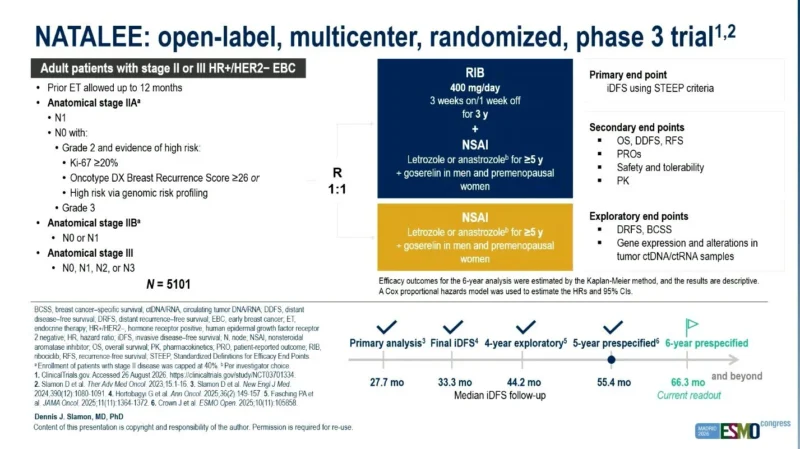
The trial: 5,101 patients with stage II–III HR+/HER2− early breast cancer, including selected high-risk node-negative patients, randomised to:
- Ribociclib 400 mg for 3 years + NSAI
- NSAI alone
Median follow-up: 66.5 months. Patients have been off ribociclib for a median of 38 months.
The results:
Overall survival (OS):
- HR 0.809 (95% CI 0.661–0.989)
- 6-year OS: 91.9% vs 89.7%
- Absolute benefit: 2.1%
Invasive disease-free survival (iDFS):
- HR 0.741 (95% CI 0.646–0.849)
- 6-year iDFS: 83.2% vs 77.9%
- Absolute benefit: 5.3%
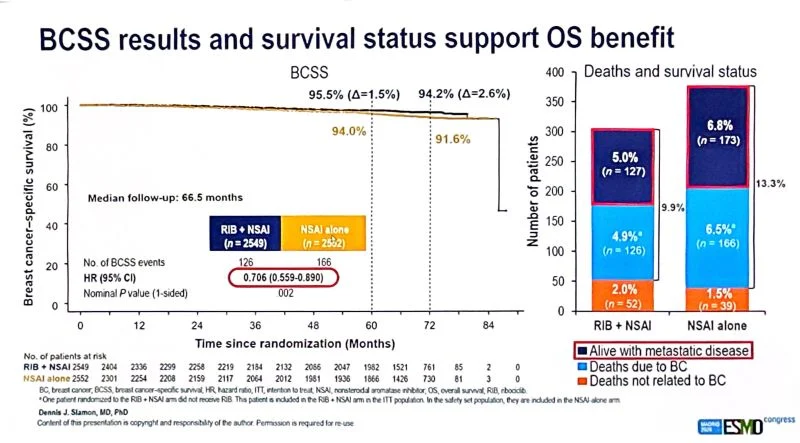
Breast cancer-specific survival:
- HR 0.706 (95% CI 0.559–0.890)
- Absolute benefit at 6 years: 2.6%
Distant disease-free survival also improved, with a 4.9% absolute difference at 6 years.
My take:
The increasing absolute iDFS benefit after treatment completion is encouraging. More importantly, the OS and breast cancer-specific survival findings suggest that preventing recurrence may be translating into fewer breast cancer deaths.
However, let’s look beyond the hazard ratios. A 19% relative reduction in the hazard of death translates into a 2.1% absolute OS difference at 6 years. The OS P value (0.019) is nominal and descriptive, therefore, we should be careful about presenting this as formally statistically significant without accounting for the trial’s prespecified testing boundaries.
Subgroup estimates generally favour Ribociclib, including node-negative disease, but confidence intervals are wide. These analyses cannot establish equal benefit across every risk group.
There is also the treatment burden. 36.3% discontinued ribociclib early, including 20% due to adverse events. Only 62.8% completed 3 years.
No new safety signals were reported, but tolerability remains relevant when treating patients who may already be cured.
We now have encouraging survival data alongside a sustained reduction in recurrence. The question in clinic remains: which patients have sufficient absolute benefit to justify 3 years of additional treatment?
For me, that discussion must consider baseline recurrence risk, tumour biology, toxicity, patient preference and the competing option of adjuvant abemaciclib where eligible.”
“NATALEE 6-y results are out! 2.1 delta in survival at 6 years.
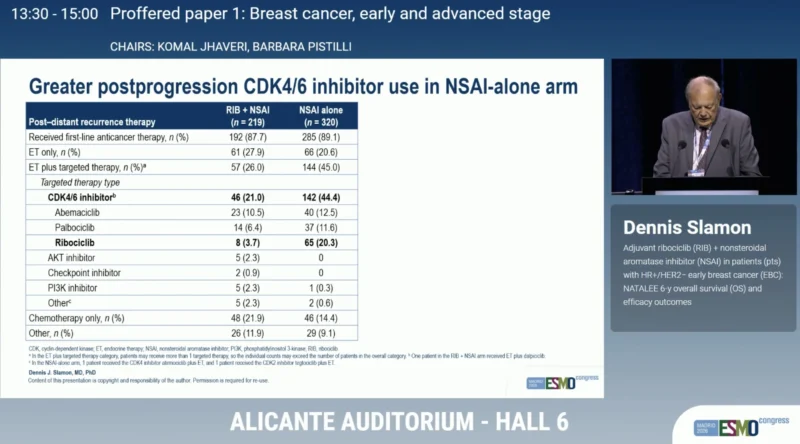
Thanks Annals of Oncology for reporting subsequent therapy data! Only 44.4% of control arm patients with distant recurrence received a first-line CDK4/6i.
Does this survival difference truly inform clinical practice in settings where CDK4/6i are standard of care for metastatic disease? In my opinion, the answer is no.”
“NATALEE OS is here. HR 0.81, 178 vs 205 deaths, 6-year OS difference 2.1%. monarchE was HR 0.84, 1.8% at 7 years.
Two CDK4/6 inhibitors, two schedules, strikingly similar survival effect. The OS gap widens after ribociclib stops at year 3, as expected since deaths lag relapses. More importantly, the iDFS curve is still separating after treatment ended. And control patients who relapsed could get a CDK4/6i for metastatic disease, which should shrink the OS difference. The benefit held.
What NATALEE adds over monarchE is N0, about 12% of the trial. The iDFS signal is there. N0 OS will be underpowered for a long time, so that conversation in clinic stays an iDFS conversation.”
“Presented today at ESMO – European Society for Medical Oncology with concurrent publication, the 6-year NATALEE analysis now brings overall survival data into the adjuvant CDK4/6 conversation.
NATALEE randomized 5,101 patients with stage II/III HR+/HER2− early breast cancer to 3 years of ribociclib plus a nonsteroidal aromatase inhibitor versus endocrine therapy alone.
At approximately 5.5 years of median follow-up:
- Overall survival: HR 0.809, with a 2.1% absolute benefit at 6 years
- iDFS: HR 0.741, with the absolute benefit increasing to 5.3%
- Breast cancer–specific survival: HR 0.706
- No new new safety signals
What stands out to me is that the curves continue to separate well after ribociclib has stopped, with patients now a median of approximately 38 months off therapy.
That suggests a durable effect on disease biology rather than simply delaying recurrence while patients remain on treatment.
Another important point: patients in the control arm received a CDK4/6 inhibitor at recurrence about twice as often as those in the ribociclib arm, yet earlier treatment still translated into an OS advantage.
The caveats: OS was descriptive without an allocated alpha, the confidence interval approaches 1, the absolute survival benefit remains modest, and node-negative OS estimates are still imprecise,HR 0.790 (95% CI 0.407–1.533). Longer follow-up is needed.
But taken together with monarchE, we now have two large adjuvant CDK4/6 inhibitor trials demonstrating a survival signal in high-risk HR+/HER2− early breast cancer. The conversation is increasingly shifting from whether adjuvant CDK4/6 inhibition works to which patients derive enough absolute benefit to justify years of treatment.
For me, one of the most important remaining questions is the stage II, node-negative population.
How are others weighing the NATALEE data for these patients?”
“ESMO 2026, NATALEE: Positive OS at 6 years!
- OS: HR 0.809 (95% CI 0.661–0.989), P=0.019
- 6-yr OS: 91.9% vs 89.7% (Δ 2.1%)
- BCSS: HR 0.706 (~29% ↓ BC mortality)
- iDFS/DDFS/DRFS: ~5% absolute benefit at 6 years
- OS benefit generally consistent across subgroups
- Post-recurrence CDK4/6i: 21% vs 44.4%
Take-home: First positive OS results from NATALEE, supporting adjuvant RIB in HR+/HER2− EBC.”
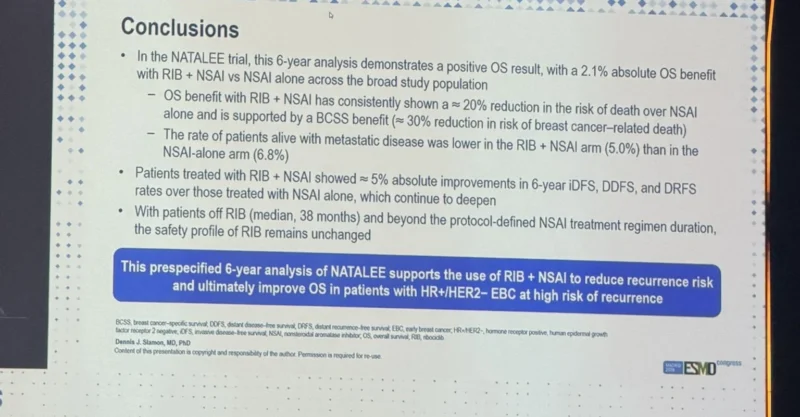
“NATALEE 6-year OS analysis shows modest (early…given what we just saw in NSABP42…) improvement in OS. IDFS benefit persists over time.”
“Today, we’ll probably spend most of our time discussing NATALEE!
At 6 years, OS: 91.9% vs 89.7% (HR 0.81; nominal p=0.019).
BCSS benefit is also encouraging (HR 0.71).”
“NATALEE 6-year analysis demonstrated an OS benefit with adjuvant ribociclib in HR+/HER2− early breast cancer (HR 0.81; absolute benefit 2.1%), with sustained iDFS benefit (HR 0.74; absolute benefit 5.3%).”
“NATALEE: 6-year outcomes
Adjuvant ribociclib + NSAI vs NSAI alone in eligible HR+/HER2− stage II–III EBC:
OS: HR 0.809 (95% CI 0.661–0.989) Absolute 6-year benefit: 2.1 percentage points.
IDFS: HR 0.741 (95% CI 0.646–0.849) Absolute 6-year benefit: 5.3 percentage points.
Benefit persists with patients off ribociclib for a median of ~3 years.
My key question: In clinically eligible patients with low Oncotype DX RS and/or low overall recurrence risk, especially N0 disease, is the absolute benefit large enough to justify 3 years of ribociclib, considering toxicity, monitoring burden, and QOL?”
“NATALEE at 6 years
Ribociclib + NSAI vs NSAI alone in HR+/HER2− early breast cancer:
- 6-year OS: 91.86% vs 89.73%
- OS HR 0.809 (95% CI 0.661–0.989); nominal 1-sided P=0.019
- Absolute OS benefit: 2.1%
- 6-year iDFS: 83.23% vs 77.92%
- iDFS HR 0.741 (95% CI 0.646–0.849)
- Absolute iDFS benefit: 5.3% Is OS significant?
Looking forward to full data.”
“NATALEE: OS data – Adjuvant ribociclib in ER+ breast cancer
6 year OS HR 0.809 (delta 2.1%), BCSS: 0.706 (delta 2.6%)
6 year iDFS HR 0.741 (delta ~5%), DDFS: HR 0.744.”
“NATALEE study shows persistent iDFS and emerging OS signal. Given treatment options for MBC, the treatment upon recurrence matters. Fewer than half the patients in the ET-alone arm get CDK46i on recurrence. Which poses the question: how relevant are OS data to US/OECD outcomes?
In the online publication, the OS difference is smaller, and not statistically significant, in US/Western Europe.”
“NATALEE: 6-Year Update at ESMO26
Adjuvant ribociclib + NSAI continues to improve iDFS in HR+/HER2− early breast cancer, with updated data showing an OS benefit (HR 0.81; 95% CI, 0.66–0.99) and improved breast cancer – specific survival.”
Title: Overall survival with adjuvant ribociclib plus nonsteroidal aromatase inhibitor in patients with high-risk HR+/HER2– early breast cancer: Six-year follow-up of the NATALEE trial
Authors: D. J. Slamon, G. N. Hortobagyi, D. Stroyakovskiy, D. A. Yardley, C.-S. Huang, J. Crown, A. Bardia, S. Chia, S.-A. Im, M. Martin, S. Loi, B. Xu, S. A. Hurvitz, C. H. Barrios, A. Cuesta Fernández, M. Untch, F. Visco, A. L. Perez, M. Miller, S. Majumdar, S. Peyrard, T. Taran, P. A. Fasching
Find out more:
NATALEE: Ribociclib Delivers Overall Survival Benefit at 6 Years in HR+/HER2− Early Breast Cancer