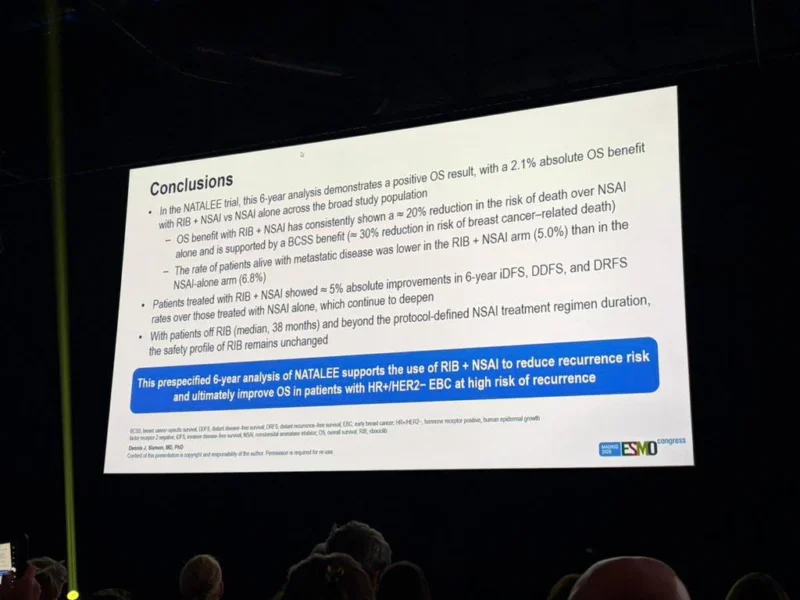
The long-term NATALEE story has reached an important new milestone. At ESMO Congress 2026, the prespecified 6-year analysis of the phase III NATALEE trial showed a positive overall survival result with adjuvant ribociclib plus a nonsteroidal aromatase inhibitor in patients with stage II–III hormone receptor-positive, HER2-negative early breast cancer at high risk of recurrence.
After a median overall survival follow-up of 66.5 months, ribociclib plus endocrine therapy reduced the risk of death by approximately 19% compared with endocrine therapy alone, with an HR of 0.809 (95% CI 0.661–0.989; nominal one-sided P=0.019).
The absolute survival difference increased over time. Five-year OS was 93.89% with ribociclib plus NSAI versus 92.73% with NSAI alone, an absolute difference of 1.2 percentage points. At six years, OS was 91.86% versus 89.73%, widening the absolute benefit to 2.1 percentage points.
Perhaps equally important, the survival signal emerged well beyond the active ribociclib treatment period. At the latest analysis, all patients had completed or discontinued ribociclib and had been off the CDK4/6 inhibitor for a median of approximately 38 months.
The findings strengthen the evidence that a finite three-year course of adjuvant ribociclib can produce a treatment effect that persists years after therapy ends.
NATALEE Addressed a Broader Early Breast Cancer Population
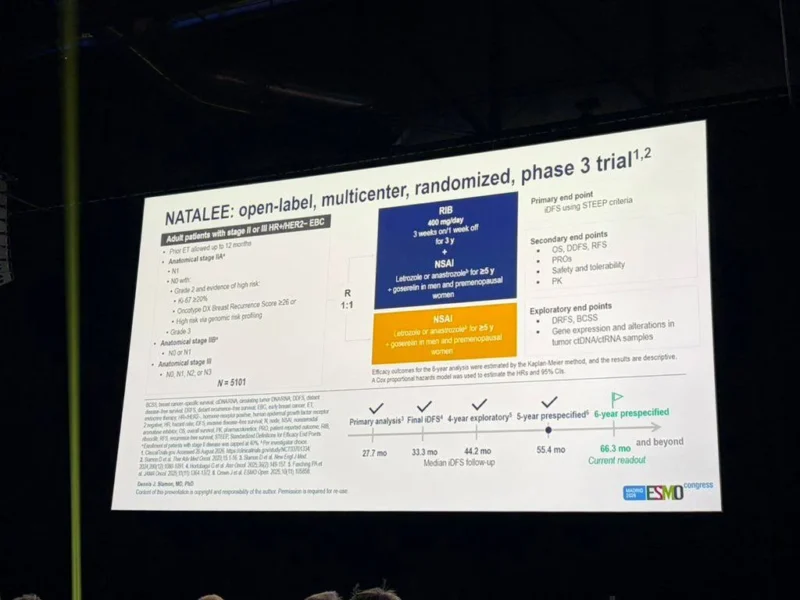
NATALEE was designed to test whether CDK4/6 inhibition could reduce recurrence risk across a broader population of HR-positive/HER2-negative early breast cancer than had previously been evaluated with adjuvant CDK4/6 therapy.
The trial enrolled 5,101 patients with stage II or III disease. Eligible patients included stage IIA disease with nodal involvement, as well as selected node-negative stage IIA cancers with additional high-risk features. Patients with stage IIB or stage III disease were also eligible.
This broader eligibility framework is clinically important because recurrence risk in HR-positive breast cancer extends beyond patients with extensive nodal involvement.
Patients were randomized 1:1 to receive ribociclib plus a nonsteroidal aromatase inhibitor or an aromatase inhibitor alone.
Ribociclib was administered at 400 mg once daily for three weeks followed by one week off, for a total planned duration of three years. The endocrine therapy consisted of letrozole or anastrozole and was planned for at least five years. Premenopausal women and men also received ovarian or gonadal suppression with goserelin.
The 400-mg ribociclib dose is lower than the 600-mg dose historically used in metastatic breast cancer, reflecting the different risk-benefit requirements of long-term treatment in potentially cured patients.
The Trial Had Already Established a Recurrence Benefit
Overall survival was not the first positive endpoint from NATALEE. The trial had previously demonstrated a statistically significant improvement in invasive disease-free survival with ribociclib plus endocrine therapy, establishing the basis for adjuvant use.
What remained unresolved was whether preventing invasive recurrences would eventually translate into fewer deaths. That question is particularly difficult in HR-positive early breast cancer.
Recurrences can occur many years after initial treatment, survival after metastatic recurrence can be prolonged, and patients may receive multiple effective therapies after relapse. Consequently, a meaningful overall survival difference can take years to emerge.
The 6-year analysis now provides the clearest evidence to date that the recurrence benefit is translating into a survival advantage.
Overall Survival Benefit Widened With Longer Follow-Up
At the May 15, 2026 data cutoff, median OS follow-up had reached 66.5 months. The HR of 0.809 corresponds to an approximately 19% reduction in the risk of death with ribociclib plus NSAI compared with NSAI alone. The absolute difference provides another important perspective.
At five years, the survival difference was relatively modest at 1.2 percentage points. By six years, that difference had increased to 2.1 percentage points. This widening is consistent with the biological expectation that preventing recurrence in early HR-positive breast cancer may require time before translating into a measurable survival difference.
The investigators also reported that the OS effect was generally consistent across key prespecified subgroups, supporting the overall treatment effect across the broad NATALEE-eligible population.
Breast Cancer–Specific Survival Strengthened the OS Finding
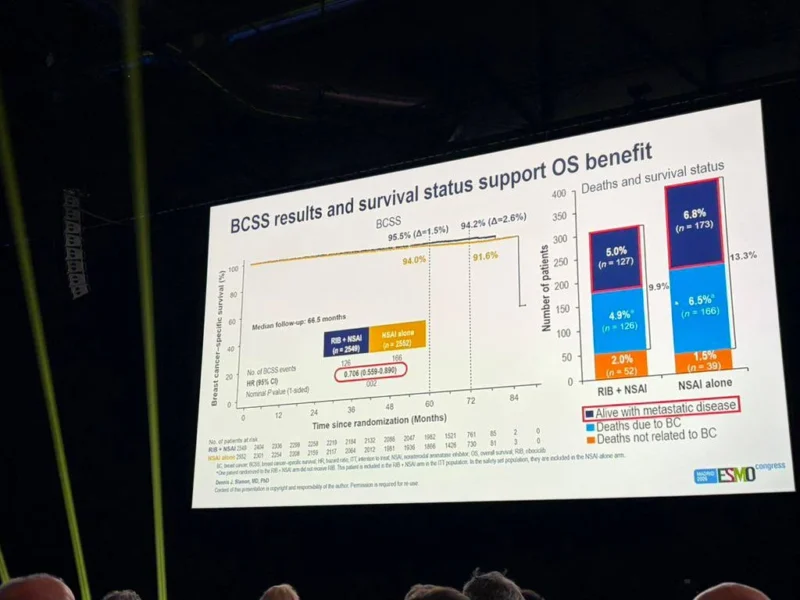
The survival analysis was supported by breast cancer-specific survival. The HR for breast cancer-specific survival was:
- 0.706 (95% CI 0.559–0.890)
This represents an approximately 29% reduction in the risk of breast cancer-related death with ribociclib plus endocrine therapy.
The breast cancer-specific survival findings are particularly relevant because overall survival includes deaths unrelated to breast cancer.
A concordant reduction in breast cancer mortality supports the interpretation that the overall survival difference is biologically linked to improved cancer control rather than an imbalance in unrelated causes of death. At six years, breast cancer-specific survival was approximately 94.2% with ribociclib plus NSAI versus 91.6% with NSAI alone, corresponding to an absolute difference of approximately 2.6 percentage points.
The proportion of patients who were alive with metastatic breast cancer was also lower in the ribociclib arm, another observation consistent with fewer patients experiencing incurable distant recurrence.
The iDFS Benefit Continued to Deepen
The long-term invasive disease-free survival results also remained strongly positive. At a median iDFS follow-up of 66.3 months, ribociclib plus NSAI produced an HR of:
- 0.741 (95% CI 0.646–0.849; nominal one-sided P<0.0001)
This corresponds to an approximately 26% reduction in the risk of an invasive disease-free survival event. Importantly, the absolute difference continued to increase after ribociclib treatment had ended.
At five years, iDFS was 85.32% with ribociclib plus NSAI versus 81.24% with NSAI alone, an absolute improvement of 4.1 percentage points. At six years, iDFS was:
- 83.23% versus 77.92%
The absolute difference therefore widened to:
- 5.3 percentage points
This pattern reinforces one of the most important long-term observations from NATALEE: the treatment effect does not appear to disappear when ribociclib is stopped. Instead, the difference between the groups has continued to deepen during follow-up.
Distant Recurrence Was Also Reduced
Distant metastatic recurrence is particularly important in early breast cancer because it generally marks transition from potentially curable disease to incurable advanced disease. At six years, the benefit extended consistently to distant disease endpoints. The HR for distant disease-free survival was 0.744, while the HR for distant recurrence-free survival was 0.738.
Both estimates correspond to an approximately 26% reduction in risk with ribociclib-based therapy. The absolute improvements in iDFS, DDFS, and DRFS were all approximately 5 percentage points at six years.
This consistency across endpoints strengthens confidence that the long-term benefit is being driven by meaningful prevention of breast cancer recurrence, including distant relapse.
The Post-Treatment Effect Is One of the Most Important Findings
All patients in the NATALEE analysis were off ribociclib at the latest data cutoff. The median time since completion of ribociclib was approximately 38 months. That means the observed six-year survival and recurrence advantages cannot be explained simply by continued active treatment.
The findings instead suggest a durable carryover effect from the three-year period of CDK4/6 inhibition. One potential biological explanation is that prolonged suppression of proliferation during the period of greatest early recurrence risk may eliminate or durably suppress micrometastatic clones before they establish clinically detectable metastatic disease.
The precise biology remains uncertain, but the clinical pattern is increasingly clear: the benefit continues after ribociclib exposure ends.
For patients considering three years of adjuvant therapy, this distinction matters. The objective is not indefinite disease suppression requiring continuous CDK4/6 inhibition, but a finite period of treatment intended to alter long-term recurrence risk.
Safety Did Not Reveal New Long-Term Signals
No new safety signals emerged with longer follow-up. This is reassuring because adjuvant treatment exposes patients who may already have been cured by surgery and standard therapy to additional treatment toxicity.
The established ribociclib safety profile includes neutropenia, liver enzyme abnormalities, QT prolongation, fatigue, nausea, and other treatment-related effects requiring laboratory and electrocardiographic monitoring during active treatment.
However, the latest analysis occurred years after most patients had completed ribociclib, and investigators did not identify evidence of a new late-emerging toxicity pattern.
The absence of new long-term signals becomes increasingly relevant as adjuvant CDK4/6 therapy is used in broader populations.
Absolute Benefit Still Matters for Individual Treatment Decisions
Although the survival result is important, a 2.1% absolute OS improvement at six years also highlights why adjuvant treatment decisions should remain individualized.
The relative reduction in mortality is clinically meaningful, but the absolute benefit for an individual patient depends heavily on baseline recurrence risk. A patient with stage III disease and extensive nodal involvement has a substantially different untreated recurrence risk from a patient with selected node-negative stage II disease.
For higher-risk patients, a similar relative treatment effect may translate into a larger absolute benefit. For patients at the lower boundary of NATALEE eligibility, the balance between expected recurrence reduction, three years of treatment, monitoring, toxicity, and patient preference deserves careful discussion.
The new OS finding strengthens the overall benefit-risk equation but does not eliminate the need for risk-based selection.
NATALEE Moves Beyond Prevention of Recurrence
The major conceptual change in the 6-year analysis is that ribociclib can no longer be discussed only as a drug that improves invasive disease-free survival. The trial now provides evidence that recurrence prevention is translating into fewer deaths.
That distinction is important in the curative setting. Improving iDFS establishes that a therapy delays or prevents clinically important cancer events. Demonstrating OS benefit provides a more direct indication that treatment is changing the long-term natural history of the disease.
For NATALEE, the survival difference emerged gradually and became positive only after extended follow-up. That is consistent with the biology of HR-positive breast cancer and reinforces why long-term follow-up of adjuvant trials remains essential.
OncoDaily Takeaway
The 6-year NATALEE analysis marks a major maturation of the evidence for adjuvant ribociclib in HR-positive/HER2-negative early breast cancer. Ribociclib plus a nonsteroidal aromatase inhibitor reduced the risk of death by approximately 19%, with an OS HR of 0.809.
Six-year overall survival was 91.86% with ribociclib plus NSAI compared with 89.73% with NSAI alone, producing a 2.1% absolute survival advantage. The survival result was supported by an approximately 29% reduction in breast cancer-specific mortality, while the invasive disease-free survival advantage continued to deepen.
At six years, iDFS was 83.23% versus 77.92%, an absolute difference of 5.3 percentage points. Perhaps the most compelling aspect of the update is timing. All patients had been off ribociclib for a median of approximately 38 months, yet the recurrence and survival curves continued to separate.
The findings therefore suggest that three years of adjuvant ribociclib can produce a durable treatment effect extending well beyond active therapy.
NATALEE had already demonstrated that ribociclib can prevent recurrence across a broad stage II–III population. The 6-year analysis now addresses the more consequential question: does preventing those recurrences ultimately help patients live longer? For the overall NATALEE population, the answer is now positive.
Source
- Slamon DJ, Hortobagyi GN, Stroyakovskiy D, et al. Adjuvant ribociclib plus nonsteroidal aromatase inhibitor in patients with HR-positive/HER2-negative early breast cancer: NATALEE 6-year overall survival and efficacy outcomes. Presented at ESMO Congress 2026, October 23, 2026. Clinical trial identifier NCT03701334.