Nabil Ismaili, Director of Medical Oncology and Radiotherapy Department at Mohammed VI University of Sciences and Health, shared on LinkedIn:
“ESMO 2026 and The Lancet: Iza-bren (EGFRxHER3 ADC) Doubles PFS in EGFRm NSCLC Post-TKI Progression!
I just attended the highly anticipated presentation of the Phase 3 PANKU-Lung01 trial, which was simultaneously published in The Lancet. This is a massive paradigm shift for patients with EGFR-mutant non-squamous NSCLC who progress on 3rd-generation EGFR-TKIs.
We are officially moving from standard chemotherapy to a highly potent bispecific Antibody-Drug Conjugate (ADC). Iza-bren (izalontamab brengitecan) targets both EGFR and HER3, delivering a topo-I inhibitor payload directly to the tumor.
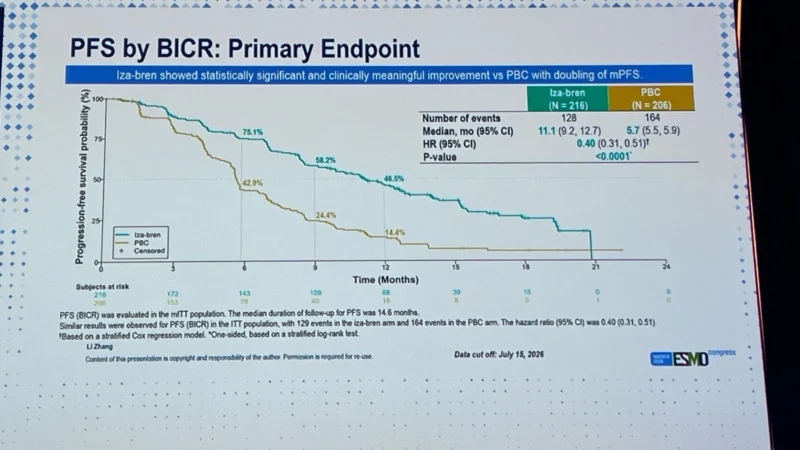
Here is the breakdown of these spectacular data (N=432)
The Efficacy (Primary Endpoint Met):
- Progression-Free Survival (PFS): The PFS was literally doubled. Median PFS was 11.1 months vs. 5.7 months for platinum-based chemotherapy (HR 0.40; 95% CI 0.31-0.51; p<0.0001).
- Objective Response Rate (cORR): A remarkable 60.2% vs. 34.5%.
- Overall Survival (OS): Data remains immature, but there is a clear, strong trend favoring Iza-bren (Median OS: Not Reached vs. 19.4 months).
Safety and Tolerability:
As expected with this class of ADC, the most common TRAEs are hematologic (anemia, thrombocytopenia, leukopenia, neutropenia). However, the safety profile is manageable:
- Grade ≥3 hematologic toxicities resolved relatively quickly (e.g., anemia in a median of 8 days).
- The rate of treatment discontinuation due to TRAEs was very low (1.9%).
- Crucially, treatment-related Interstitial Lung Disease (ILD) was very low (0.9%).
My Clinical Takeaway:
This trial establishes a potential new standard of care for this heavily pretreated population. The fact that global registrational studies (IZABRIGHT-Lung01 and Lung02) are already ongoing shows how confident the scientific community is in these results.
However, integrating this into practice will require our medical teams to become experts in managing hematologic toxicities (using G-CSF, dose delays, and transfusions) to keep patients on treatment and maximize benefit.
For my thoracic oncology colleagues: With a PFS HR of 0.40, how ready are your day-care units to handle the hematologic monitoring required for bispecific ADCs? Will this ADC replace traditional chemotherapy in your 2nd-line algorithms?”
This also can be interesting:
SARON: Consolidation Radiotherapy Improves PFS but Not Overall Survival in Oligometastatic NSCLC