
Muna Al-Khaifi, GP Oncologist at Mount Sinai Hospital (Toronto), Sinai Health, presents this article on the growing importance of cognitive health in menopause after cancer. The article explores the cognitive changes that can occur during menopause, including difficulties with memory, attention, concentration, and information processing, with a particular focus on surgical menopause and the evidence surrounding cognitive health. It highlights the importance of recognizing and assessing cognitive concerns in clinical practice, alongside evidence-based lifestyle approaches to support cognitive health.
The article also introduces the inaugural Advances in Onco-menopause International Conference, which will bring internationally recognized experts together to advance evidence-based menopause care for people living with and beyond cancer.
Advancing Cognitive Health in Menopause After Cancer
When we think about menopause, the conversation often begins with vasomotor symptoms such as hot flushes and night sweats. However, its effects can extend well beyond these symptoms to include cognitive changes, such as difficulties with memory, attention, and concentration.
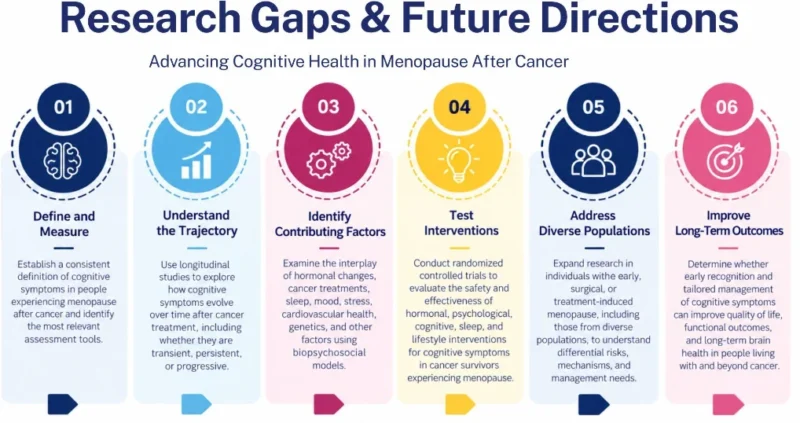
This article summarizes a recent 2026 Personal View by Gurvich and colleagues, “Advances in understanding of cognitive symptoms during menopause,” published in The Lancet Obstetrics, Gynaecology, and Women’s Health. It highlights key evidence, clinical considerations, and research gaps related to cognitive symptoms during the menopause transition.
Why should cognition be part of the menopause conversation?
Cognitive health is increasingly recognized as a priority in menopause research, with the 2024 Menopause Priority Setting Partnership ranking cognitive problems among its top three research priorities, followed by a 2025 UK priority setting exercise that identified understanding the causes, diagnosis, management, and prevention of cognitive effects during perimenopause and menopause as a top 10 research priority and the only menopause specific question included in the top ten.
Across cross sectional studies, memory related symptoms have been reported by 26% to 95% of women in perimenopause, while concentration difficulties have been reported by 52% to 90%.
These experiences may include:
- Forgetfulness or difficulty retrieving words
- Reduced concentration and sustained attention
- Slower information processing
- Mental fatigue
- Difficulty planning, organizing, making decisions, or multitasking
What do we know about cognition after surgical menopause?
A meta analysis of 11 studies involving 18,867 women found that early surgical menopause before age 46 was associated with an increased risk of later life dementia. Surgical menopause at any age was also associated with faster decline in verbal memory, semantic memory, and processing speed following surgery.
Several smaller studies provide insight into the more immediate patient experience:
- In a qualitative study of 16 women within 24 months of surgical menopause occurring, 15 of 16 women, (94%), reported cognitive symptoms, including slower processing speed, difficulties with memory and retrieval, and attention problems.
- A prospective cohort of 57 women assessed before and after risk reducing salpingo oophorectomy identified declines in perceived cognition within the first six months after surgical menopause.
- In a prospective study, 83 women undergoing risk-reducing salpingo oophorectomy were compared with 98 women, and a small adverse effect on verbal learning was identified at 24 months
Evidence-based recommendations on lifestyle behaviours to improve cognitive health
- Maintain regular sleep patterns, create a comfortable sleep environment; a 2024 scoping review of randomized controlled trials supports cognitive behavioural therapy for insomnia as a first-line intervention
- Regular aerobic exercise may support cognitive function, improve brain health, and reduce the risk of dementia. For adults aged 40-64 years, WHO guidelines recommend 150-300 minutes of moderate-intensity aerobic activity or 75-150 minutes of vigorous-intensity activity per week, combined with muscle-strengthening activities at least 2 days per week.
- A healthy, balanced diet is recommended to support cognitive health and reduce the risk of cognitive decline and dementia. A Mediterranean-style diet is also recommended as a dietary approach for reducing the risk of cognitive decline.
How should cognitive concerns be assessed in clinical practice?
Clinicians should validate cognitive concerns during menopause, as new memory or concentration difficulties can cause anxiety and concerns about conditions such as dementia or ADHD. Although young-onset dementia is rare, progressive cognitive decline affecting daily functioning warrants further assessment.
Assessment should include:
- onset and course, changes in memory/concentration, duration, fluctuation, or progression;
- functional impact, effects on work and daily activities;
- mental health and stressors, including mood changes and psychosocial stress; and
- associated symptoms, particularly whether cognition worsens with poor sleep or mood changes.
Clinicians should also consider alternative or contributing causes, including medical conditions, nutritional deficiencies, psychiatric conditions, and psychosocial factors.
Reference
Gurvich C, Spector A, Hickey M. Advances in understanding of cognitive symptoms during menopause. The Lancet Obstetrics, Gynaecology, & Women’s Health, 2, e335-e345
Want to learn more about menopause care after cancer?
Learn more about assessing and managing menopause after cancer at the inaugural Advances in Onco-menopause International Conference, taking place online on October 30, 2026.
Chaired by Dr. Muna Al-Khaifi, MD, CCFP, MPH, the conference brings together internationally recognized experts to explore evidence-based approaches to menopause care across the cancer continuum, including cognitive changes, vasomotor symptoms, sexual health, bone and metabolic health, fertility, menopausal hormone therapy, and more.
Early Bird registration ends October 12, 2026.
Register today and join us in advancing evidence-based menopause care for people living with and beyond cancer.
You may also be interested in: Muna Al-Khaifi: Advancing Menopause Care for People Living With and Beyond Cancer