Muna Al-Khaifi, GP oncologist at Mount Sinai Hospital (Toronto), Sinai Health, shared on LinkedIn:
“A New Non-Hormonal Option for Vasomotor Symptoms in Breast Cancer Survivors: The OASIS-4 Trial
Hot flashes and night sweats are among the most common and disruptive consequences of endocrine therapy for breast cancer. For many survivors, these symptoms affect sleep, quality of life, daily functioning – and potentially adherence to life-saving endocrine therapy.
The OASIS-4 phase 3 randomized trial provides important new evidence for elinzanetant, a non-hormonal dual neurokinin-1 and neurokinin-3 (NK1/NK3) receptor antagonist.
The study included 474 women aged 18–70 years with, or at high risk for developing, hormone receptor–positive breast cancer who were experiencing ≥35 moderate-to-severe vasomotor symptoms per week while receiving endocrine therapy.
Participants received elinzanetant 120 mg once daily or placebo for 12 weeks, followed by elinzanetant in the placebo group.
What did the study find?
At baseline, women experienced approximately 11.5 moderate-to-severe hot flashes per day.
By week 4, symptoms decreased by:
- 6.5 episodes/day with elinzanetant
- 3.0 episodes/day with placebo
By week 12:
- 7.8 fewer episodes/day with elinzanetant
- 4.2 fewer episodes/day with placebo
The benefits were apparent as early as week 1, and elinzanetant also improved vasomotor symptom severity, sleep disturbance, and menopause-related quality of life.
Common adverse events included headache, fatigue, and somnolence.
Why is this important for cancer survivors?
This is an important development in onco-menopause and cancer survivorship care.
Women receiving tamoxifen, aromatase inhibitors and/or ovarian suppression can experience significant treatment-induced menopausal symptoms. Unlike women experiencing natural menopause, many breast cancer survivors are not candidates for systemic menopausal hormone therapy, leaving clinicians with a more limited therapeutic toolbox.
Poorly controlled symptoms are not simply a quality-of-life issue. They can contribute to difficulty remaining on endocrine therapy.
OASIS-4 is particularly important because it studied a therapy directly in the breast cancer endocrine-therapy population, rather than extrapolating evidence from women experiencing natural menopause.
As survivorship care evolves, managing treatment-related menopause should be viewed as an integral part of cancer care – not an optional addition after treatment.
Effective symptom management has the potential to improve quality of life, sleep, functioning, and treatment persistence, while helping survivors live well during years of endocrine therapy.
Treating the cancer is essential. Helping patients live well with the consequences of treatment is also part of cancer care.”
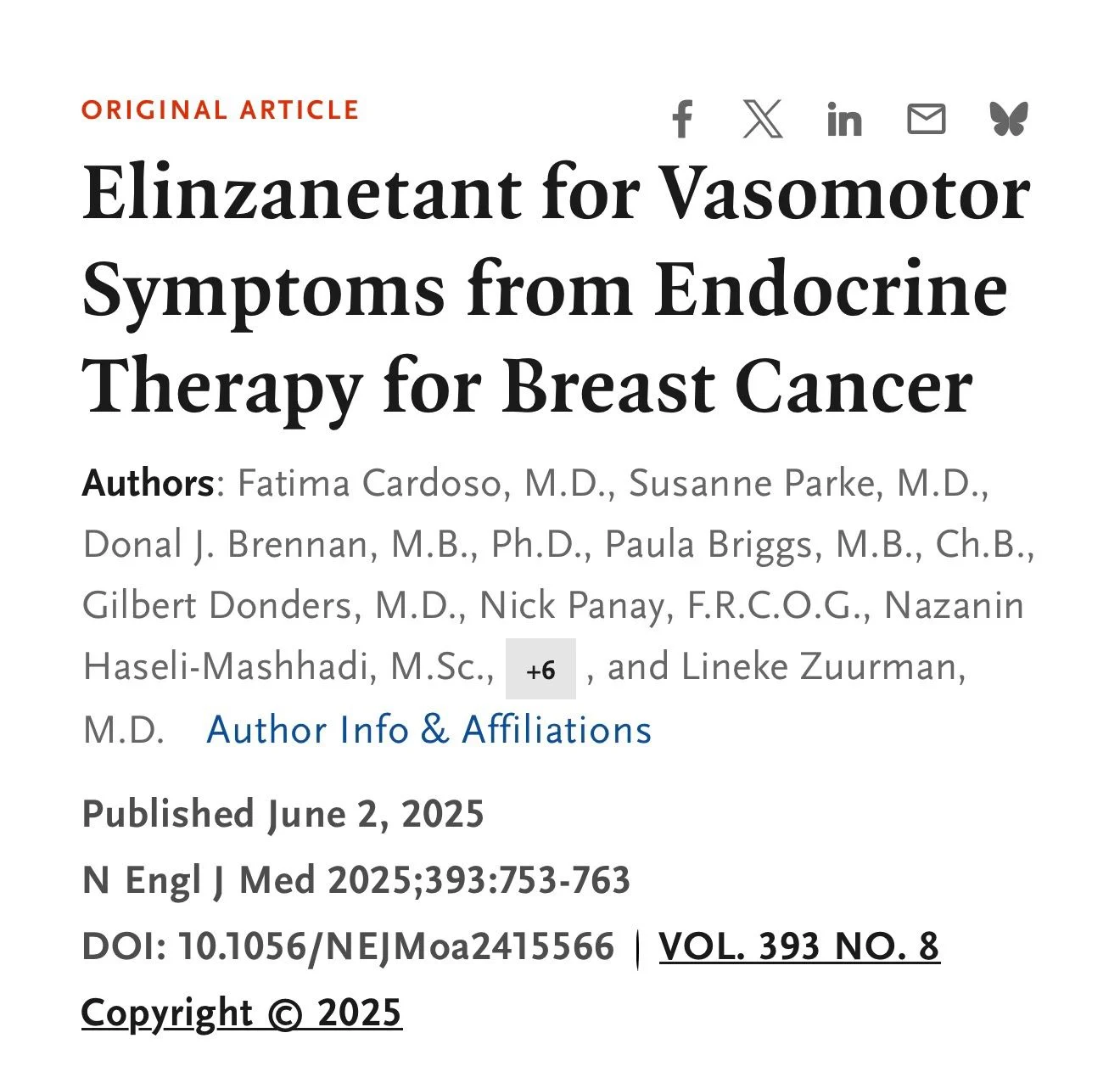
Title: Elinzanetant for Vasomotor Symptoms from Endocrine Therapy for Breast Cancer
Authors: Fatima Cardoso, Susanne Parke, Donal J Brennan, Paula Briggs, Gilbert Donders, Nick Panay, Nazanin Haseli-Mashhadi, Michael Block, Cecilia Caetano, Maja Francuski, Claudia Haberland, Kaisa Laapas, Christian Seitz, Lineke Zuurman.
Read the full article.
You can find this interesting: ASCO Updates Breast Cancer Follow-Up Guidelines With Risk-Based Surveillance Approach