





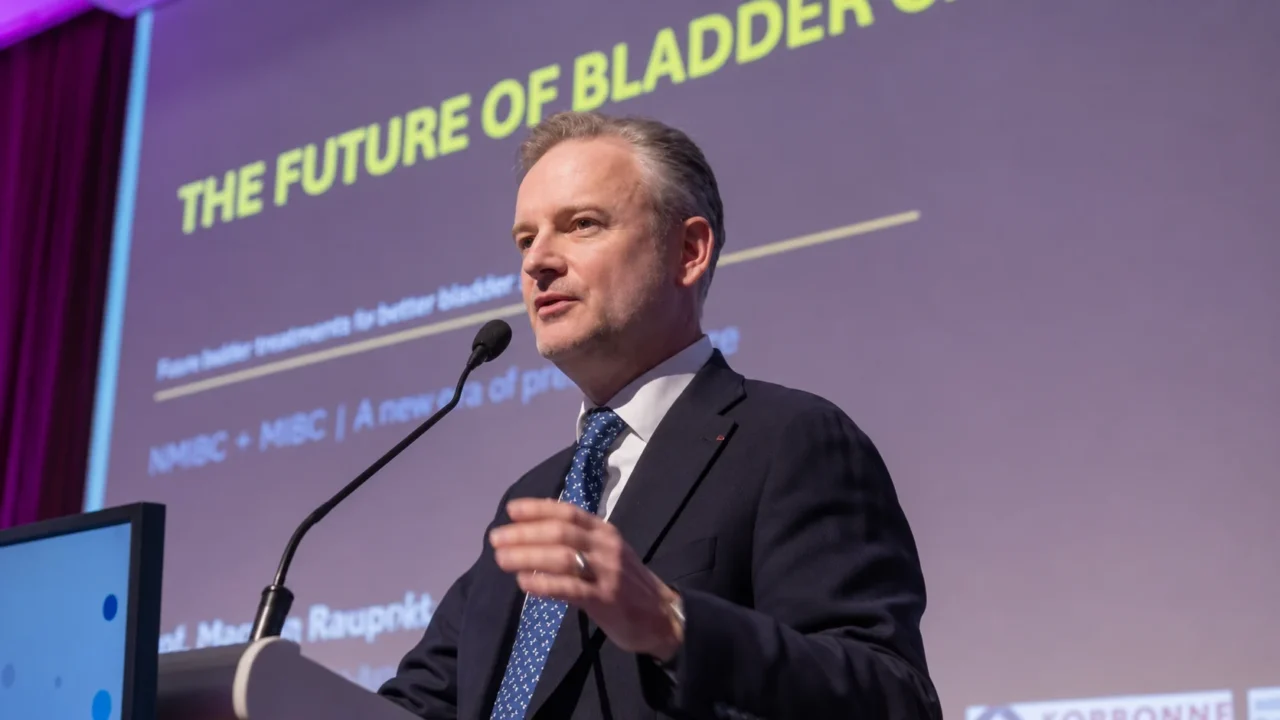
Morgan Rouprêt, Editor-in-Chief European Urology Oncology at European Urology Oncology, shared on LinkedIn:
“The future of bladder cancer- From better treatments to better bladder preservation.
A great pleasure to be in beautiful Mondsee, Austria, for UFO2026 (Urologisches Fortbildungsforum in der Onkologie), and to share my vision of the future of bladder cancer management through two keynote lectures dedicated to NMIBC and MIBC.
We are experiencing an unprecedented acceleration of therapeutic innovation in bladder cancer. However, the next revolution should not simply be about adding more treatments, but about selecting the right treatment for the right patient.
In NMIBC:
- Reaffirming the importance of high-quality TURBT as the cornerstone of treatment.
De-escalating treatment in selected low-risk patients.
Exploiting the unique anatomy of the bladder as a hollow organ for innovative intravesical drug delivery.
Personalising BCG strategies and critically interpreting the ALBAN, CREST and POTOMAC trials.
POTOMAC Trial: Durvalumab Plus BCG in High-Risk NMIBC
In MIBC:
- Rethinking perioperative treatment following NIAGARA, VOLGA and KEYNOTE-905.
Maintaining surgical excellence in the era of immunotherapy and antibody-drug conjugates.
Moving towards molecular response assessment, including ctDNA.
Developing evidence-based, response-adapted bladder preservation strategies.
Could ctDNA eventually become for bladder cancer what PSA is for prostate cancer?
KEYNOTE-905 at ESMO 2026: Perioperative Pembrolizumab With or Without Enfortumab Vedotin in MIBC
My vision for 2030: fewer unnecessary interventions, fewer unnecessary cystectomies, more cures and better quality of life.
Bladder preservation must never come at the expense of oncological safety.
A very special thank you to my Austrian colleagues for their incredibly warm welcome, the stimulating scientific discussions and their hospitality. Congratulations to the scientific chairs Thomas Bauernhofer and Nastasiia Artamonova, and many thanks to the entire AstraZeneca Austria team for this excellent educational initiative.
Always a privilege to represent Sorbonne University and Greater Paris University Hospitals – AP-HP, and to strengthen scientific collaboration across Europe European Association of Urology European Urology Oncology.”