Miguel Bronchud, Co-Founder at Regenerative Medicine Solutions, shared a post on LinkedIn:
“Ovarian cancer (OC) risk: Does constitutional BRCA1 promoter methylation (detectable in peripheral blood-derived DNA) contribute to this disease?
Women carrying pathogenic germline variants (PGVs) in BRCA1, BRCA2, BRIP1, PALB2, RAD51C, and RAD51D are at an increased risk for ovarian cancer (OC) compared with the general female population.
In addition, OC is part of the tumor spectrum of the Lynch syndrome, and women with PGVs in MLH1, MSH2, and MSH6 are at an elevated OC risk.
Up to 20% of patients with OC carry heterozygous PGVs in BRCA1/2, and up to 5% carry PGVs in further OC predisposition genes. This means 1 out of 4 women with this type of aggressive cancer carry in their chromosomes genetic mutations that predispose them.
A proportion of OCs may additionally be explained by unfavorable OC-specific polygenic risk scores (PRSs).
However, the majority of unselected OCs are not caused by known heritable risk factors such as PGVs in established OC predisposition genes or PRSs.
Pathogenic somatic variants (PSVs) in OC predisposition genes and BRCA1 promoter methylation observed in the tumor tissue are usually attributed to sporadic OC, not associated with a positive family history of cancer as shown for PGVs.
Mutations in BRCA1/2 and BRCA1promoter methylation observed in the tumor tissue are associated with a homologous recombination–deficient tumor phenotype, predicting favorable response to treatment with DNA-damaging agents and DNA repair inhibition, such as platinum or poly(ADP-ribose) polymerase (PARP) inhibitors.
And , PGVs and PSVs in BRCA1/2 and BRCA1 promoter methylation observed in the tumor tissue are mutually exclusive, with only a few exceptions
Constitutional epimutations arise early in development and are present across normal tissues, including peripheral blood.
Constitutional BRCA1 promoter methylation has emerged as a risk factor for BRCA1-associated cancers, such as ovarian cancer (OC), and may serve as a biomarker for OC risk.
This German study retrospectively evaluated the clinical relevance of constitutional BRCA1promoter methylation in 473 patients with OC enrolled in the observational AGO-TR1 study.
BRCA1 promoter methylation was quantified by the methylation-specific real-time polymerase chain reaction using whole blood-derived DNA from 476 female controls and 473 patients with OC along with 473 corresponding tumor-derived DNA samples.
Methylation levels ≥1.0% were considered methylation-positive. But BRCA1 promoter methylation in blood-derived DNA was detected in 42 of 473 patients with OC and in 26 of 476 controls (8.9% v 5.5%; odds ratio [OR], 1.69 [95% CI, 1.02 to 2.80], P = .0432), with the strongest association observed with methylation levels ≥10% (OR, 6.17 [95% CI, 1.37 to 27.72], P = .018).”
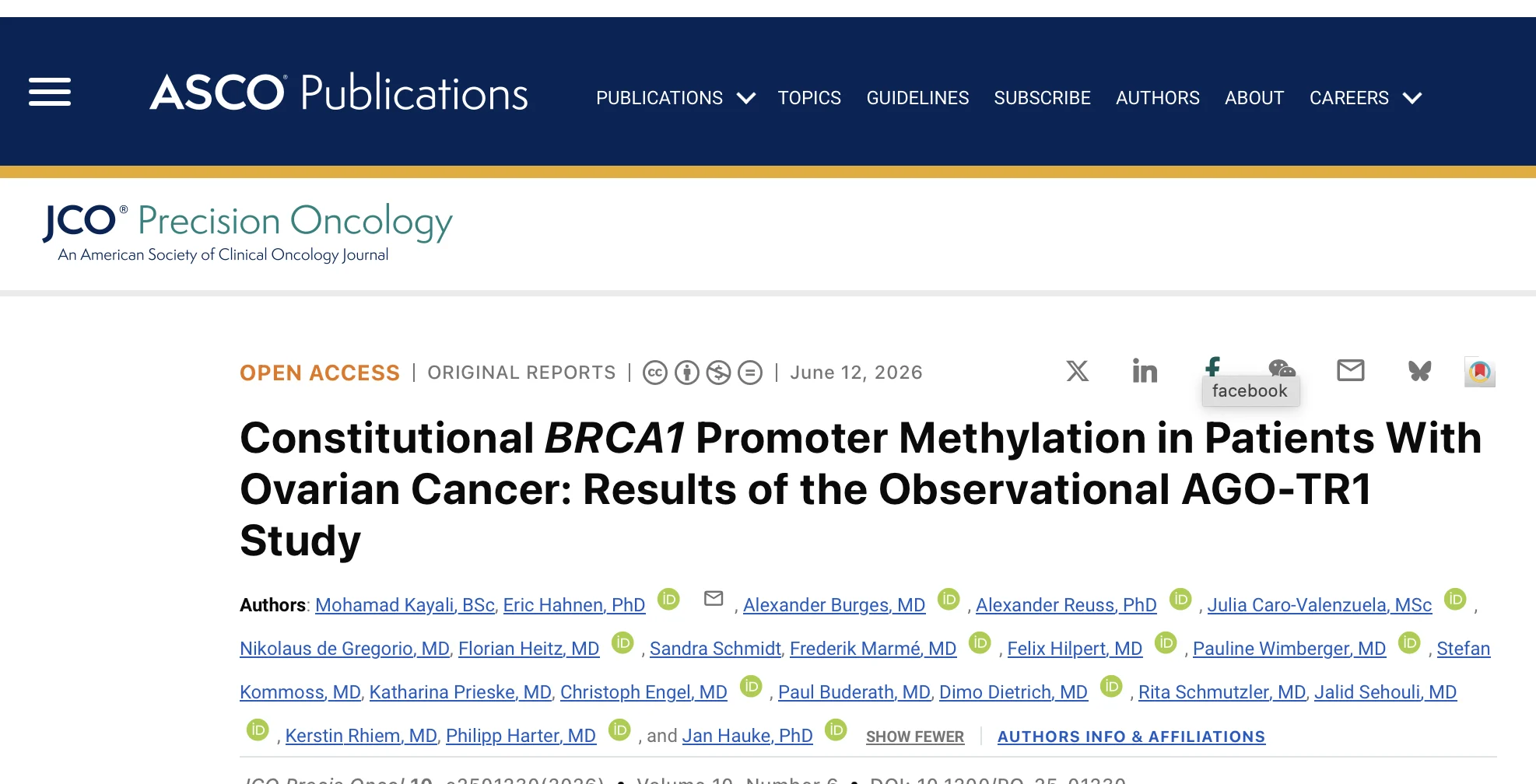
Title: Constitutional BRCA1 Promoter Methylation in Patients With Ovarian Cancer: Results of the Observational AGO-TR1 Study
Authors: Mohamad Kayali, Eric Hahnen, Alexander Burges, Alexander Reuss, Julia Caro-Valenzuela, Nikolaus de Gregorio, Florian Heitz, Sandra Schmidt, Frederik Marmé, Felix Hilpert, Pauline Wimberger, Stefan Kommoss, Katharina Prieske, Christoph Engel, Paul Buderath, Dimo Dietrich, Rita Schmutzler, Jalid Sehouli, Kerstin Rhiem, Philipp Harter, Jan Hauke
Read the Full Article.