Jing Liang, Entrepreneur, Drug hunter, shared on X:
”I think Dr. Kurzrock is making a very important point that some people are missing.
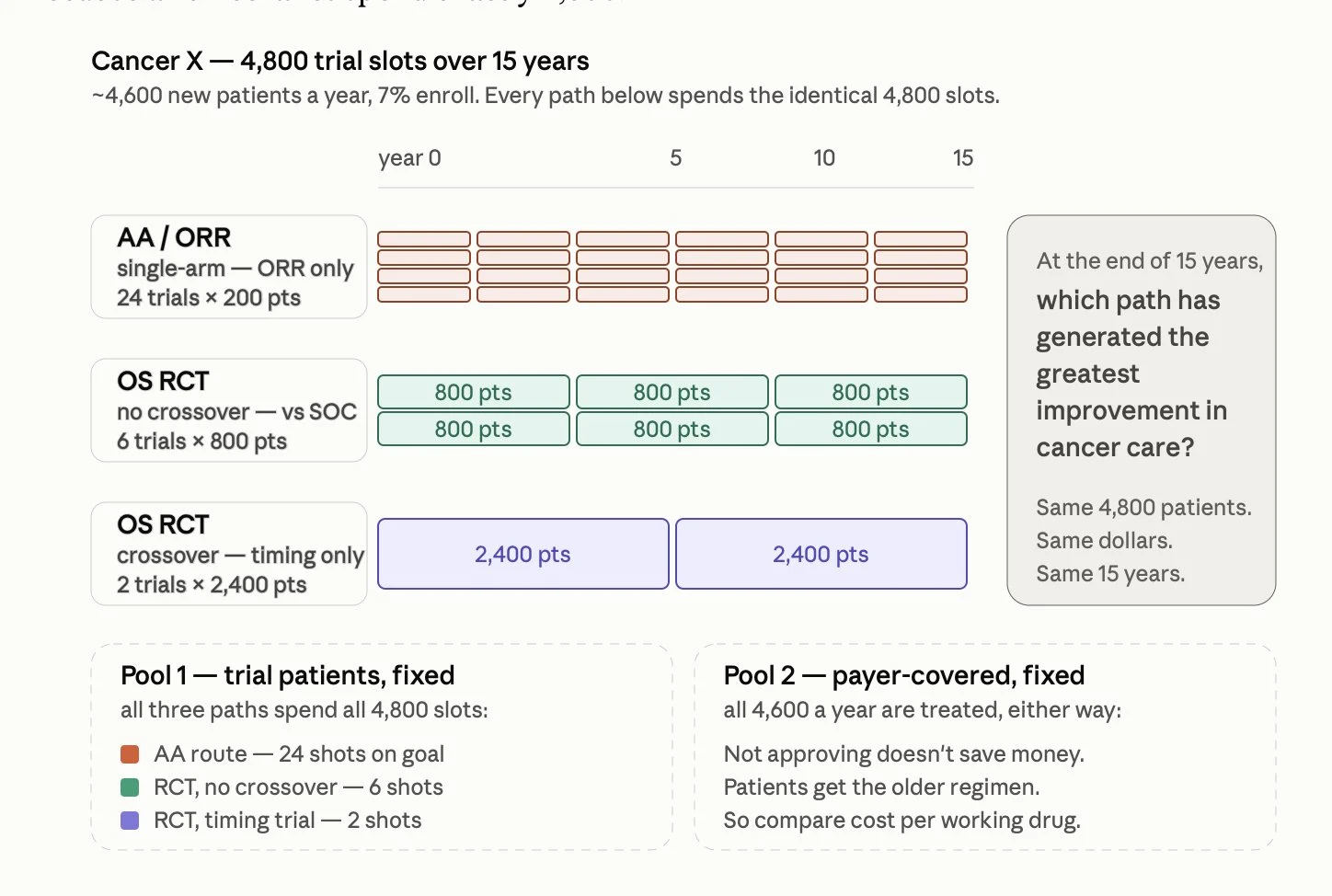
I asked Claude to create an illustration of what I mean. For a given cancer, the incidence is relatively fixed, which means the clinical trial patient pool is relatively fixed. Same pool of patients buys you 24 small ORR trials or 2 big crossover OS trials. Also, a big crossover OS RCT does not guarantee to give you a better drug – which is the point Dr. Kurzrock is making. Over lets say 15 years, as a public policy, what regulatory approval standards will give you the greatest improvement in cancer care?
This is completely different from the question:
‘which trial design will give you the most accurate assessment of an individual drug’s efficacy?’
I also understand the argument that patients will end up paying for drugs that may not work better than SOC. Sure, this may be true at any given snapshot in time, but it is unlikely to be true over 24 iterations across 15 years. Also. I don’t buy the argument that you save society money, as the # of patients treated is also relatively fixed. The same $$$ will be spent on the older SOC.”
To which, Hannah Abrams, PGY6 at Fred Hutch Cancer Center, added:
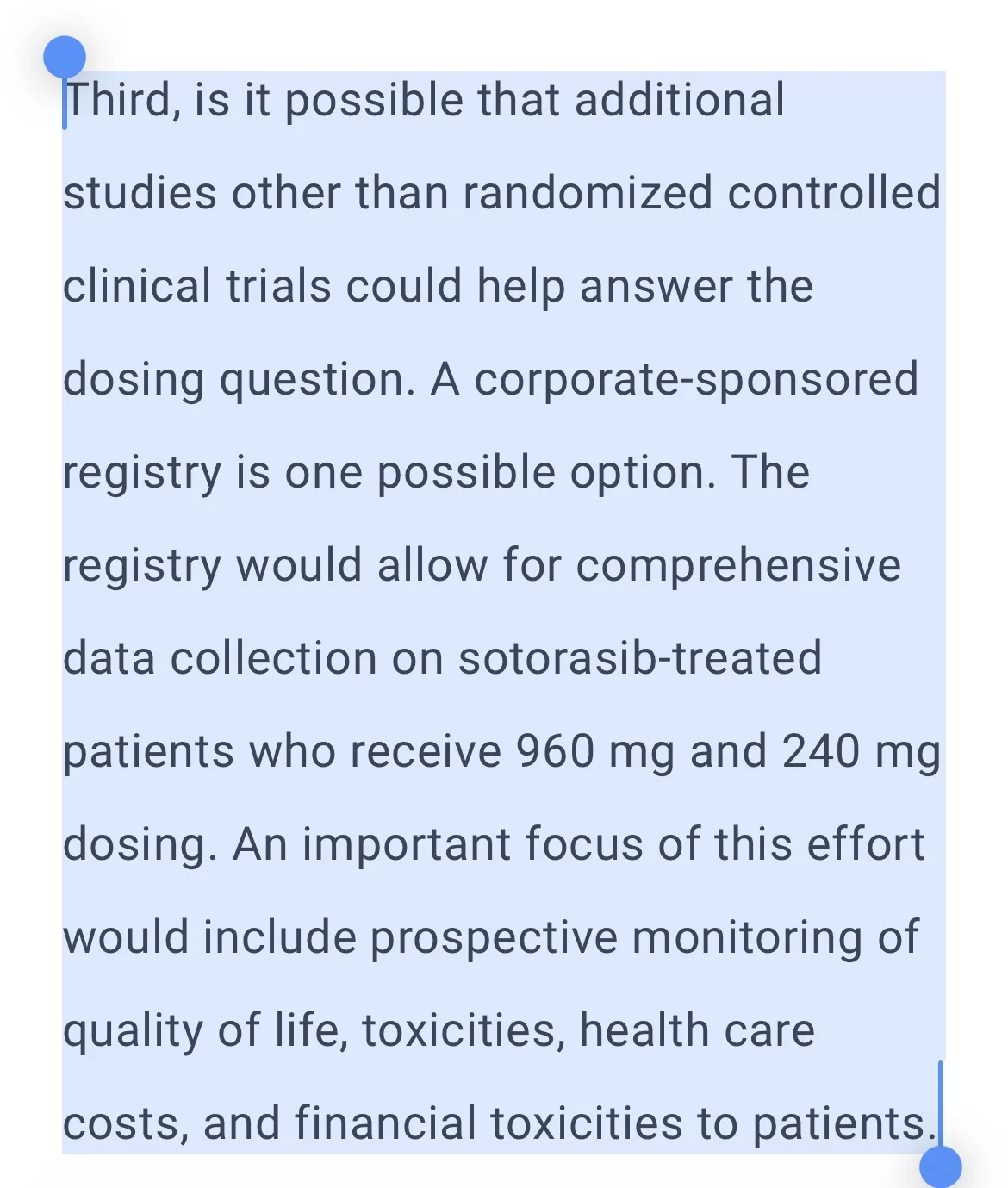
”Adjacent question to the ongoing debate: are RCTs really the right venue for answering dose optimization questions?
Editorial in JCO Oncology Practice on sotorasib meta-analysis by Arthur Aung.”
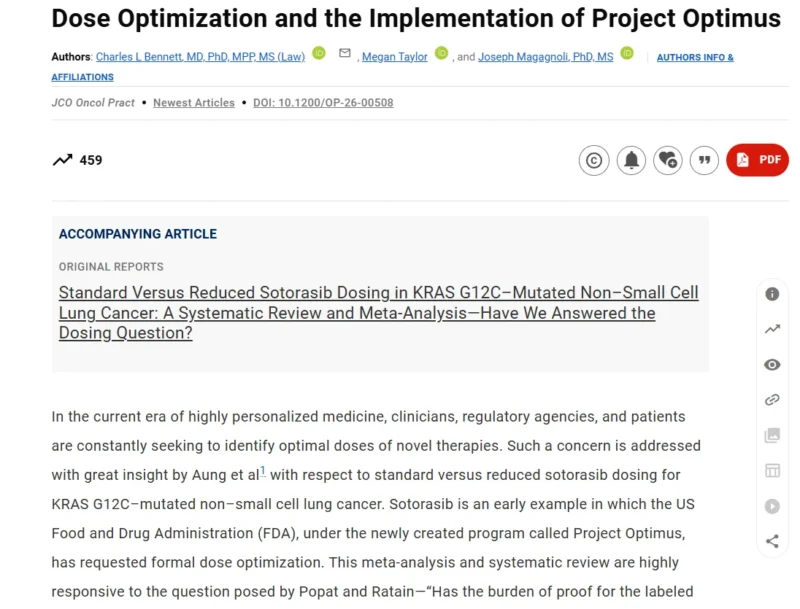
Title: Dose Optimization and the Implementation of Project Optimus
Authors: Charles Bennett, Megan Taylor and Joseph Magagnoli
You can also read ‘T-DXd Plus Sotorasib Shows Preclinical Promise in KRAS G12C-Mutant NSCLC‘