



Jenny Seligmann, Professor of Gastrointestinal Oncology at University of Leeds, shared Annals of Oncology’s post on LinkedIn, adding:
“I was pleased to co-author and recruit 9 patients at Leeds Teaching Hospitals NHS Trust. Dostarlimab worked well in dMMR locally advanced rectal cancer evidenced by combined CCR and pCR rates. It was well tolerated. What was more challenging was assessment of cCR following 6 months to make MDT organ preservation decisions. Radiological assessment particularly challenging with mucinous tumours. Some patients need more time for cCR – 8 months plus patience required.
But sometimes dostar not enough – not 100% cCR in real world. This needs clear communication of risks vs benefit with patients. Overall however a huge step forward for patients and FDA approval with cCR at 12 months makes locally advanced rectal cancer very interesting. In the meanwhile let’s focus on MDT education of response assessment!”
Quoting Annals of Oncology:
“New data in press: first results from the global phase II AZUR-1 trial, simultaneously published with the presentation at ESMO26
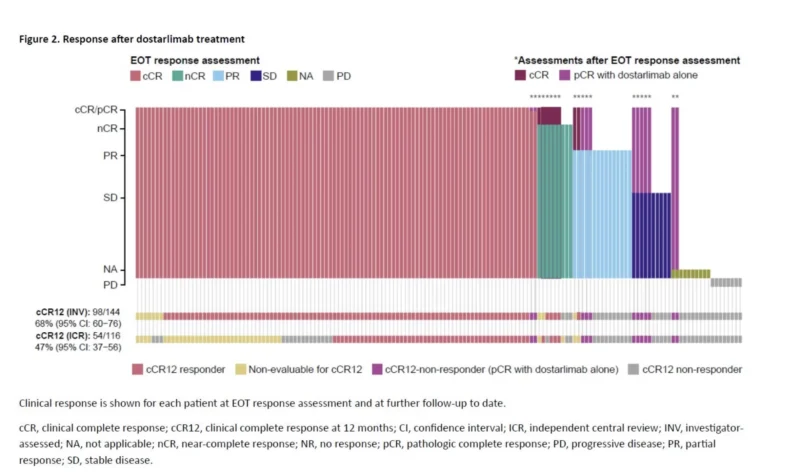
Dostarlimab monotherapy was evaluated in previously untreated stage II/III dMMR/MSI-H locally advanced rectal cancer (154 patients, 42 centers, 10 countries; median follow-up 26.3 months).
Key messages:
- Over 90% of patients treated with dostarlimab have no evidence of disease progression to date
- 98% of evaluable patients who achieved cCR with dostarlimab alone maintained cCR for ≥12 months, with no recurrences
- The composite cCR12 (investigator-assessed) + pCR rate was 76% (cCR12 68%; pCR 80% in patients undergoing surgery after dostarlimab alone)
- For most patients who did not achieve cCR with dostarlimab alone, salvage treatment pathways remained accessible and effective
- Manageable safety profile (grade ≥3 immune-mediated AEs 3%), with meaningful improvements in patient-reported outcomes
Important considerations:
- Single-arm design
- Primary endpoint (cCR12 by independent central review) still immature
- cCR rate lower than the 100% reported in the initial single-center MSK experience
These results support dostarlimab monotherapy as the new standard of care for dMMR/MSI-H stage II/III LARC. This dataset matters because moving from a single expert center to a global multicenter setting gives a more realistic estimate of what this strategy can achieve in routine practice, and it highlights the need for standardized response assessment.
You may also be interested in: