At the ESMO Congress 2026, Andrea Cercek (New York, USA) presented the first results from the global registrational AZUR-1 trial (NCT05723562), evaluating dostarlimab monotherapy in patients with mismatch repair-deficient or microsatellite instability-high (dMMR/MSI-H) locally advanced rectal cancer (LARC).
The analysis, presented as Late-Breaking Abstract LBA87 in the Proffered Paper session, assessed sustained clinical complete response (cCR), pathological complete response (pCR), disease outcomes, and safety following treatment with dostarlimab.
Why Was AZUR-1 Conducted?
Multimodal treatment involving chemotherapy, radiation, and surgery is a standard-of-care approach for locally advanced rectal cancer but is associated with significant treatment-related toxicity and morbidity. Following total neoadjuvant therapy (TNT), clinical complete response rates range from 21% to 41%, highlighting the need for alternative treatment strategies.
Tumours with dMMR/MSI-H status are particularly responsive to PD-1 blockade. Previous findings from a small study demonstrated durable clinical complete responses with neoadjuvant dostarlimab, eliminating the need for standard multimodal treatment in most patients.
AZUR-1 was designed as the first global registrational study evaluating the clinical benefit of dostarlimab monotherapy in patients with dMMR/MSI-H locally advanced rectal cancer.

AZUR-1 Study Design and Methods
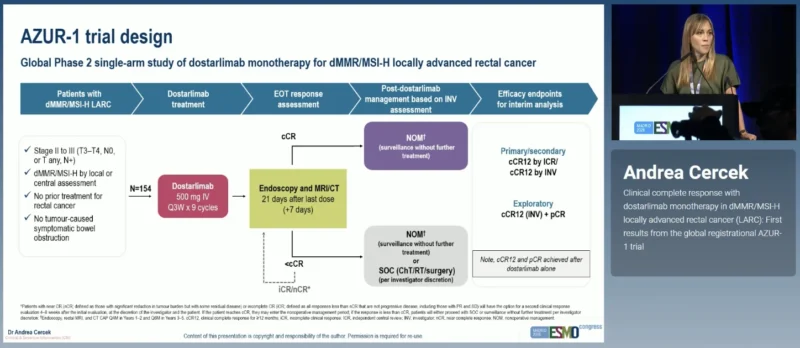
AZUR-1 was a global, single-arm Phase II trial enrolling patients with dMMR/MSI-H locally advanced rectal cancer. Patients received dostarlimab 500 mg intravenously every three weeks for nine cycles. Key efficacy endpoints included the rate of clinical complete response sustained for 12 months (cCR12) after dostarlimab treatment, assessed by independent central review (ICR) and investigator assessment.
An exploratory composite endpoint combined investigator-assessed cCR12 and pathological complete response (pCR) following dostarlimab monotherapy. Safety and disease outcomes were also assessed.
Key Findings from AZUR-1
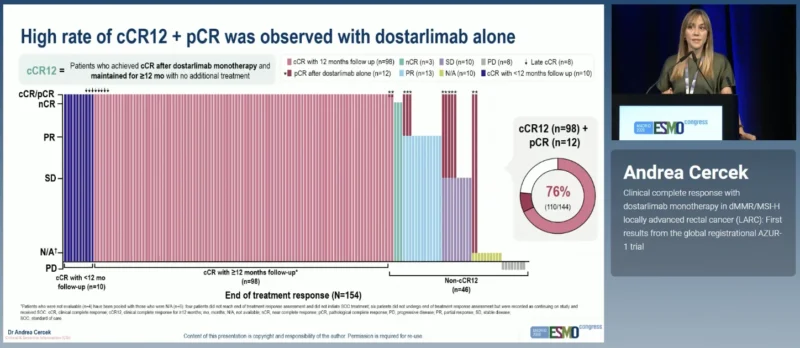
At the April 20, 2026 data cutoff, a total of 154 patients had been enrolled. Median follow-up was 26.3 months (range 2–36). Among the enrolled patients, 144 had at least 12 months of follow-up and were included in the investigator-assessed sustained clinical complete response analysis.
Sustained Clinical Complete Response
Among 144 evaluable patients, 68% achieved a clinical complete response following dostarlimab monotherapy that was maintained for at least 12 months without additional treatment, according to investigator assessment. The analysis also evaluated pathological complete responses among patients who underwent surgery after dostarlimab monotherapy.
Of the 15 patients who underwent surgery following dostarlimab alone, 12 (80%) achieved a pathological complete response. The composite rate of investigator-assessed cCR12 and pathological complete response was 76%. These findings demonstrated sustained clinical responses with dostarlimab monotherapy, while pathological assessment confirmed complete responses in most patients who subsequently underwent surgery.
Independent Central Review
Independent central review identified a lower proportion of patients evaluable for the sustained cCR endpoint, primarily because clinical complete response was confirmed later than the initial end-of-treatment assessment. Among 116 patients evaluable by independent central review, 54 (47%) achieved cCR12.
At the data cutoff, an additional 38 patients were in clinical complete response and undergoing follow-up to determine whether their responses would be sustained for 12 months. The investigators noted that differences in the timing of response confirmation affected the number of patients evaluable for cCR12 by independent central review.
Durability of Response and Disease Outcomes
Among patients who achieved a clinical complete response and had sufficient follow-up to assess 12-month durability, 98% maintained their response for at least 12 months. No disease recurrences had been reported at the data cutoff among patients who achieved a clinical or pathological complete response.
Overall, 93% of patients were undergoing surveillance without evidence of disease progression following dostarlimab, with or without subsequent standard-of-care treatment. Additionally, 71% of patients achieved this outcome with dostarlimab monotherapy alone.
These findings indicated that a substantial proportion of patients remained under surveillance without evidence of progression, including patients who had not required additional standard multimodal treatment.
Safety Outcomes
The investigators reported an acceptable safety profile with dostarlimab monotherapy. Overall, 88% of patients completed all nine planned treatment cycles. Grade 3 or higher immune-mediated adverse events occurred in four patients.
Conclusions
The interim analysis of the global AZUR-1 trial demonstrated sustained clinical complete responses with dostarlimab monotherapy in patients with dMMR/MSI-H locally advanced rectal cancer. Among patients with at least 12 months of follow-up, the investigator-assessed cCR12 rate was 68%, while the composite rate of sustained clinical complete response and pathological complete response was 76%.
Among patients who achieved a clinical complete response, 98% maintained that response for at least 12 months, and no disease recurrences were reported among patients who achieved cCR or pCR at the data cutoff.
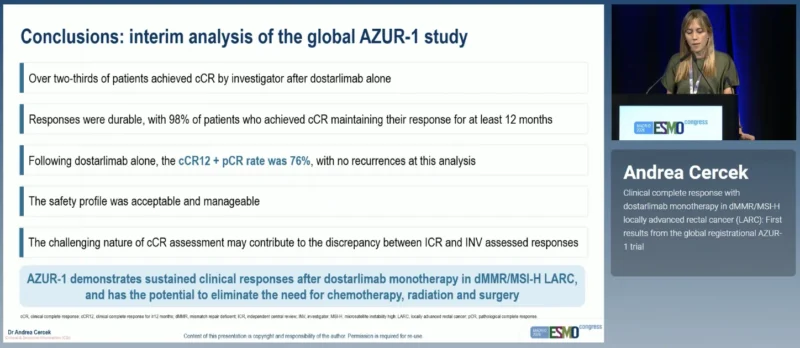
Overall, 93% of patients were undergoing surveillance without evidence of disease progression following dostarlimab with or without subsequent standard-of-care treatment, including 71% who achieved this outcome with dostarlimab alone. The safety profile was reported as acceptable, with Grade 3 or higher immune-mediated adverse events occurring in four patients.
These interim findings support the potential of dostarlimab monotherapy to reduce the need for chemotherapy, radiation, and surgery in patients with dMMR/MSI-H locally advanced rectal cancer. However, the single-arm design and ongoing follow-up should be considered when interpreting the durability of responses and the potential for replacing standard multimodal treatment.