Gustavo Viani, Professor at Faculty of Medicine of Botucatu, São Paulo State University (UNESP), shared on LinkedIn:
“ESMO 2026 | Radiation Oncology Highlights
Five trials. Five clinical questions. Are we getting closer to truly individualized cancer treatment?
Several important studies presented at ESMO 2026 illustrate how radiation oncology is evolving, not only through new radiation techniques, but also through systemic intensification, local consolidation, and response-adapted treatment.
DASL-HiCaP | Prostate cancer
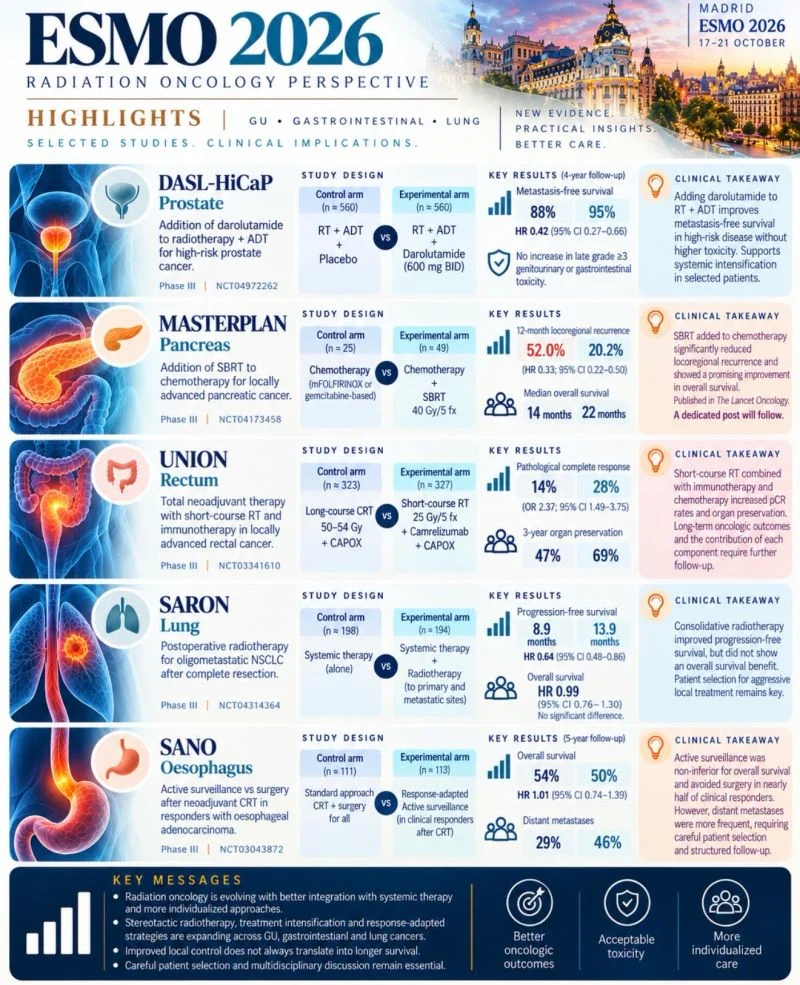
Adding darolutamide to RT + ADT improved 4-year metastasis-free survival from 88% to 95% (HR 0.42).
Clinical implication: Systemic intensification may improve outcomes in high-risk disease. Patient selection and long-term safety remain essential.
Read More about DASL-HiCaP Trial
MASTERPLAN | Pancreatic cancer
Adding SBRT to chemotherapy reduced 12-month locoregional recurrence from 52.0% to 20.2%.
Published simultaneously in The Lancet Oncology, this randomized phase II trial provides encouraging evidence for SBRT in high-risk localized pancreatic cancer.
Clinical implication: Local treatment may meaningfully influence disease control, but larger confirmatory trials are needed.
A dedicated analysis of MASTERPLAN is coming next.
Read More about AGITG MASTERPLAN Trial
UNION | Rectal cancer
Short-course RT combined with immunotherapy and chemotherapy was compared with long-course chemoradiotherapy followed by chemotherapy.
Earlier randomized results showed higher pathological complete response rates with the experimental strategy.
Clinical implication: Treatment intensification may improve tumor response, but long-term oncologic outcomes and the contribution of each treatment component remain critical.
SARON | Oligometastatic NSCLC
Consolidative radiotherapy improved progression-free survival (13.9 vs 8.9 months; HR 0.64) but did not demonstrate an overall survival benefit (HR 0.99).
Clinical implication: Better local control does not necessarily translate into longer survival. Appropriate selection for aggressive local treatment remains a central question.
SANO | Esophageal cancer
At five years, overall survival was 50% with active surveillance versus 54% with standard surgery after a clinical complete response to neoadjuvant chemoradiotherapy.
However, distant metastases were more frequent with surveillance.
Clinical implication: Organ preservation is attractive, but avoiding surgery requires careful patient counseling and structured follow-up.
My perspective․
These studies reinforce three important principles:
- More intensive treatment is not always better for every patient.
- Improved local control does not automatically translate into improved overall survival.
- Treatment de-escalation requires evidence that oncologic safety is preserved.
The next frontier in radiation oncology is not simply delivering more or less radiation, it is identifying the right treatment strategy for the right patient.”
You can also read: SARON: Consolidation Radiotherapy Improves PFS but Not Overall Survival in Oligometastatic NSCLC