Results from the phase III DASL-HiCaP trial (ANZUP1801), presented by Tamim Niazi at ESMO 2026 (Late-Breaking Abstract LBA4), showed that adding darolutamide to androgen deprivation therapy (ADT) and radiotherapy significantly improved metastasis-free survival in patients with very high-risk localized or biochemically persistent or recurrent prostate cancer following radical prostatectomy.
At four years, metastasis-free survival reached 95% with darolutamide compared with 88% with placebo, corresponding to a 58% relative reduction in the hazard of metastasis or death.
The findings provide important evidence supporting treatment intensification with androgen receptor inhibition in patients with very high-risk prostate cancer receiving definitive or postoperative radiotherapy.
Background
Patients with very high-risk localized prostate cancer remain at substantial risk of disease recurrence and distant metastases despite treatment with radiotherapy and long-term ADT.
Similarly, patients with persistent or recurrent prostate-specific antigen (PSA) following radical prostatectomy may require additional treatment to reduce the risk of disease progression.
Darolutamide is a potent androgen receptor inhibitor that has demonstrated clinical activity in advanced prostate cancer. However, its benefit when added to long-term ADT and locoregional radiotherapy in very high-risk localized or early recurrent disease required evaluation.
The DASL-HiCaP trial investigated whether this combination could improve metastasis-free survival compared with ADT and radiotherapy alone.
Study Design and Patient Population
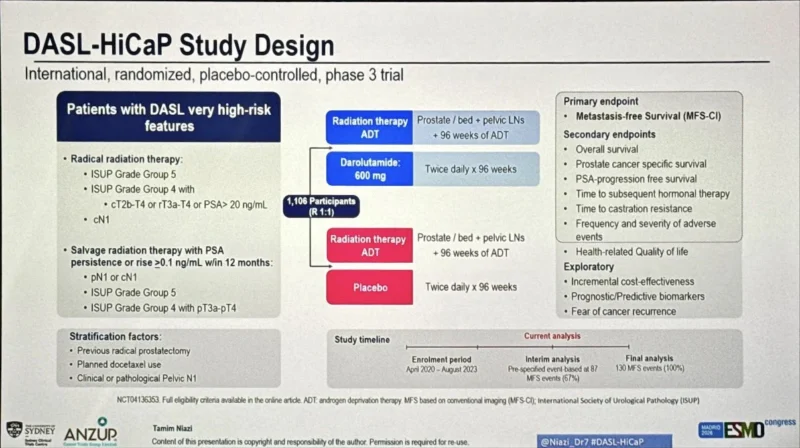
DASL-HiCaP (ANZUP1801) was an international, randomized, double-blind, placebo-controlled phase III trial.
Between April 2020 and August 2023, 1,106 patients were randomized 1:1 to receive:
- Darolutamide plus ADT and radiotherapy: 553 patients.
- Placebo plus ADT and radiotherapy: 553 patients.
All participants received an LHRH analogue for 96 weeks alongside radiotherapy to the prostate or prostate bed and pelvic lymph nodes. The experimental group received darolutamide 600 mg twice daily for 96 weeks, while the control group received a matching placebo. Eligible patients had very high-risk localized prostate cancer or biochemically persistent or recurrent disease within one year following radical prostatectomy.
The median age was 71 years. Approximately 29% had pelvic nodal involvement on CT, 73% had Gleason scores of 9–10, and 15% had previously undergone radical prostatectomy.
The primary endpoint was metastasis-free survival assessed using conventional imaging, including CT and/or technetium bone scans. Secondary endpoints included PSA progression-free survival, prostate cancer-specific survival, overall survival, and safety.
Metastasis-Free Survival Results
At a median follow-up of 3.8 years, adding darolutamide significantly improved metastasis-free survival. Four-year metastasis-free survival was 95% with darolutamide compared with 88% with placebo. Metastasis-free survival events occurred in 27 patients receiving darolutamide versus 63 patients receiving placebo.
The hazard ratio was 0.42 (95% CI, 0.27–0.66; P=0.0001), representing a 58% relative reduction in the hazard of metastasis or death. The results crossed the prespecified statistical threshold for the interim analysis, demonstrating a significant benefit from adding darolutamide to standard ADT and radiotherapy.
PSA Progression-Free Survival
The addition of darolutamide also significantly improved PSA progression-free survival.
At four years, 91% of patients receiving darolutamide remained free from PSA progression compared with 83% in the placebo group.
PSA progression-free survival events occurred in:
- 46 patients receiving darolutamide.
- 95 patients receiving placebo.
The hazard ratio was 0.47 (95% CI, 0.33–0.67).
These findings indicate that more intensive androgen receptor inhibition improved biochemical disease control alongside the observed benefit in metastasis-free survival.
Overall and Prostate Cancer-Specific Survival
At the time of the interim analysis, overall survival and prostate cancer-specific survival remained high in both treatment groups.
Four-year overall survival was 97% with darolutamide versus 95% with placebo, with a hazard ratio of 0.88 (95% CI, 0.49–1.59). Prostate cancer-specific survival was approximately 99% in both groups, with a hazard ratio of 0.58 (95% CI, 0.17–1.97).
Neither outcome demonstrated a clear survival advantage at the current follow-up. However, relatively few deaths had occurred, and longer follow-up is necessary to determine whether the metastasis-free survival benefit translates into improved overall survival.
Safety Findings
The addition of darolutamide was associated with a higher overall incidence of severe adverse events.
Grade 3 or higher adverse events occurred in 43% of patients receiving darolutamide compared with 36% receiving placebo.
For selected adverse events of special interest, grade 2 or higher rates were:
- Fatigue or asthenia: 14% with darolutamide versus 10% with placebo.
- Hypertension: 7% versus 9%.
- Fractures: 2% versus 3%.
- Cardiac adverse events: 3% in both groups.
These findings suggest that treatment intensification with darolutamide increased the overall severe adverse event burden, while several adverse event categories of particular interest remained comparable between arms.
Clinical Implications
The DASL-HiCaP trial provides important phase III evidence supporting the addition of darolutamide to long-term ADT and radiotherapy for patients with very high-risk localized prostate cancer or early biochemical persistence or recurrence after prostatectomy.
The improvement in four-year metastasis-free survival from 88% to 95% is clinically relevant, particularly in a population characterized by aggressive disease features, including a high prevalence of Gleason 9–10 tumors.
Metastasis-free survival is an established surrogate endpoint for overall survival in localized prostate cancer, although continued follow-up of this trial is needed to determine whether the observed benefit translates into longer survival.
Treatment decisions will also need to consider the increased frequency of severe adverse events, patient comorbidities, and the potential benefits of more intensive androgen receptor inhibition.
The findings may influence future treatment recommendations for patients receiving radiotherapy and long-term ADT in this high-risk setting.
Conclusion
The phase III DASL-HiCaP trial demonstrated a significant improvement in metastasis-free survival with the addition of darolutamide to ADT and radiotherapy in patients with very high-risk localized or biochemically persistent or recurrent prostate cancer.
At four years, metastasis-free survival was 95% with darolutamide versus 88% with placebo, with a hazard ratio of 0.42.
PSA progression-free survival also improved, while overall survival data remain immature. These results establish a promising treatment-intensification strategy, with longer follow-up required to confirm its impact on overall survival and fully characterize long-term tolerability.