Long-term results from the SANO trial, presented at ESMO 2026 (LBA78), suggest that active surveillance remains a feasible alternative to immediate surgery for selected patients with locally advanced esophageal cancer who achieve a complete clinical response after neoadjuvant chemoradiotherapy.
The findings show similar five-year overall survival between active surveillance and standard surgery, although distant metastases were significantly more frequent among patients managed without immediate surgery.
Background
The Surgery As Needed for Esophageal Cancer (SANO) trial previously demonstrated that active surveillance was non-inferior to standard surgery in terms of two-year overall survival among patients achieving a complete clinical response after neoadjuvant chemoradiotherapy. Active surveillance was also associated with improved quality of life, supporting further investigation of organ preservation in esophageal cancer.
The latest analysis evaluated whether these outcomes were maintained over five years.
Study Design and Patient Population
SANO was a multicenter, stepped-wedge cluster-randomized controlled trial conducted between 2017 and 2021. The study included 309 patients with locally advanced esophageal cancer who achieved a complete clinical response following neoadjuvant chemoradiotherapy.
Complete clinical response was defined as no detectable tumor on endoscopic biopsies, endoscopic ultrasound, or PET-CT. Of the enrolled patients, 198 underwent active surveillance, while 111 received standard surgery.
Researchers evaluated five-year overall survival, disease-free survival, and the cumulative incidence of distant metastases. Median follow-up was 76 months.
Five-Year Survival Outcomes
At five years, overall survival was 50% in the active surveillance group compared with 54% in the standard surgery group.
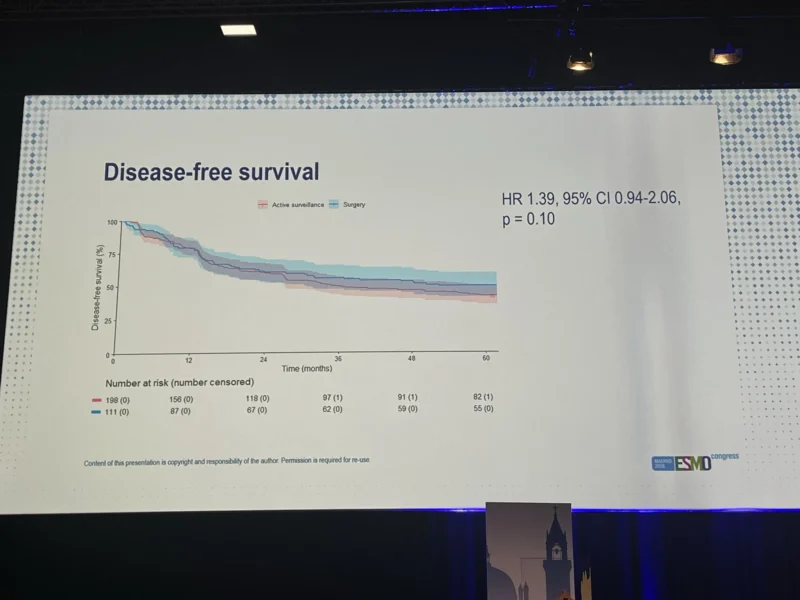
The difference was not statistically significant (HR 1.17; 95% CI 0.77–1.77), with similar findings across histological subtypes. Disease-free survival was also not statistically significantly different between groups (HR 1.39; 95% CI 0.94–2.06).
These results suggest that the survival outcomes observed in the initial SANO analysis were maintained during longer follow-up.
Distant Metastases and Organ Preservation
Despite similar overall survival, a significant difference was observed in the development of distant metastases. At five years, the cumulative incidence of distant metastases was 46% with active surveillance versus 29% with standard surgery (P<0.01).
This finding raises important questions about long-term disease control among patients managed without immediate esophagectomy. At the same time, active surveillance allowed a substantial proportion of patients to avoid surgery.
Overall, 85 of 198 patients (43%) avoided an esophagectomy considered non-beneficial. This included patients who maintained a complete clinical response through their last follow-up and those who developed distant metastases within six months after neoadjuvant chemoradiotherapy.
Clinical Implications
The five-year SANO results provide further evidence supporting active surveillance as a treatment option for selected patients with esophageal cancer who achieve a complete clinical response after neoadjuvant chemoradiotherapy. Avoiding immediate esophagectomy may spare patients the morbidity associated with major surgery and preserve quality of life. However, the higher incidence of distant metastases in the active surveillance group remains an important concern.
The findings emphasize the need for careful patient selection, accurate response assessment, multidisciplinary decision-making, and structured surveillance.
Importantly, the absence of a statistically significant survival difference does not establish that the two strategies are equivalent across all long-term outcomes.
Conclusion
The long-term SANO trial results demonstrate no statistically significant difference in five-year overall survival between active surveillance and standard surgery among patients with esophageal cancer who achieved a complete clinical response after neoadjuvant chemoradiotherapy.
While active surveillance allowed 43% of patients to avoid non-beneficial esophagectomy, distant metastases were significantly more frequent than with standard surgery.
These findings support active surveillance as a feasible organ-preservation strategy for appropriately selected patients while highlighting the importance of longer-term disease monitoring and further investigation of distant recurrence risk.