
On November 16, 2026, the FDA approved Wilserdly (giredestrant) plus everolimus for adults with ER-positive, HER2-negative, ESR1-mutated locally advanced or metastatic breast cancer following prior endocrine-based therapy.
Supported by results from the Phase III evERA trial, the approval has sparked active discussion among oncologists on social media—highlighting the progression-free survival gains, the FDA’s decision to restrict the label to ESR1-mutated disease, and how the combination fits into treatment sequencing after CDK4/6 inhibitors.
“Roche receives FDA approval for Wilserdly™ (Giredestrant): Next-Generation Oral SERD for ESR1-Mutated Advanced Breast Cancer.
⠀
Wilserdly plus everolimus is approved for previously endocrine-treated adults with ER-positive, HER2-negative, ESR1-mutated advanced breast cancer.
⠀
1. Compelling Phase 3 Clinical Evidence
⠀
evERA, published in The New England Journal of Medicine, demonstrated:
- 62% reduction in progression or death risk versus standard endocrine therapy plus everolimus.
- PFS HR: 0.38 (95% CI: 0.27–0.54; p<0.0001).
2. Dual-Pathway Therapeutic Strategy
- Giredestrant: oral selective estrogen receptor degrader (SERD).
- Everolimus: mTOR inhibitor.
- Combined targeting of ER signaling and PI3K/AKT/mTOR-mediated resistance.
⠀
3. Expanding Clinical Opportunities
⠀
ESR1 mutations affect up to 40% of HR-positive metastatic breast cancer patients. Adjuvant indication remains under FDA Priority Review, with a November 30, 2026 decision expected.
Leadership Perspective
⠀
Levi Garraway, CMO and Head of Global Product Development, and Teresa Harris Graham, CEO of Roche Pharmaceuticals, highlighted targeted oral therapy and expanded clinical opportunities.
My Takeaway
⠀
This approval reinforces the integration of precision oncology and molecular diagnostics. ESR1 mutation testing using FDA-authorized assays is essential for treatment selection, with longitudinal ctDNA profiling offering further potential.”
“We have a new FDA-approved oral SERD combo for HR+ mBC!
In evERA, led by Erica Mayer, giredestrant (vs SoC ET) + everolimus nearly doubled PFS (10 vs 5.5 mo) and ORR (27% vs 14%) in patients with ESR1 mutations. Another important option for our patients!”
“FDA approval: giredestrant + everolimus for ESR1-mutated, ER+/HER2- advanced breast cancer (Nov 16, 2026). For a few years, endocrine therapy after CDK4/6 inhibitors felt like a field out of business. Today you can’t blink without missing an approval. This is the 5th new option for HR+/HER2- metastatic disease in 2026.
The data (evERA, phase 3, n=373, post-CDK4/6i)
- Giredestrant + everolimus vs standard ET + everolimus
- ESR1m: mPFS 10 vs 5.5 months, HR 0.38
- ORR 27% vs 14%
- ITT: HR 0.56
- First all-oral SERD combination to beat an active everolimus-based control
The ins and outs
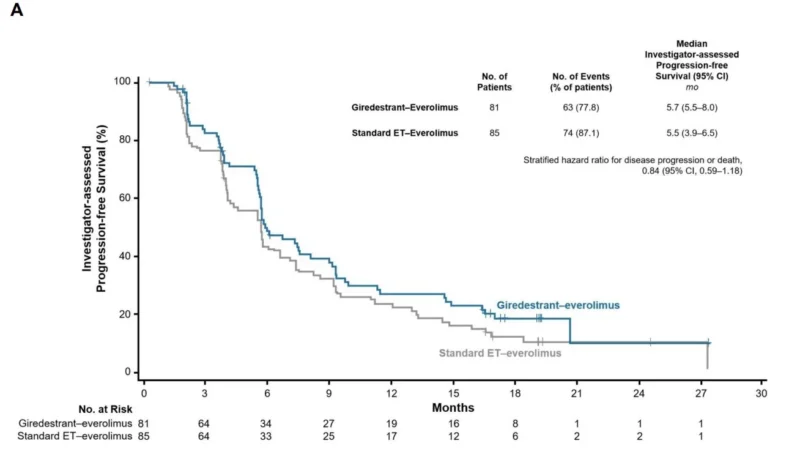
- Label is ESR1m only. In ESR1 wild-type the exploratory HR was 0.84, no clear benefit.
- ESR1m is not the drug’s target. ER is. ESR1m is our best current surrogate for a tumor that is still ER-dependent after an AI.
- Benefit held with PIK3CA co-mutation and after short (<12 mo) prior CDK4/6i, where SERD monotherapy struggles.
Caveats
- OS immature
- No head-to-head data between oral SERDs
- Everolimus toxicity is real: stomatitis, rash, pneumonitis. Dexamethasone mouthwash from day 1.
- Bradycardia warning on the label
- Almost no data on one oral SERD after another
How I see the algorithm, HR+/HER2- MBC
First line
- Endocrine-sensitive: AI + CDK4/6i. ESR1m emerging on ctDNA? Option to switch to camizestrant + same CDK4/6i (SERENA-6)
- Endocrine-resistant + PIK3CAm: inavolisib + palbociclib + fulvestrant (INAVO120)
At progression: liquid biopsy. Every time. ESR1 is acquired, archival tissue will miss it.
Second line
- ESR1m: giredestrant + everolimus 🆕 | imlunestrant + abemaciclib | monotherapy elacestrant, imlunestrant or vepdegestrant
- ESR1 wild-type + PIK3CA/AKT1/PTEN altered: capivasertib + fulvestrant
- PIK3CA wild-type: gedatolisib + fulvestrant ± palbociclib
- gBRCA: PARP inhibitor
Endocrine-refractory: ADCs, then chemotherapy
What’s next
The bigger question is early-stage disease. Adjuvant giredestrant (lidERA, iDFS HR 0.70) has an FDA decision date of November 30. Potentially the first new adjuvant endocrine therapy in 20+ years.
More options is a good problem. The hard part now is sequencing, and the trials did not answer it for us. How are you sequencing oral SERDs in your practice?”
“FDA approves giredestrant + everolimus for ER+/HER2- MBC. As I expected, the FDA approved it only for ESR1-mutant tumors (evERA: PFS 10.0 vs 5.5 mo, HR 0.38).
For non-mutated tumors after CDK4/6i, options remain extremely limited, making the gedatolisib approval (VIKTORIA-1) in that population critical.”
“The evERA study/giredestrant approval is interesting because the FDA did not approve the drug for the whole study population.
The evERA trial accrued for tumors w/w/o ESR1 mutations. The overall result was positive. But study was designed to focus on ESR1 mutated tumors, and there was no/minimal benefit in ESR1 wildtype cohort.
So FDA only granted approval into the already-crowded space of 2nd line ET for ESR1 mutated tumors. Here are data from NEJM Supplemental appendix for the ESR1 wt subset (below).”
“Good morning everyone! A 62% reduction in the risk of disease progression or death is a significant result for patients with treatment resistant breast cancer.
Genentech has received FDA approval for WILSERDLY (giredestrant), a next generation oral estrogen receptor degrader for adults with ESR1 mutated, ER positive, HER2 negative advanced breast cancer. In the phase III evERA trial, WILSERDLY plus everolimus significantly outperformed standard endocrine therapy plus everolimus in patients whose disease had progressed following prior treatment, including CDK4/6 inhibitors (HR 0.38, p<0.0001).
The science is what makes this approach particularly interesting. ESR1 mutations can allow cancer cells to continue relying on estrogen signaling even after traditional hormone therapies stop working. Rather than simply blocking the receptor, giredestrant binds to it and triggers its degradation, effectively removing a key driver of tumor growth. Everolimus adds a second mechanism by inhibiting the mTOR pathway, which can also contribute to treatment resistance.
For patients, the potential impact is meaningful: longer disease control, more time before the next treatment becomes necessary and the possibility of delaying more intensive therapies. Importantly, both medicines are taken orally, allowing patients to receive treatment at home. This approval is another important step toward overcoming acquired resistance through precision medicine. With a separate FDA decision on WILSERDLY for early-stage breast cancer expected by November 30, its potential role could extend beyond advanced disease.”
“FDA Approves Giredestrant + Everolimus for ESR1-Mutated, ER+/HER2− Advanced Breast Cancer:
evERA Shows a 62% Reduction in the Risk of Progression or Death (HR 0.38), While OS Benefit Is Not Yet Established.”
“On November 16, 2026, the FDA approved Wilserdly (giredestrant), an oral estrogen receptor antagonist, in combination with everolimus for the treatment of patients with estrogen receptor (ER)-positive, human epidermal growth factor receptor 2 (HER2)-negative, estrogen receptor 1 (ESR1)-mutated locally advanced or metastatic breast cancer, whose disease has recurred during or after completion of endocrine-based adjuvant therapy, or has progressed on at least one endocrine-based regimen in the metastatic setting.
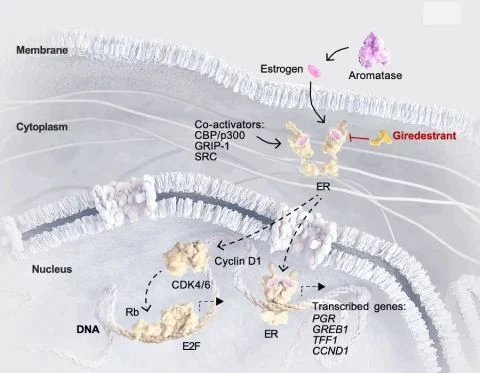
Giredestrant is an orally bioavailable selective estrogen receptor degrader (SERD) and full antagonist primarily developed for hormone receptor-positive (HR+), HER2-negative (HER2–) breast cancer.
It binds with high potency directly to the ligand-binding domain (LBD) of both wild-type and mutant estrogen receptor-alpha (ERα), competing with estradiol to block the hormone from activating the receptor.
Binding induces an inactive conformation in the receptor LBD, shifting helix 12 position to disfavor co-activator recruitment, promote corepressor engagement, and effectively immobilize the ER. This halts ER-dependent gene transcription and cellular proliferation.
Beyond blocking activity, giredestrant triggers proteasome-mediated degradation, actively lowering the total cellular levels of the ER protein.
Giredestrant retains potency against mutant forms of the receptor (such as ESR1mutations) that frequently drive resistance to traditional endocrine therapies like aromatase inhibitors. The recommended giredestrant dose is 30 mg taken orally once daily with or without food until disease progression or unacceptable toxicity.
Everolimus is a targeted therapy that acts as an mTOR (mammalian target of rapamycin) inhibitor, specifically targeting mTORC1. It binds to an intracellular protein called FKBP-12, forming a drug-protein complex that directly inhibits the activity of the mTOR kinase.
By inhibiting mTORC1, everolimus blocks downstream effectors (such as S6K1 and 4E-BP1) that regulate cell protein synthesis, cycle progression, cell growth, and metabolism. This inhibition halts the transition of cancer cells from the G1 phase into the S phase, leading to cell growth arrest and programmed cell death (apoptosis).
Everolimus decreases the expression of hypoxia-inducible factor (HIF-1) and vascular endothelial growth factor (VEGF), which starves tumors by blocking the formation of new blood vessels (angiogenesis) needed for growth.
In hormone receptor–positive (HR⁺), HER2⁻ breast cancer, chronic activation of the PI3K/AKT/mTOR signaling pathway is a primary driver of resistance to standard endocrine therapies (such as aromatase inhibitors). By combining everolimus with an endocrine partner like exemestane, the drug blocks this escape pathway and restores hormone sensitivity.”
“Based on evERA trial, Giredestrant (oral SERD) + everolimus is now FDA for HR+ mESR1 breast cancer HR+ after CDK4/6i + ET:
- high PFS2: 19.02mos vs. 13.7mos (HR: 0.69)
- Improved chemo-free survival: 11.1mos vs. 7.9 mos (HR: 0.61)
- More options in mESR1.”
“On 16 November, the FDA approved giredestrant + everolimus for ESR1-mutated, ER+/HER2− advanced or metastatic breast cancer following endocrine therapy.
The phase III evERA trial adds another option after CDK4/6 inhibitors, but raises important questions about biomarker selection and sequencing.
Trial Design
373 patients with progression or recurrence following CDK4/6 inhibitor + endocrine therapy were randomised to giredestrant + everolimus or investigator’s choice endocrine therapy (exemestane, fulvestrant or tamoxifen) + everolimus.
Efficacy
ESR1-mutated population (n=207):
- Median PFS: 10.0 vs 5.5 months
- HR 0.38 (95% CI 0.27–0.54)
- ORR: 27% vs 14%
Overall population (n=373):
- Median PFS: 8.8 vs 5.5 months
- HR 0.56 (95% CI 0.44–0.71)
PFS improved significantly in both populations, with a larger relative benefit in ESR1-mutated disease. Overall survival remains immature.
Safety
Any-grade stomatitis occurred in 47.3% vs 48.9%; grade ≥3 in 2.7% vs 3.2%. Yet stomatitis-related everolimus dose reductions were more frequent with giredestrant (6.0% vs 2.7%).
Because both arms received everolimus, this suggests that a newer oral SERD does not remove the toxicity burden of mTOR inhibition.
My Clinical Reflections
- Why restrict approval to ESR1-mutated disease?
Despite statistically significant PFS improvement in the overall population, FDA approval was restricted to ESR1-mutated disease, where the relative benefit was substantially greater.
This raises an important question about interpreting biomarker-defined treatment effects when the broader trial population also demonstrates benefit. The magnitude of benefit matters, but so does understanding who benefits.
2. Where does it fit in sequencing?
After CDK4/6 inhibitors, we now have oral SERDs and PI3K/AKT/mTOR-targeted strategies. ESR1, PIK3CA, AKT1 and PTEN status, prior treatment, tolerability and patient preference all matter. Without head-to-head trials, the optimal sequence remains unclear.
3. What is still missing?
Mature OS, quality-of-life outcomes and comparative evidence against oral SERD monotherapy. Does the PFS gain translate into outcomes patients can feel, including longer time before chemotherapy?
My Take
evERA supports dual ER antagonism/degradation and mTOR inhibition, particularly in ESR1-mutated disease. However, adding another effective regimen does not automatically solve the sequencing challenge.
The next frontier is not simply developing more treatments. It is generating the comparative evidence to select the right treatment for the right patient at the right time.”
“Today FDA approved giredestrant in combination with everolimus for adults with ER+/HER-/ESR1 mutated Metastatic Breast Cancer after prior endocrine therapy in adjuvant or advanced setting.”
“FDA approved today Giredestrant plus everolimus for ESR1-mutated ER+/HER2- MBC. evERA: PFS 10.0 vs 5.5 months, HR 0.38. ESR1m MBC now, simplified:
- On 1L AI + CDK4/6, ESR1 emerges on ctDNA – camizestrant switch
- Progression, after long CDK4/6 benefit – SERD alone
- Progression, after shorter benefit or more disease – giredestrant + everolimus
- PIK3CA/AKT1/PTEN altered, ESR1 wild type – capivasertib + fulvestrant Visceral crisis – ADC or chemo.
The catch: each drug is tied to a different ctDNA assay. FoundationOne Liquid CDx for giredestrant. Guardant360 CDx for elacestrant and camizestrant. The first test you order can decide what your patient gets. Retest ctDNA at every progression.”
“Another major breast cancer FDA approval – Giredestrant + Everolimus enters the ESR1-mutated metastatic breast cancer treatment landscape! What an exciting year 2026 has been for breast oncology!
The FDA approval is based on the phase III evERA trial in ER+/HER2− advanced breast cancer.
Median PFS:
- ESR1-mutated: 10.0 vs. 5.5 months (HR 0.38)
- ITT: 8.8 vs. 5.5 months (HR 0.56)
Despite positive results in both populations, approval is restricted to ESR1-mutated disease and those with ESR1wt did not benefit and ESR1-mutated most likely driving benefit in ITT.
My question: What is your preferred combination in ESR1-mutated disease – imlunestrant + abemaciclib or giredestrant + everolimus?
My take
I’ve been using imlunestrant + abemaciclib fairly readily this year and have become increasingly comfortable with the combination. Everolimus/giredestrant achieved an impressive HR of 0.38 against an active combination vs EMBER3 tested combo against oral SERD and in some subgroup analyses did show activity in genomic subgroups such as RB1 and TP53.
As a relatively young(er) oncologist, prescribing everolimus is a newer experience for me, and managing toxicities, particularly stomatitis, can be challenging despite using dexamethasone mouth wash and experience from the SWISH trial. However, giredestrant itself appears well tolerated, and I’m interested in incorporating this combination for patients in whom I feel CDK4/6 inhibitor recycling isn’t the answer in settings of things such as TP53 and RB1.
And 2026 may not be done yet, with the FDA decision on adjuvant giredestrant (lidERA) expected by November 30!”
“Exciting news in breast oncology! FDA approves giredestrant + everolimus for ESR1-mutated, ER+/HER2− advanced breast cancer. The phase III evERA trial showed impressive PFS improvement: 10 vs 5.5 months (HR 0.38).”
“The FDA approved Roche’s oral SERD giredestrant, but first in the established second-line setting for ESR1-mutated, advanced HR+/HER2- breast cancer, where two competitors are already on the market. Despite a closer PDUFA date, the FDA has not ruled on the more-important adjuvant indication.
Following this approval, Roche CFO Alan Hippe told Jefferies that management sees no issue with getting the advanced cancer approval first.
In Europe,
‘EMA has encouraged Roche to submit the most comprehensive dataset possible, incl OS, which the company is confident it will have by mid-2027,’
Jefferies summarized from the CFO’s comments. So much about people pegging this delay as a poster child of MFN out of pure speculation despite it being a regulatory/scientific question.”
“The FDA has approved giredestrant in combination with everolimus for patients with ER-positive, HER2-negative, ESR1-mutated advanced breast cancer, based on the results of the Phase III evERA Breast Cancer trial.
I’m genuinely happy and proud to have been part of this journey as a Sub-Investigator, contributing alongside a dedicated team of professionals to a clinical trial that may translate into a new treatment option for patients.
Clinical research is a collective effort, and moments like this remind us why the work we do matters. Congratulations and thank you to everyone involved in making this achievement possible!”
“Encouraging news from Roche/Genentech, with FDA approval of giredestrant plus everolimus for certain patients with ESR1-mutated advanced breast cancer.
In the pivotal trial, the combination reduced the risk of disease progression or death by 62% compared with standard hormone therapy plus everolimus, extending median progression-free survival from 5.5 to 10 months.
A meaningful new option for patients whose cancer has progressed despite earlier hormone treatment.”
“Great news! FDA approves giredestrant + everolimus for ESR1-mutated ER+/HER2− aBC.
Watch out for everolimus-related stomatitis! Don’t forget dexamethasone mouthwash. Perhaps 7.5 mg of everolimus would be a better option, as in ELEVATE and ADALE…”
“evERA: A Positive Trial, but a Restricted FDA Approval!
Why did the FDA approve giredestrant + everolimus only for ESR1-mutated breast cancer?
- evERA Phase III (n=373): Giredestrant + everolimus vs standard endocrine therapy + everolimus in ER+/HER2− advanced breast cancer.
- Overall population: PFS 8.8 vs 5.5 months (HR 0.56).
- ESR1-mutated: PFS 10 vs 5.5 months (HR 0.38) — 62% reduction in progression/death hazard.
- ESR1-wild-type: HR 0.84 — no convincing benefit demonstrated.
- FDA | Nov 16, 2026: Approval restricted to ESR1-mutated disease after prior endocrine therapy.
Take-home: A positive overall trial doesn’t necessarily mean an all-comer approval. Biomarker selection matters!”
Continue exploring: