
Endocrine resistance after CDK4/6 inhibitor therapy remains one of the central treatment challenges in ER-positive/HER2-negative advanced breast cancer. Although several molecularly selected strategies have entered this setting, the optimal approach after progression depends increasingly on the biology driving resistance.
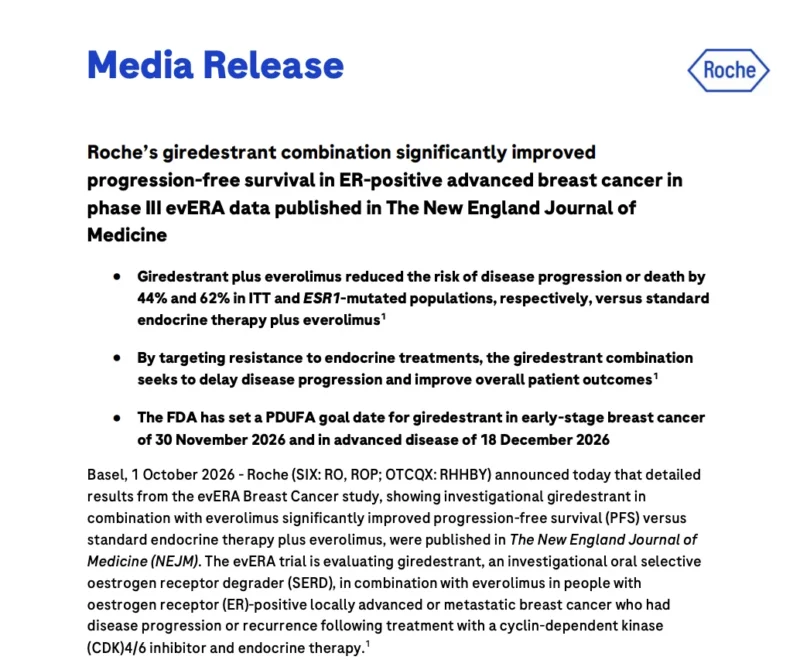
The phase III evERA Breast Cancer study provides important evidence for combining the next-generation oral SERD giredestrant with the mTOR inhibitor everolimus. Detailed results, now reported in The New England Journal of Medicine, showed a statistically significant progression-free survival advantage over standard endocrine therapy plus everolimus in both the intention-to-treat population and the prespecified ESR1-mutated population (Mayer et al., 2026).
The benefit was particularly pronounced in tumors harboring ESR1 mutations, reinforcing a broader evolution in HR-positive breast cancer: treatment after CDK4/6 inhibition is moving away from empiric endocrine sequencing and toward mechanism-informed selection according to acquired resistance biology.
evERA Targets Two Major Routes of Endocrine Resistance
Giredestrant is an investigational oral selective estrogen receptor degrader and full antagonist designed to block estrogen receptor signaling while promoting receptor degradation. Everolimus inhibits mTOR, addressing a separate signaling pathway frequently implicated in endocrine resistance. The rationale for evERA is therefore biologically complementary.
One component seeks to restore more effective suppression of ER signaling, while the other targets downstream pathway activation that can allow tumor cells to escape endocrine dependence. The phase III trial enrolled patients with ER-positive/HER2-negative locally advanced or metastatic breast cancer whose disease had progressed or recurred after prior treatment with a CDK4/6 inhibitor and endocrine therapy (Mayer et al., 2026).
Patients were randomized to giredestrant plus everolimus or standard endocrine therapy plus everolimus. The co-primary endpoints were investigator-assessed PFS in the overall intention-to-treat population and in patients with ESR1-mutated tumors.
PFS Improved Across the Overall Population
In the intention-to-treat population, median progression-free survival was:
- 8.8 months with giredestrant + everolimus
versus
- 5.5 months with standard endocrine therapy + everolimus.
The hazard ratio was:
- HR 0.56; 95% CI, 0.44–0.71; P<0.001 (Mayer et al., 2026).
This corresponds to a 44% reduction in the risk of disease progression or death.
The finding is clinically relevant because both treatment groups received everolimus. The benefit therefore isolates the contribution of replacing conventional endocrine therapy with a more potent next-generation ER-directed agent rather than simply demonstrating the known activity of mTOR inhibition.
ESR1-Mutated Disease Showed the Largest Benefit
The strongest signal emerged in the prespecified ESR1-mutated population.
Median PFS was:
- 10.0 months with giredestrant + everolimus
versus
- 5.5 months with the comparator.
The hazard ratio was:
- HR 0.38; 95% CI, 0.27–0.54; P<0.001 (Mayer et al., 2026).
This represents a 62% reduction in the risk of progression or death. The magnitude of effect is biologically coherent. ESR1 mutations commonly emerge under the selective pressure of aromatase inhibitor therapy and can produce ligand-independent activation of the estrogen receptor, reducing sensitivity to conventional endocrine therapy.
The source notes that up to 40% of patients with ER-positive disease after CDK4/6 inhibitor treatment may harbor ESR1 mutations, making this a clinically substantial subgroup rather than a rare molecular niche. The evERA results therefore reinforce ESR1 testing as potentially more than prognostic characterization, it may increasingly influence therapeutic selection.
The Benefit Extends Beyond ESR1-Mutated Disease
Although the relative treatment effect was strongest in ESR1-mutant tumors, the overall ITT population also experienced a clear PFS improvement. This matters because endocrine resistance in HR-positive breast cancer is heterogeneous. Not every progressing tumor will harbor an ESR1 alteration, and resistance may arise through PI3K–AKT–mTOR activation, loss of ER dependence, cell-cycle adaptation, or multiple coexisting mechanisms.
The positive ITT result suggests that replacing conventional endocrine therapy with a more potent ER degrader may remain useful beyond a strictly ESR1-mutated population when paired with mTOR inhibition.
However, the regulatory strategy described in the release is more molecularly focused: Roche’s current US application for advanced disease specifically covers ER-positive/HER2-negative, ESR1-mutated locally advanced or metastatic breast cancer in the relevant endocrine-resistant setting.
Overall Survival Is Not Yet Mature
The current dataset should not yet be interpreted as demonstrating an overall survival advantage. At the reported analysis, OS remained immature. Nevertheless, the numerical trends favored giredestrant:
- ITT OS: HR 0.69; 95% CI, 0.47–1.00
and
- ESR1-mutated OS: HR 0.62; 95% CI, 0.38–1.02
These results are encouraging but remain inconclusive. The confidence intervals, particularly in the ESR1-mutant subgroup, include the possibility of no statistically confirmed survival difference. Continued follow-up is therefore essential. For a post-CDK4/6 endocrine strategy to meaningfully influence long-term sequencing, durability of disease control and ultimately overall survival will be important alongside PFS.
Post-Progression Analyses Suggest the Benefit May Extend Beyond First Progression
Another clinically interesting observation comes from previously reported analyses of evERA.
According to the release, additional data presented at the 2026 ASCO Annual Meeting showed improvement in PFS2, the time from randomization to progression following the next line of therapy, as well as chemotherapy-free survival with giredestrant plus everolimus. These endpoints may help address a common concern in metastatic treatment sequencing.
A therapy that merely delays progression but compromises subsequent treatment would have less strategic value than one whose benefit persists across the treatment trajectory. Although these secondary analyses require appropriate caution, they suggest that the evERA strategy may delay both disease progression and transition to chemotherapy.
The Safety Profile Appears Consistent With the Component Drugs
The combination’s safety profile was described as manageable and consistent with the established toxicities of the individual agents. No unexpected safety signals were reported. The release specifically notes no photopsia and low rates of bradycardia, toxicities of interest with some oral SERD development programs (Mayer et al., 2026).
That distinction may become increasingly relevant as multiple oral SERDs compete for positioning across early and metastatic HR-positive breast cancer. Efficacy will remain the primary determinant of treatment selection, but differences in cardiovascular, ocular, gastrointestinal, metabolic, and quality-of-life effects may meaningfully influence long-term use.
evERA Reflects the Changing Post-CDK4/6 Treatment Landscape
The treatment question after progression on first-line endocrine therapy plus a CDK4/6 inhibitor has become considerably more complex. The next decision may now depend on several molecular and clinical factors: ESR1 mutation status, PI3K/AKT pathway alterations, germline or somatic BRCA-associated biology, HER2 expression, prior endocrine sensitivity, tempo of progression, visceral disease burden, and previous targeted therapies.
Within that increasingly segmented landscape, evERA represents a strategy targeting both the estrogen receptor and mTOR pathway simultaneously. Its particularly strong result in ESR1-mutated disease illustrates how molecular resistance mechanisms can help determine which endocrine backbone should accompany pathway inhibition.
This is a meaningful evolution from an era in which fulvestrant or an aromatase inhibitor was often selected largely according to previous exposure.
ESR1 Testing Is Becoming Increasingly Actionable
The clinical significance of ESR1 mutations has changed rapidly. Historically, ESR1 mutations primarily helped explain acquired resistance to aromatase inhibitors. They are increasingly becoming treatment-selection biomarkers. The evERA findings extend that concept into combination therapy after CDK4/6 inhibition.
Rather than asking only whether an oral SERD is more active than conventional endocrine therapy, the more relevant question becomes whether the presence of a specific resistance alteration identifies patients in whom a next-generation ER degrader provides particularly large incremental benefit.
With a hazard ratio of 0.38 in the ESR1-mutated population, evERA provides a strong signal supporting that framework.
Giredestrant Development Extends Beyond Metastatic Disease
evERA is part of a broader phase III giredestrant program. The clinical development strategy includes: lidERA, evaluating adjuvant giredestrant in ER-positive/HER2-negative early breast cancer; persevERA, combining giredestrant with palbociclib in endocrine-sensitive advanced disease; pionERA, evaluating giredestrant plus a CDK4/6 inhibitor in disease resistant to adjuvant endocrine treatment; and heredERA, studying giredestrant with HER2-directed therapy in ER-positive/HER2-positive advanced disease.
The program therefore tests whether more effective ER degradation can improve outcomes across several stages of the disease continuum rather than only in a late endocrine-resistant setting.
Regulatory Decisions Are Approaching
The evERA results have already entered regulatory review. The FDA has accepted the application for giredestrant plus everolimus in ER-positive/HER2-negative, ESR1-mutated locally advanced or metastatic breast cancer after relevant endocrine therapy.
The reported PDUFA goal date is: December 18, 2026.
Separately, giredestrant is under Priority Review in early-stage ER-positive/HER2-negative breast cancer based on lidERA, with a PDUFA date of November 30, 2026. These are regulatory reviews rather than approvals. Giredestrant therefore remains investigational in the settings described at the time of this report.
The Bottom Line
The phase III evERA Breast Cancer results establish giredestrant plus everolimus as a highly active endocrine-based strategy after progression on CDK4/6 inhibitor therapy. In the overall population:
- Median PFS: 8.8 vs 5.5 months
- HR 0.56 — 44% lower risk of progression or death
In patients with ESR1-mutated disease:
- Median PFS: 10.0 vs 5.5 months
- HR 0.38 — 62% lower risk of progression or death
Overall survival remains immature, and longer follow-up will determine whether the substantial PFS advantage ultimately translates into a survival benefit. For now, the broader message may be just as important as the numerical result.
Post-CDK4/6 HR-positive breast cancer is increasingly becoming a biomarker-defined disease state. ESR1 mutations are moving from an explanation of endocrine resistance toward an actionable determinant of treatment choice.
evERA adds further evidence that the next generation of endocrine treatment will be defined not simply by stronger ER inhibition, but by matching that inhibition to the molecular mechanism driving resistance.
Reference
- Mayer, E. L., et al. (2026). Giredestrant plus everolimus in advanced breast cancer. The New England Journal of Medicine. https://doi.org/10.1056/NEJMoa2602457.