
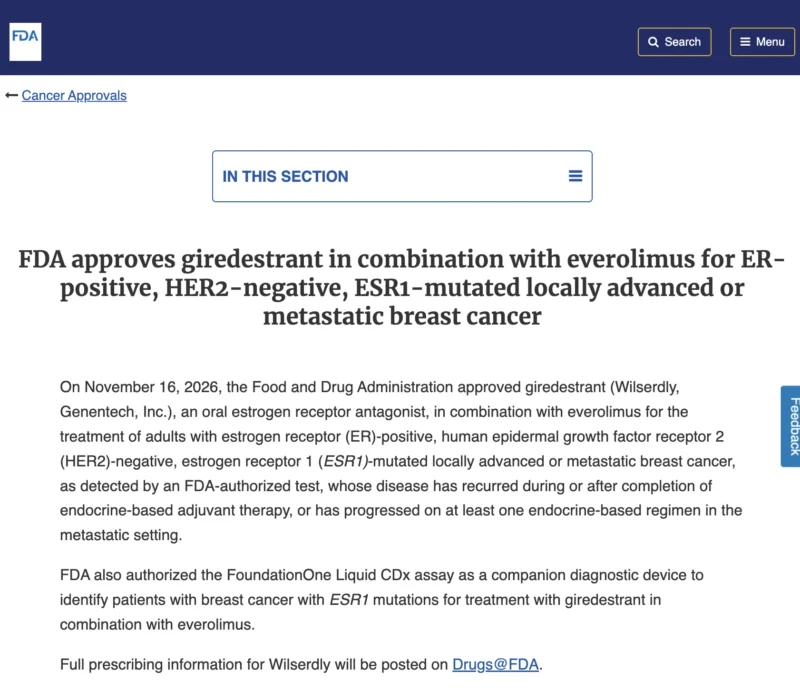
The US Food and Drug Administration has approved giredestrant plus everolimus for adults with estrogen receptor-positive, HER2-negative, ESR1-mutated locally advanced or metastatic breast cancer following prior endocrine-based treatment. The November 16, 2026, approval introduces another biomarker-directed endocrine treatment option, supported by the phase III evERA Breast Cancer trial, in which the combination nearly doubled median progression-free survival compared with physician’s choice of endocrine therapy plus everolimus in patients with ESR1-mutated tumors.
The treatment landscape of hormone receptor-positive/HER2-negative advanced breast cancer continues to evolve rapidly as therapeutic strategies become increasingly guided by molecular resistance mechanisms.
Despite substantial advances with CDK4/6 inhibitors, endocrine therapy combinations, and targeted agents, acquired endocrine resistance remains a defining challenge in metastatic disease. Among the most clinically important mechanisms are acquired mutations in ESR1, the gene encoding estrogen receptor alpha.
These alterations can promote estrogen-independent receptor activity, allowing tumor cells to sustain estrogen receptor signaling despite estrogen deprivation. The development of newer estrogen receptor antagonists and degraders has created opportunities to target this resistance mechanism more effectively.
On November 16, 2026, the FDA approved giredestrant, marketed as Wilserdly by Genentech, in combination with the mTOR inhibitor everolimus for a molecularly defined population of adults with advanced breast cancer.
The decision follows the phase III evERA Breast Cancer trial, whose primary results were published in the New England Journal of Medicine on October 1, 2026. Led by Erica L. Mayer and colleagues, the study demonstrated a substantial progression-free survival benefit with the all-oral combination, particularly in patients whose tumors harbored ESR1 mutations.
The approval reinforces the growing importance of molecular reassessment at endocrine progression and expands the options available to patients who wish to continue effective endocrine-based therapy before transitioning to chemotherapy or antibody–drug conjugates.
What Exactly Did the FDA Approve?
The FDA approved giredestrant in combination with everolimus for adults with ER-positive, HER2-negative, ESR1-mutated locally advanced or metastatic breast cancer. Patients must have experienced disease recurrence during or after completion of endocrine-based adjuvant treatment, or progression on at least one endocrine-based regimen in the metastatic setting.
The presence of an eligible ESR1 mutation must be confirmed using an FDA-authorized test. This indication is important for several reasons. First, the approval is specifically for giredestrant plus everolimus, rather than giredestrant monotherapy.
Second, the approved population is restricted to patients with eligible ESR1-mutated tumors. Third, although the pivotal trial enrolled patients previously treated with a CDK4/6 inhibitor plus endocrine therapy, the precise regulatory wording does not separately require previous CDK4/6 inhibitor exposure.
This distinction between the enrolled clinical trial population and the final approved indication should be considered when applying the evidence to individual patients. The FDA also authorized FoundationOne Liquid CDx as a companion diagnostic for identifying eligible ESR1 alterations.
Why ESR1 Mutations Matter in Endocrine Resistance
Estrogen receptor signaling remains the major biological driver of most hormone receptor-positive breast cancers. Endocrine treatments interfere with this pathway through estrogen deprivation, direct receptor antagonism, or receptor degradation.
However, sustained therapeutic pressure can select for tumor populations that develop alternative mechanisms of estrogen receptor activation. ESR1 mutations are particularly relevant after exposure to aromatase inhibitors.
Many occur in the ligand-binding domain of the estrogen receptor and allow the receptor to retain transcriptional activity in the absence of normal estrogen stimulation. As a result, tumors may become less dependent on circulating estrogen while remaining biologically dependent on estrogen receptor signaling.
This creates an important therapeutic opportunity. Instead of relying exclusively on estrogen deprivation, newer oral estrogen receptor antagonists and degraders aim to directly inhibit the receptor driving malignant growth.
However, ESR1 mutations are not the only mechanism of resistance. Alterations involving PI3K–AKT–mTOR signaling, cell-cycle regulation, and other pathways may also contribute. Consequently, a combination targeting both estrogen receptor activity and downstream growth signaling offers a biologically compelling strategy.
Why Combine Giredestrant With Everolimus?
Giredestrant is an oral estrogen receptor antagonist with selective estrogen receptor-degrading activity. Its therapeutic mechanism involves direct targeting of the estrogen receptor, including mutant receptor forms associated with endocrine resistance.
Everolimus is an inhibitor of mammalian target of rapamycin, or mTOR, a central component of the PI3K–AKT–mTOR signaling pathway. Activation of this pathway can support tumor-cell survival and proliferation despite endocrine treatment.
Everolimus has an established role in endocrine-resistant advanced breast cancer, particularly in combination with exemestane. Combining giredestrant with everolimus therefore targets two interconnected mechanisms.
Giredestrant suppresses estrogen receptor signaling, while everolimus inhibits a downstream pathway that can contribute to endocrine escape. The rationale is particularly attractive in ESR1-mutated disease, where persistent receptor activity may coexist with activation of growth and survival pathways.
Nevertheless, a strong biological rationale is not sufficient to establish clinical efficacy. The evERA trial was designed to determine whether replacing conventional endocrine therapy with giredestrant while retaining everolimus could meaningfully improve clinical outcomes.
evERA Breast Cancer: A Randomized Phase III Trial
The phase III evERA Breast Cancer study, NCT05306340, was a global, multicenter, randomized, open-label trial involving 373 adults with ER-positive/HER2-negative locally advanced or metastatic breast cancer.
All enrolled patients had previously experienced disease progression or recurrence following treatment with a CDK4/6 inhibitor and endocrine therapy. Patients were randomized 1:1 to receive giredestrant plus everolimus or physician’s choice of endocrine therapy plus everolimus.
The experimental group included 183 patients, while 190 were assigned to the comparator group. Giredestrant was administered orally at 30 mg once daily. Everolimus was administered at 10 mg once daily in both groups. Physician’s choice of endocrine therapy included exemestane, fulvestrant, or tamoxifen.
Premenopausal and perimenopausal women received ovarian function suppression with a gonadotropin-releasing hormone agonist. Male participants also received a GnRH agonist unless they had undergone bilateral orchiectomy.
Treatment continued until disease progression or unacceptable toxicity. ESR1 mutation status was centrally assessed using circulating tumor DNA and the FoundationOne Liquid CDx assay.
A total of 207 patients had eligible ESR1 mutations. The primary efficacy endpoint was investigator-assessed progression-free survival according to RECIST version 1.1. Overall survival and objective response were among the additional efficacy outcomes.
A 62% Reduction in the Hazard of Progression or Death
The most important result emerged in the ESR1-mutated population. Median progression-free survival reached 10.0 months with giredestrant plus everolimus, compared with 5.5 months with physician’s choice of endocrine therapy plus everolimus.
The hazard ratio was 0.38 (95% CI 0.27–0.54; P less than 0.0001). This corresponds to a 62% relative reduction in the hazard of disease progression or death. The absolute difference in median progression-free survival was 4.5 months.
Importantly, the improvement occurred against an active endocrine-based comparator that also included everolimus. Therefore, the study tested the additional benefit of using giredestrant as the endocrine partner rather than simply comparing a two-drug regimen against endocrine monotherapy.
The magnitude of the observed association was particularly notable in patients with ESR1-mutated tumors. These findings provided the principal evidence supporting the FDA’s biomarker-restricted approval.
Higher Objective Response Rates Reinforce the Efficacy Findings
The improvement in progression-free survival was accompanied by a higher objective response rate. Among patients with ESR1-mutated tumors, the objective response rate was 27% with giredestrant plus everolimus, compared with 14% in the control group.
The corresponding 95% confidence intervals were 18%–37% and 8%–22%. These findings indicate that the experimental combination increased the proportion of patients experiencing measurable tumor shrinkage.
The response advantage is relevant because endocrine-resistant metastatic breast cancer often requires disease control without immediately introducing cytotoxic chemotherapy. For selected patients, maintaining an effective endocrine-based strategy may help postpone the need for subsequent treatments associated with different toxicity profiles.
However, the trial does not establish that chemotherapy can safely be deferred in every patient. Treatment selection must still account for disease tempo, visceral involvement, symptoms, prior therapies, and the urgency of achieving tumor reduction.
Benefit Was Also Observed in the Overall Trial Population
Although the FDA approval is limited to eligible ESR1-mutated disease, the broader evERA population also demonstrated improved progression-free survival. Across all randomized patients, median progression-free survival was approximately 8.8 months with giredestrant plus everolimus versus 5.5 months with standard endocrine therapy plus everolimus.
The hazard ratio was 0.56 (95% CI 0.44–0.71). This finding supports the general antitumor activity of the combination. However, the larger treatment effect observed in the ESR1-mutated population was central to the regulatory decision.
The all-comer findings should not be interpreted as authorization to use the regimen in patients without an eligible ESR1 mutation. They also do not establish the optimal treatment sequence relative to every other contemporary endocrine-targeted regimen.
Overall Survival Data Remain Immature
Although the progression-free survival findings were statistically significant, overall survival data were immature at the time of the primary efficacy analysis. This distinction is essential when interpreting the approval. Longer progression-free survival may provide meaningful clinical benefit, including delaying disease progression and the need for subsequent treatment.
However, an overall survival advantage cannot yet be claimed. Longer follow-up will be necessary to determine whether the improvement in disease control translates into an overall survival benefit. Additional analyses of subsequent treatment, time to chemotherapy, and patient-reported outcomes may also help clarify the broader clinical value of the regimen.
For now, the established benefit supporting the FDA approval is the improvement in progression-free survival among patients with eligible ESR1 mutations.
Safety: Stomatitis, Pneumonitis, and Hematologic Abnormalities
The safety profile reflects the combined effects of estrogen receptor targeting and mTOR inhibition. According to the FDA, the most common adverse reactions, reported in at least 20% of patients receiving giredestrant plus everolimus, included stomatitis, rash, fatigue, diarrhea, musculoskeletal pain, pneumonitis, and nausea.
Frequently reported laboratory abnormalities included decreases in hemoglobin, lymphocytes, white blood cells, neutrophils, platelets, calcium, potassium, and sodium. Increases in AST, ALT, and creatinine were also observed.
These findings emphasize the importance of laboratory monitoring and proactive toxicity management. Stomatitis is a well-recognized complication of everolimus-containing therapy and can affect treatment adherence and quality of life.
Noninfectious pneumonitis is another clinically relevant risk requiring prompt evaluation of new or worsening respiratory symptoms. The combination should therefore not be viewed as toxicity-free simply because both agents are administered orally.
Patients receiving this regimen require appropriate clinical assessment, adverse-event monitoring, and dose modification when indicated.
Bradycardia Is a Specific Giredestrant Safety Consideration
The FDA prescribing information includes a warning regarding bradycardia. Giredestrant can reduce heart rate, making assessment of baseline cardiac conditions and concomitant medications important. Clinical trial labeling information indicates that bradycardia was observed in 3.8% of patients receiving giredestrant plus everolimus, with reported events being asymptomatic grade 1.
Nevertheless, the potential for decreased heart rate should be considered in patients with relevant cardiovascular comorbidities or those receiving other medications that may affect heart rate. The label also includes embryo-fetal toxicity precautions.
Clinicians should consult the complete prescribing information for monitoring recommendations, dose modifications, and drug-interaction guidance.
Recommended Administration and Molecular Testing
The approved giredestrant dosage is 30 mg orally once daily, with or without food. Everolimus was administered at 10 mg once daily in the pivotal trial, although dose modifications and precautions should follow its own prescribing information.
Treatment is continued until disease progression or unacceptable toxicity. Importantly, eligible ESR1 mutation status must be documented using an FDA-authorized test. The newly authorized FoundationOne Liquid CDx companion diagnostic provides a plasma-based approach to identifying qualifying alterations.
However, the authorization applies to specified ESR1 ligand-binding-domain mutations, rather than every possible ESR1 variant. The analytical scope of the assay and the exact mutation detected should therefore be considered when assessing eligibility.
The role of serial molecular testing is also becoming increasingly relevant. As ESR1 mutations may emerge under endocrine treatment pressure, genomic assessment performed at initial diagnosis may not fully represent the tumor’s current molecular profile at progression.
The approval further strengthens the rationale for molecular reassessment when selecting endocrine-based therapy in advanced breast cancer.
Where Does Giredestrant Fit After CDK4/6 Inhibitor Progression?
One of the most important clinical implications concerns treatment sequencing after endocrine therapy and CDK4/6 inhibition. The post-CDK4/6 setting has become increasingly complex.
Available treatment approaches may include oral estrogen receptor-directed agents, PI3K- or AKT-pathway inhibitors, everolimus-based combinations, chemotherapy, and antibody–drug conjugates, depending on molecular characteristics, prior therapies, disease burden, and regulatory availability.
The approval of giredestrant plus everolimus adds another molecularly selected option. For patients with eligible ESR1 mutations who remain appropriate candidates for endocrine-based therapy, the regimen offers evidence of meaningful disease control following previous treatment.
However, evERA did not directly compare giredestrant plus everolimus against all other available ESR1-directed strategies or combinations incorporating PI3K/AKT pathway inhibitors. Consequently, the trial cannot establish superiority over those options.
Treatment selection should remain individualized. Factors include ESR1 status, coexisting PIK3CA or AKT pathway alterations, previous endocrine exposure, prior everolimus use, disease tempo, comorbidities, toxicity concerns, and patient preferences.
The availability and reimbursement of treatment may also influence real-world implementation.
An Important Regulatory Step Through Project Orbis
The FDA reviewed the application under Project Orbis, an initiative designed to facilitate concurrent regulatory review of oncology products among international partners. For this application, the FDA collaborated with Health Canada and Israel’s Ministry of Health.
However, collaboration through Project Orbis does not mean that the treatment has automatically received approval in those jurisdictions. National regulatory decisions remain separate.
The FDA also used its Assessment Aid review process and granted approval approximately four weeks ahead of its goal date. The decision highlights the growing regulatory importance of biomarker-defined endocrine treatment strategies.
As the molecular landscape of advanced breast cancer becomes more complex, companion diagnostic development is increasingly intertwined with therapeutic innovation.
OncoDaily Takeaway
The FDA’s November 16, 2026, approval of giredestrant plus everolimus marks an important expansion of targeted endocrine treatment options for ER-positive/HER2-negative, ESR1-mutated advanced breast cancer.
The decision is supported by the randomized phase III evERA Breast Cancer trial, in which median progression-free survival improved from 5.5 months with standard endocrine therapy plus everolimus to 10.0 months with giredestrant plus everolimus in patients with ESR1-mutated tumors.
The hazard ratio of 0.38 represents a substantial reduction in the risk of progression or death over time. Objective response rates also improved, reaching 27% versus 14%. However, overall survival data remain immature, and the combination has not been directly compared with every other contemporary molecularly targeted option.
Safety considerations, including stomatitis, pneumonitis, laboratory abnormalities, and bradycardia—remain important. The central clinical message is that ESR1 testing can now identify patients eligible for another FDA-approved endocrine-targeted combination after prior treatment.
As endocrine resistance mechanisms become increasingly actionable, molecular reassessment and individualized sequencing will remain essential to maximizing the benefit of precision treatment in advanced breast cancer.
Sources
- US Food and Drug Administration. FDA Approves Giredestrant in Combination With Everolimus for ER-Positive, HER2-Negative, ESR1-Mutated Locally Advanced or Metastatic Breast Cancer. November 16, 2026.
- Mayer EL, Tolaney SM, Martín M, et al. Giredestrant plus Everolimus in Advanced Breast Cancer. New England Journal of Medicine. 2026;395:1285–1298. DOI: 10.1056/NEJMoa2602457
- Genentech. Wilserdly (Giredestrant) Prescribing Information. November 2026.
- ClinicalTrials.gov. evERA Breast Cancer. NCT05306340.