
Allan Pereira, GI Medical Oncologist and Researcher, Associate Member at Moffitt Cancer Center, shared on X:
“Special Edition – Early-onset colorectal cancer: the most recent publications about this:
- 80,551 Dutch patients: matched under-50 survival = age 50–69, EHR 1.02
- Young patients with liver metastases: more chemo, shorter PFS, same OS
- US young-onset CRC deaths: 3.25 per 100,000, rising 1.06%/yr
3 papers this week point the same way: earlier diagnosis is the lever.
N1: Is early-onset CRC a different disease? (eClinicalMedicine)
- 80,551 Dutch CRC patients, 2016–2022, 3,917 under 50
- Crude 5-yr relative survival 70% under 50 vs 77% at 50–69
- Stage IV pMMR: under-50s did better, EHR 0.87, with more triplet chemo
- Matched for stage, MMR, RAS/BRAF and treatment: EHR 1.02, no difference
This is the cleanest answer yet to a question patients ask in clinic: is my cancer worse because I am young? In this Dutch registry, once stage and treatment are matched, the survival gap between under-50s and 50–69-year-olds closes completely.
Based solely on this data, the implication cuts two ways: earlier diagnosis is the lever, and age alone is not a reason to escalate to triplet chemotherapy.
Title: Association between early-onset colorectal cancer outcomes and established prognostic factors: a nationwide population-based study
Authors: Lauri H. Borghuis, Sander R. van Hooff, Rik van Eekelen, Evelien Dekker, Louis Vermeulen, Tineke E. Buffart
Read the Full Article on eClinicalMedicine
N2: Young patients with colorectal liver metastases (ESMO GI Oncology, AmCORE)
- 351 pts treated locally for CRLM: 31 under 50, 164 aged 50–69, 156 aged 70+
- Induction chemo 58.1% vs 40.5% vs 21.8%
- More metastases at diagnosis: median 4 vs 2 vs 2
- PFS shorter in under-50s (P=0.019)
- OS no different by age (P=0.22)
Same Amsterdam group as the national cohort in N1, same message from a different angle: young patients with liver metastases arrive with more disease, are treated harder, and do not live longer for it. 31 patients under 50 is far too few to settle anything on its own, but read next to the 80,551-patient registry it adds weight to the case that age is a proxy for disease burden, not for tumor biology.
Title: Differences in treatment and outcomes between young and older patients with colorectal cancer liver metastases: an AmCORE-based study
Authors: J.F.E. Vedder, H.H. Schulz, R.-J. Swijnenburg, M.R. Meijerink, K.S. Versteeg, T.E. Buffart
Read the Full Article on ESMO Gastrointestinal Oncology
N3: Where young Americans are dying of CRC (JNCI)
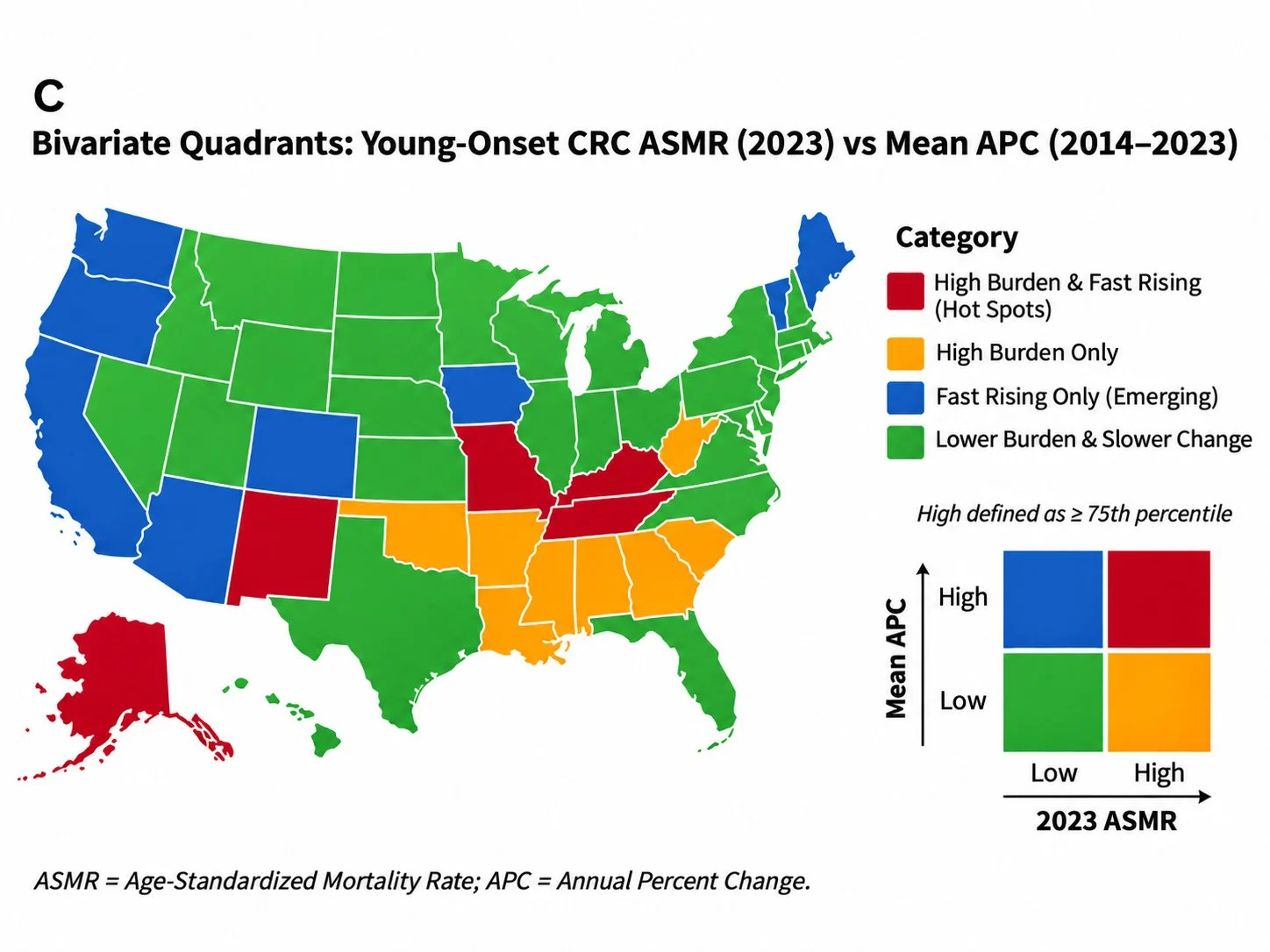
Using Global Burden of Disease 2023 estimates, the authors mapped colorectal cancer mortality among Americans aged 15-49 from 1990 through 2023.
They note that CRC is the only one of the 5 leading causes of cancer death under 50 whose mortality is rising.
- Ages 15-49: 3.25 deaths per 100,000 in 2023
- Rising 1.06% a year over 2014–2023
- 10 of 13 highest-mortality states in the South, fastest rises in the West
- Hotspots: Alaska, Kentucky, Missouri, New Mexico, Tennessee
- 65.5% of deaths tied to assessed risks, 56.1% behavioral.
If early-onset CRC outcomes are mostly driven by stage at diagnosis, then the US map of young-onset deaths is largely a map of late diagnosis and modifiable risk, and the five hotspot states are where screening at 45 and faster work-up of symptoms in young adults should be pushed first. (The figure below is adapted from the original figure in the publication.)
Title: US geographical disparities in young-onset colorectal cancer mortality, 1990–2023
Authors: James Fan Wu, Emma Ruoyi Zhang, Nishwant Swami, Erin Jay G Feliciano, Edward Christopher Dee
Read the Full Article on JNCI: Journal of the National Cancer Institute
As a final comment, our understanding of early-onset CRC continues to evolve, and whether its biology differs from that of later-onset disease remains an open question.
Some studies, including some of my own, suggest distinct tumor biology. However, much of the apparent genomic distinction may reflect confounding factors.
After excluding MSI-H and hereditary cases, a Memorial Sloan Kettering (MSK) cohort of 759 patients showed no significant differences in tumor grade or genomic profile between early- and later-onset disease (Sinicrope FA. NEJM. 2022).
Other studies have found that these differences largely disappear after adjusting for MSI status and tumor sidedness (Porter CBM, Murphy SP, Cazaubiel J, et al. Nature Medicine. 2026).”
You can also read: Early-Onset Colorectal Cancer: Recognition, Workup and Treatment Selection