
Early-Onset Colorectal Cancer (EOCRC), generally defined as colorectal cancer diagnosed before the age of 50 years, has become an increasingly important clinical and public health concern. Its incidence has continued to rise among younger adults while colorectal cancer incidence in older populations has declined in many countries. In the United States, EOCRC incidence has increased by approximately 2% annually and now accounts for approximately 14% of all colorectal cancer cases. Globally, 184,709 cases of EOCRC were reported in 2022, making colorectal cancer the most common early-onset gastrointestinal malignancy (Jayakrishnan and Ng, 2025).
This epidemiologic shift creates a particular diagnostic challenge. Younger adults are outside the traditional age range associated with colorectal cancer and may therefore be less likely to undergo prompt gastrointestinal evaluation when symptoms develop. Yet symptomatic EOCRC is increasingly recognized as a disease in which diagnostic delay represents a clinically important and potentially modifiable problem.
A systematic review and meta-analysis including 81 studies and more than 24.9 million individuals younger than 50 years, found that hematochezia, abdominal pain, and altered bowel habits were the most common presenting features of EOCRC. Hematochezia occurred in 45% of patients, abdominal pain in 40%, and altered bowel habits in 27%. The median time from symptom presentation to diagnosis was four months, with delays of four to six months occurring frequently (Demb et al.; 2024).
A Clinical Case of EOCRC
A 36-year-old man developed persistent abdominal pain and bloating. He initially managed his symptoms with laxatives and NSAIDs. He noticed blood in his stool on one occasion but did not seek medical evaluation. His abdominal pain continued, and he contacted emergency services several times but was not transferred to the hospital for further evaluation. A few days later, he developed severe abdominal pain and presented to the hospital himself. Evaluation revealed intestinal perforation and peritonitis, requiring an emergency right hemicolectomy. Carcinomatosis was identified intraoperatively.
Pathological examination demonstrated grade 2 mucinous adenocarcinoma of the hepatic flexure with mucinous differentiation. Four of 11 lymph nodes were involved, with lymphovascular invasion present and no perineural invasion. The tumor was staged as pT4bN2aM1. KRAS, NRAS, and BRAF were wild-type, and the tumor was proficient in mismatch repair (pMMR). The patient subsequently received FOLFOX plus bevacizumab.
At 36 years of age, this patient illustrates the central clinical challenge of EOCRC: young age can lower clinical suspicion for colorectal cancer even when concerning symptoms are present.
Delayed Diagnosis in Early-Onset Colorectal Cancer
The symptoms of EOCRC are often nonspecific, but their persistence and combination should prompt appropriate investigation. Rectal bleeding, abdominal pain, altered bowel habits, iron-deficiency anemia, and unexplained weight loss are important clinical signals. Hematochezia was associated with at least a five-fold increased likelihood of EOCRC, emphasizing that rectal bleeding in a young adult should not automatically be attributed to benign anorectal disease (Demb et al.; 2024).
The challenge is particularly relevant because population screening does not capture every young patient who develops CRC. In the United States, average-risk screening begins at age 45 years, while the steepest increase in EOCRC incidence has been observed among individuals younger than 40 years (Jayakrishnan and Ng, 2025).
At the population level, screening and early detection have demonstrated substantial effects on CRC mortality. CRC mortality trends across 48 countries and estimated more than 2.8 million avoided CRC deaths, with the greatest reductions observed in countries where screening programs had been established. The findings reinforce the importance of both prevention and early detection, while also demonstrating substantial differences between countries (Brenner et al.; 2026).
Our research group conducted a retrospective study in Georgia, providing real-world insights into the clinical characteristics of EOCRC in the country. These preliminary data showed that EOCRC accounted for 14% of 385 patients with CRC treated at a tertiary referral center between 2023 and 2025. Approximately one-third of patients with EOCRC presented with stage IV disease at diagnosis, with the liver being the predominant metastatic site. Rectal bleeding was reported in 24% of young patients, while bowel obstruction occurred in 22.2%.
The clinical lesson is not that every gastrointestinal symptom in a young adult represents cancer. It is that persistent or unexplained symptoms should not be dismissed solely because of age.

Workup of Early-Onset Colorectal Cancer
Once CRC is suspected, young age should not delay standard diagnostic evaluation. Colonoscopy with biopsy establishes the diagnosis, followed by appropriate staging and multidisciplinary assessment.
EOCRC also warrants particular attention to hereditary and molecular factors. Germline pathogenic variants are more common among patients with EOCRC than among those with later-onset disease, with reported prevalence of approximately 16%–25%. Lynch syndrome represents an important contributor, although other hereditary syndromes, including familial adenomatous polyposis and MUTYH-associated polyposis, are also relevant (Jayakrishnan and Ng, 2025).
A comprehensive workup should therefore address:
- MMR/MSI status, both for hereditary risk assessment and treatment implications
- Germline genetic testing and appropriate genetic counseling
- KRAS and NRAS status in metastatic disease
- BRAF V600E status
- Additional actionable biomarkers, including HER2, when clinically appropriate
- Broader molecular profiling when results could influence treatment or clinical-trial eligibility
The molecular findings in our Georgian study further emphasize this point. MSI-high tumors were observed in 54.4% of EOCRC patients compared with 13.5% of older patients (p=0.0018). We also observed a higher frequency of RAS/BRAF alterations in the EOCRC group. These findings support the importance of systematic molecular characterization in younger patients.
The biological differences observed in EOCRC do not mean that every young patient has a hereditary cancer syndrome or requires a different treatment regimen. They mean that age should increase attention to hereditary risk and tumor biology rather than decrease it.
Does young age change treatment selection?
Young age alone does not determine treatment selection. The treatment of EOCRC generally follows the same stage- and biomarker-driven principles used for later-onset CRC. Disease stage, resectability, tumor location, molecular profile, disease burden, performance status, and patient preferences remain the major determinants of treatment.
For metastatic disease, molecular and clinicopathologic characteristics guide systemic therapy. MMR/MSI status, RAS and BRAF status, tumor sidedness, and other actionable alterations help determine the most appropriate treatment strategy. Current ASCO guidance recommends biomarker-directed treatment approaches for metastatic CRC, including immunotherapy for MSI-H/dMMR disease and molecularly selected targeted approaches. (Morris et al., 2022).
In the presented patient, the tumor was pMMR and KRAS/NRAS/BRAF wild-type, with a right-sided primary arising from the hepatic flexure. FOLFOX plus bevacizumab was selected as systemic therapy.
In EOCRC, comprehensive molecular characterization is integral to clinical decision-making, as tumor biomarkers provide critical information for hereditary risk assessment, prognostic stratification, and selection of biomarker-directed therapies.
At the same time, treatment planning for a 36-year-old extends beyond tumor control. Fertility preservation, reproductive planning, sexual health, parenting, employment, financial toxicity, psychosocial well-being, and long-term survivorship are particularly relevant to patients diagnosed during their reproductive and working years. Multidisciplinary care addressing fertility, parenting, psychosocial distress, and financial concerns in early-onset GI cancers (Jayakrishnan and Ng.; 2025).
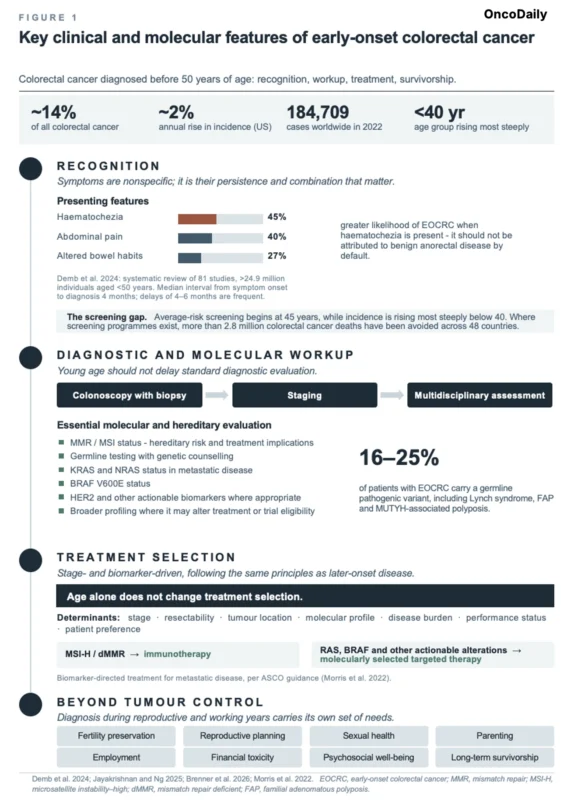
The key clinical and molecular features of EOCRC, from recognition and diagnostic evaluation to treatment principles and considerations specific to younger patients, are summarized in Figure 1.
Why So Young? Understanding the Rise of EOCRC
For many patients, however, the most difficult question remains the simplest: “Why did I get colorectal cancer at such a young age?”
The reasons remain incompletely understood and there is no single answer. Researchers are actively investigating the contribution of diet, obesity, sedentary behavior, the gut microbiome, smoking, alcohol exposure, environmental factors, and other potential contributors. Several associations have been identified, but the mechanisms underlying the broader generational increase in EOCRC remain incompletely understood (Jayakrishnan and Ng, 2025).
Recent expert discussion has similarly emphasized ongoing research into the microbiome, diet, environment, and other potential contributors, while acknowledging that no single factor currently explains the increasing incidence among younger adults (Olazagasti and Bernabe, 2026).
What is clearer is what can be done today. Patient education, symptom awareness, and earlier recognition remain essential. EOCRC is not addressed simply by lowering the screening age. It also requires a change in clinical thinking. When a young patient develops persistent or unexplained gastrointestinal symptoms, age should not be used as reassurance.
The clinical priority is to avoid both over-investigation and under-recognition. Persistent or alarm gastrointestinal symptoms in young adults should prompt timely diagnostic evaluation when clinically indicated, rather than repeated empirical treatment for presumed benign conditions.
Find more videos on OncoDaily YouTube TV.