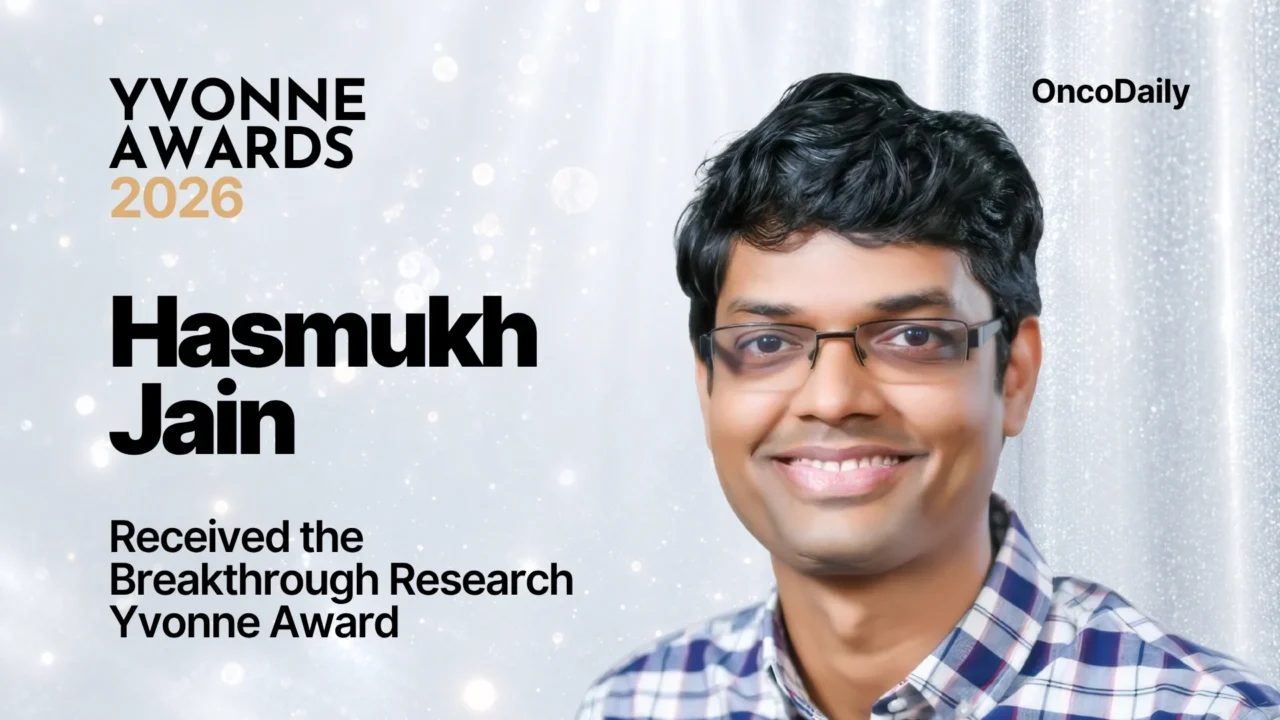
Hasmukh Jain, MD, was honored with the Breakthrough Research Yvonne Award during the Yvonne Awards Ceremony at OncoDaily Party 2026, held on May 29 at Park West in Chicago.
Natera was the exclusive partner of the Yvonne Awards Ceremony and OncoDaily Reception.
The recognition highlights Dr. Jain’s pioneering work in hematologic oncology, cell therapy, clinical research, training, and access-oriented cancer innovation in India. As Professor and Consultant Medical Oncologist at Tata Memorial Centre in Mumbai, Dr. Jain has built a career focused on developing high-quality, affordable, and scalable cancer care models for patients with hematological malignancies.
The Breakthrough Research Yvonne Award recognizes professionals whose work has moved oncology forward through meaningful scientific progress, clinical innovation, and real-world impact. In Dr. Jain’s case, that impact is closely tied to the development of India’s first indigenous CAR-T cell therapy and the creation of systems that can make advanced treatment accessible beyond a single institution.
A Career Built in Hematologic Oncology
Dr. Jain completed his MBBS at Kempegowda Institute of Medical Sciences in Bangalore, followed by an MD in Internal Medicine at Kasturba Medical College in Mangalore. He then completed his DM in Medical Oncology at Tata Memorial Centre in Mumbai in 2013.
That same year, he joined Tata Memorial Hospital as Assistant Professor in Medical Oncology, working in the division of adult hematolymphoid cancers. He was promoted to Associate Professor in 2015 and became Professor in 2020.
His academic and clinical career has remained closely connected to hematologic malignancies, clinical trials, cell therapy development, trainee education, and the broader question of how advanced cancer treatment can be delivered in resource-conscious settings.
Leading India’s First Indigenous CAR-T Cell Therapy Program
One of Dr. Jain’s most important contributions has been leading the clinical development of India’s first indigenous CAR-T cell therapy, talicabtagene autoleucel, formerly known as actalycabtagene autoleucel and marketed as NexCAR19, for relapsed and refractory B-cell malignancies.
This work was carried out in collaboration with the Indian Institute of Technology Bombay, with support from the National Cancer Institute, United States. The program achieved regulatory approval within 24 months of initiating the clinical trial.
The significance of this work extends beyond scientific development. CAR-T therapy has transformed outcomes for selected patients with hematologic cancers, but cost and infrastructure barriers have limited access in many parts of the world.
Making Innovation Scalable and Accessible
Breakthrough research is not only about developing a new therapy. It is also about building the pathway that allows patients to receive it safely and effectively.
To expand access beyond his own center, Dr. Jain established virtual and on-site training programs for clinicians, nurses, and trainees, both nationally and internationally. He also developed standard operating procedures to support patient selection, toxicity management, and outpatient administration.
This work is especially important in cell therapy, where success depends on more than the product itself. Centers need trained teams, clear protocols, toxicity management pathways, infrastructure, referral systems, and confidence in delivering complex care. Dr. Jain’s contribution helped create a framework that could support broader implementation of CAR-T therapy across India and beyond.
Building the Next Chapter: BCMA CAR-T
Following the success of CD19 CAR-T therapy, Dr. Jain is now spearheading the preclinical and clinical development of BCMA CAR-T, which has shown promising results in early-phase trials.
This work reflects a continuing effort to expand cell therapy options for patients with hematologic malignancies, including diseases where treatment resistance and relapse remain major challenges. By building on an existing cell therapy infrastructure, Dr. Jain’s program is positioned not only to test new therapies, but also to strengthen India’s capacity for advanced cellular immunotherapy research.
Strengthening Hematologic Cancer Care Across India
Dr. Jain’s work is driven by a broader commitment to uniform, high-quality care for hematological cancers.
He has contributed to an oncology program at a rural hospital in an underserved area, where the center now has a functional oncology unit, a preventive oncology program, multidisciplinary tumor boards, and bone marrow transplant capability.
This initiative reflects the wider meaning of cancer innovation. Advanced therapies matter, but so do systems that bring diagnosis, treatment planning, prevention, and specialized care closer to patients who might otherwise be left behind.
Training the Next Generation of Oncologists
From 2013 to 2023, Dr. Jain was in charge of the academic program for training in hematological cancers for medical oncology fellows at Tata Memorial Hospital. He also developed and led a formative assessment program for trainees in medical oncology.
This educational work is a central part of his impact. Hematologic oncology and cell therapy require a highly trained workforce, especially as new treatments become more complex. By shaping fellowship training and assessment, Dr. Jain has contributed to building the next generation of oncologists who will carry forward both clinical expertise and research capability.
Establishing India’s Largest Cell Therapy Program
Dr. Jain has also played a central role in establishing the cell therapy unit at Tata Memorial Centre. He developed standard operating procedures, piloted early activities, expanded the program, and contributed to building what has become the largest cell therapy program in India, with more than 200 patients treated.
This achievement reflects the practical infrastructure behind scientific progress. Cell therapy programs require close coordination across clinical teams, laboratory systems, pharmacy, nursing, intensive care, transfusion medicine, regulatory processes, and long-term follow-up. Dr. Jain’s work helped turn a breakthrough therapy into a functioning care platform.
Research Leadership and Collaborative Trials
Dr. Jain has authored 85 publications in peer-reviewed journals, including Lancet Haematology, Blood, Blood Advances, Blood Cancer Journal, British Journal of Haematology, Leukemia, Leukemia and Lymphoma, and JCO Global Oncology.
He is currently Principal Investigator for 15 investigator-initiated projects funded by leading Indian organizations, including the Indian Council of Medical Research, the National Cancer Grid, and the Lady Tata Memorial Trust. Over the past 12 years, he has successfully completed more than 25 investigator-initiated projects as Principal Investigator.
His research portfolio includes national and international collaborative projects addressing both contextual needs and cutting-edge questions in hematologic cancer care. This balance is important: research must be scientifically ambitious, but it must also respond to the realities of the patients and health systems it is meant to serve.
Large-Scale Trials and National Guidelines
Dr. Jain serves as Co-Chair of the Leukemia Working Group of the Hematology Cancer Consortium, a network of cancer centers working to improve care for patients with hematological cancers. He also initiated a 1,100-patient randomized trial, described as one of the largest adolescent and young adult acute lymphoblastic leukemia trials in the world.
He is also Coordinator of the National Cancer Grid resource-stratified guidelines for hematological cancers, helping shape practical treatment guidance that can be applied across different levels of healthcare infrastructure.
Resource-stratified guidance is essential in countries with large population needs and variable access to specialized care. It supports treatment decisions that are evidence-based while remaining realistic for different care environments.
Recognition for Affordable Innovation
Dr. Jain’s work has received major recognition. In 2024, he was honored at the Indo-US Rare Disease Symposium for pioneering affordable CAR-T therapy. He also received the EBMT Contest Award for the story of the first CAR-T cell therapy program in India and its aim to achieve scale and improve access. In 2025, he received the J.G. Parikh Oration at the Mumbai Hematology Group Mid-term Conference.
These recognitions reflect the international importance of his work. Affordable CAR-T therapy is not only a national achievement; it is part of a broader global oncology question: how can advanced treatment be made accessible, safe, and sustainable for patients outside the wealthiest healthcare systems?
Honoring Breakthrough Research With Real-World Impact
The Breakthrough Research Yvonne Award recognizes Dr. Hasmukh Jain for his contribution to hematologic oncology through CAR-T cell therapy development, clinical research, training, guideline development, rural oncology outreach, and access-focused innovation.
At OncoDaily Party 2026, his recognition highlighted a model of research that is both scientifically advanced and socially meaningful. Dr. Jain’s work shows that breakthrough oncology does not end with discovery. It must continue through clinical testing, regulatory progress, training, standard operating procedures, infrastructure, affordability, and national scale.
Through his work at Tata Memorial Centre, his collaboration with IIT Bombay, his leadership in cell therapy, and his commitment to hematologic cancer care across India, Dr. Jain continues to demonstrate how innovation can become a pathway to access.
Written by Nare Hovhannisyan, MD