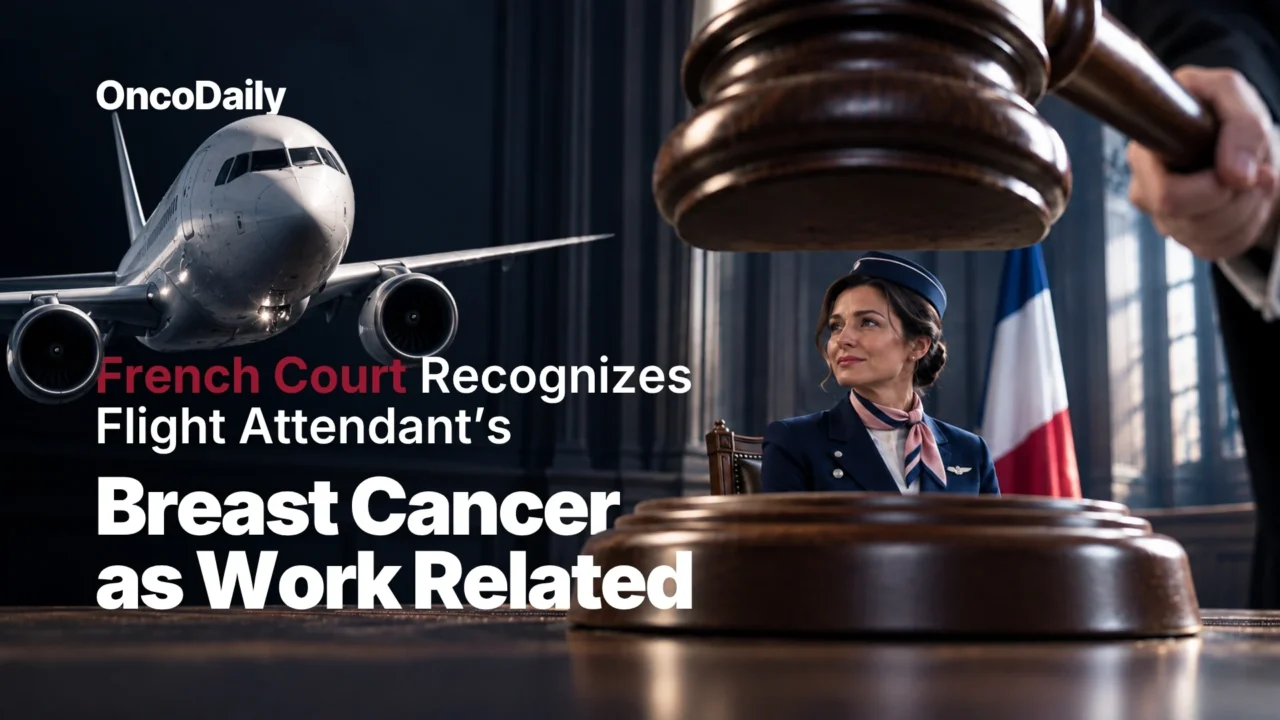
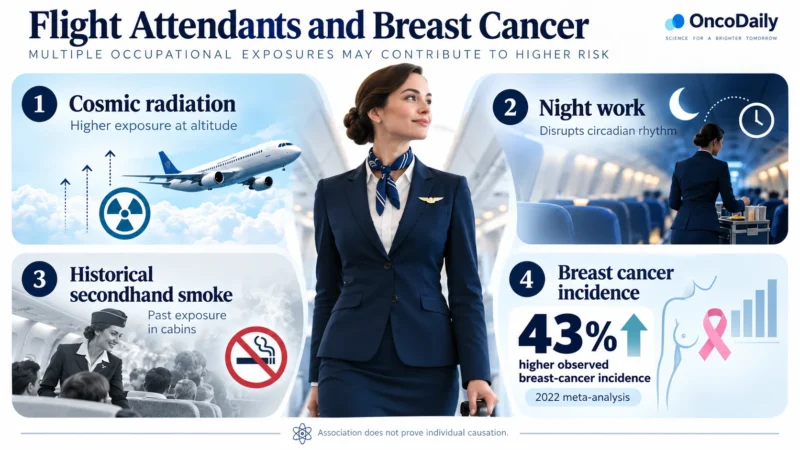
A French court has recognized the breast cancer of former Air France flight attendant and purser Sophie Lainault as an occupational disease, linking her diagnosis to decades of cumulative workplace exposure. The case of this Flight Attendant’s Breast Cancer is significant for France’s aviation sector. Lainault became the first flight attendant in France reported to have obtained legal recognition of breast cancer as an occupational disease. The Bayonne court considered several features of her working history, including repeated exposure to cosmic ionizing radiation, extensive night work, and historical exposure to secondhand tobacco smoke.
Lainault worked for Air France from 1989 to 2019, first as a flight attendant and later as a purser. Mediapart reported approximately 12,600 flight hours, including around 6,500 hours worked at night. She was diagnosed with breast cancer in May 2019, at age 53, and is now reported to be in remission. The court did not establish that one single exposure caused her cancer. Instead, the case centered on the cumulative occupational environment across three decades of aviation work and how those long-term exposures may have contributed to the flight attendant’s breast cancer.
A 30-Year Career in the Air
Lainault began working for Air France in 1989 and spent much of her career on long-haul routes. Some of those flights involved high-altitude and high-latitude travel, where exposure to cosmic radiation is higher than at ground level. She also accumulated approximately 6,500 hours of night flying, exposing her repeatedly to circadian disruption. In addition, part of her career occurred before Air France prohibited smoking on board in 2000, meaning cabin crew could be occupationally exposed to secondhand tobacco smoke. These three factors became central to the legal assessment.
What Did the French Court Find?
The Bayonne court issued its decision in July 2026, with the case becoming widely reported in August. According to Mediapart, the court accepted that three occupational factors in Lainault’s career were potentially relevant to her breast cancer: Cosmic ionizing radiation, accumulated during thousands of hours at cruising altitude. Night work, amounting to approximately 6,500 hours over her career. Historical secondhand tobacco-smoke exposure before smoking was banned aboard Air France flights. The significance of the case lies in the court considering these exposures collectively rather than attributing her cancer to one isolated cause.
Why Cosmic Radiation Matters for Flight Crews
Cosmic radiation consists of high-energy particles originating outside Earth’s atmosphere. At ground level, the atmosphere and Earth’s magnetic field provide substantial protection. At commercial cruising altitude, there is less atmospheric shielding, so radiation exposure increases. Dose also varies according to altitude, latitude, flight duration and solar activity. Flights at higher latitudes, particularly closer to the poles, can involve greater exposure because Earth’s magnetic field provides less protection. Ionizing radiation is an established human carcinogen.
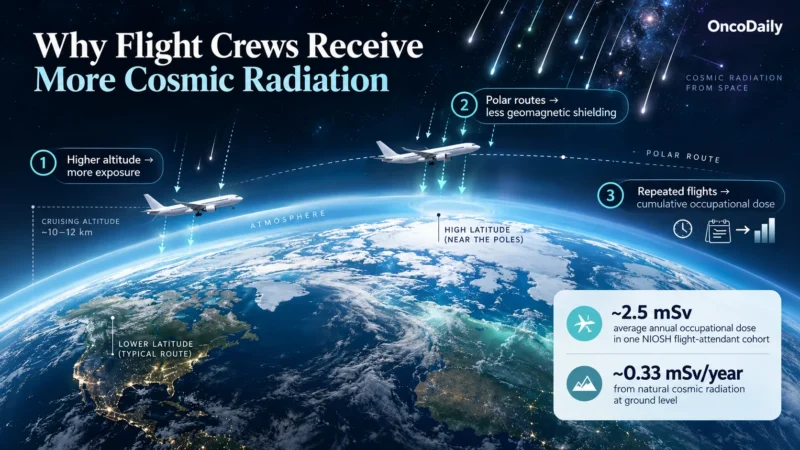
The important issue for airline workers is not one flight but repeated occupational exposure accumulated over many years. A NIOSH assessment involving 5,898 flight attendants estimated an average occupational cosmic-radiation dose of approximately 2.5 ± 1.0 millisieverts (mSv) per year and an average estimated career dose of about 30 mSv. For comparison, CDC estimates that the average annual exposure to natural cosmic radiation for a person in the United States is approximately 0.33 mSv per year at ground level.
These figures do not mean that a flight attendant receiving several millisieverts annually will develop cancer. Radiation-related risk depends on cumulative dose and many other biological factors, and it is generally impossible to determine that a particular radiation exposure caused one individual cancer.
Flight Attendant’s Breast Cancer : Is the Risk Really Higher?
Several epidemiological analyses have found a higher observed incidence of breast cancer among female flight attendants than in the general population. A 2016 meta-analysis including more than 31,000 female flight attendants and 821 breast-cancer cases found a standardized incidence ratio of 1.40, meaning breast cancer occurred approximately 40% more often than expected in the populations used for comparison.
A more recent 2022 systematic review and meta-analysis reached a similar estimate. Across nine eligible studies, the pooled standardized incidence ratio for breast cancer was 1.43 (95% CI 1.32–1.54)—approximately a 43% higher observed incidence. However, this does not mean cosmic radiation caused 43% more breast cancers. The 2022 analysis found that only three studies suggested a possible association between breast cancer and cosmic radiation, while the available evidence did not establish a clear association with circadian disruption. The authors therefore concluded that although breast-cancer incidence appears elevated among female flight attendants, existing research does not clearly identify which occupational exposure is responsible.
Association Is Not the Same as Causation
This distinction is particularly important when discussing Lainault’s case. A court determines whether evidence satisfies a legal standard for recognition of an occupational disease. Scientific epidemiology asks a different question: whether an exposure produces a measurable increase in disease across populations and whether competing explanations can be excluded.
Female flight attendants experience several exposures simultaneously, including radiation, night work, changing time zones and historically secondhand tobacco smoke. They can also differ from the general population in reproductive history, lifestyle, socioeconomic factors and healthcare utilization. An elevated cancer incidence therefore does not automatically identify the cause.
Night Flying and Circadian Disruption
Night work represents another important occupational exposure. In 2019, the International Agency for Research on Cancer re-evaluated the evidence and classified night shift work as probably carcinogenic to humans, Group 2A. IARC based that classification on limited evidence in humans, sufficient evidence in experimental animals and strong mechanistic evidence. Breast cancer was among the cancer sites considered in the human evidence.
Night work disrupts the body’s normal circadian rhythm, which regulates sleep, hormone release, metabolism, immune function and numerous cellular processes. Possible biological mechanisms under investigation include altered melatonin signaling, changes in hormonal regulation, sleep disruption, metabolic effects and interference with normal circadian control of cell division and DNA repair.
Lainault accumulated approximately 6,500 hours of night flying, making this a substantial component of her occupational history. However, IARC’s classification does not mean that every person who works nights will develop cancer or that night work can be identified as the cause of an individual breast cancer. “Probably carcinogenic” describes the strength of evidence that the exposure can cause cancer under some circumstances—not the size of an individual person’s risk.
Why Aviation Work Is Unusual
Cabin crew can experience both night work and radiation exposure at the same time. Long-haul aviation can involve crossing multiple time zones, working through normal sleeping hours and receiving repeated radiation exposure at altitude. That combination makes airline crews a particularly interesting population for occupational-health research. But studying the exposures independently is difficult.
A worker with the greatest cumulative cosmic-radiation dose may also have worked the most long-haul routes, crossed more time zones and completed more night flights. This makes it challenging to determine precisely which factor or combination of factors explains observed differences in cancer incidence.
Secondhand Tobacco Smoke: What Is Established?
Secondhand tobacco smoke is also an established human carcinogen. IARC classifies involuntary, or secondhand, tobacco smoke as carcinogenic to humans. Its strongest established cancer association is with lung cancer. According to CDC, adults who do not smoke but are exposed to secondhand smoke have approximately a 20–30% higher risk of developing lung cancer, and secondhand smoke contributes to more than 7,300 lung-cancer deaths annually among U.S. adults who do not smoke.
However, the evidence is less clear for breast cancer specifically. IARC reviews have described the epidemiological evidence linking secondhand smoke to breast cancer as inconsistent, and the U.S. Surgeon General has characterized the evidence as suggestive but insufficient to establish a causal relationship. This distinction matters. Lainault’s secondhand-smoke exposure can accurately be described as an occupational exposure to a known carcinogen and part of the cumulative exposure history considered by the court. It should not be presented as independently proven to have caused her breast cancer.
Smoking on Aircraft: A Historical Occupational Exposure For younger travelers today, smoking inside a commercial aircraft may sound difficult to imagine. But cabin crew who worked before widespread smoking bans could spend hours inside enclosed aircraft containing tobacco smoke. Lainault began working in 1989, and Air France prohibited smoking on its flights in 2000, meaning this exposure was part of the earlier portion of her aviation career. The exposure therefore belongs in the occupational-health history even though the scientific evidence linking passive smoking specifically to breast cancer remains uncertain.
Why Lainault’s Case Was Difficult
Breast cancer is not included in France’s standard table of occupational diseases. That meant Lainault could not rely on an automatic presumption that her illness was related to work. Instead, her claim had to establish an individual relationship between her disease and occupational exposures. She pursued the case for approximately two and a half years with support from the French CFDT trade union. Two regional occupational-disease committees initially rejected the claim. The Bayonne court ultimately recognized the disease as occupational, concluding that the previous assessments had not adequately accounted for her cumulative exposure history.
Why Occupational Cancer Is So Difficult to Prove
Most cancers do not have a single identifiable cause. Breast cancer risk is influenced by age, genetics, reproductive and hormonal factors, alcohol consumption, body weight after menopause, previous radiation exposure and other environmental and biological factors. Cancer can also develop decades after an occupational exposure. This latency makes occupational cancer particularly difficult to evaluate at the individual level.
Even when an exposure is known to increase cancer risk across a population, physicians generally cannot examine one tumor and determine which environmental exposure caused it. Occupational disease assessments therefore rely on a combination of exposure history, epidemiological evidence, biological plausibility and the presence or absence of other major risk factors.
What Does the Court Recognition Mean?
The decision means that Lainault’s breast cancer has been legally recognized as an occupational disease in her individual case. Because she is now reported to be in remission, the decision can affect rights related to occupational-disease compensation, healthcare coverage and potentially early retirement. It may also make it easier for other aviation workers to argue that similar cumulative exposures deserve consideration. But the ruling does not automatically change breast cancer into a recognized occupational disease for every French flight attendant. Each future claim would still need to satisfy the relevant medical and legal requirements unless France changes its occupational-disease system.
Is Breast Cancer Now an Occupational Disease for All Flight Attendants?
This is one of the most important limitations of the ruling. The court recognized Lainault’s individual cancer as occupational based on her particular work history and exposure profile. It did not conclude that all cabin crew face the same level of risk or that every case of breast cancer among flight attendants was caused by aviation work. The decision may create an important precedent, but it is not equivalent to a universal occupational-disease classification.
Does Flying Cause Breast Cancer?
The evidence does not support such a broad statement. Occasional passengers receive a relatively small amount of cosmic radiation from individual flights. The occupational issue arises because pilots and cabin crew may spend thousands of hours at altitude over decades. Repeated exposure changes the question from the dose received on one flight to the worker’s cumulative career dose. Epidemiological studies have found elevated breast-cancer incidence among flight attendants, but the contribution of cosmic radiation, night work and other factors remains difficult to separate. It is therefore scientifically inaccurate to say simply that “flying causes breast cancer.”
Photo: Depositphotos
What the Numbers Show
Several figures help put Lainault’s case and the broader science into perspective. Lainault worked approximately 12,600 flight hours during three decades with Air France, including approximately 6,500 night-flight hours. A NIOSH study involving 5,898 flight attendants estimated a mean annual occupational cosmic-radiation dose of approximately 2.5 mSv, with an estimated average career dose of about 30 mSv. The average U.S. resident receives around 0.33 mSv annually from natural cosmic radiation at ground level.
A 2016 meta-analysis found approximately 40% higher breast-cancer incidence among female flight attendants compared with reference populations. A 2022 analysis found a similar 43% higher observed incidence, although it could not establish that cosmic radiation or circadian disruption alone explained the difference. These numbers demonstrate why aviation is an important occupational-health research area. They do not provide a formula for predicting an individual flight attendant’s cancer risk.
What Could Change for Aviation Workers?
Lainault has said she hopes the ruling will encourage stronger prevention and recognition of occupational risks among aviation workers. Possible strategies include more systematic monitoring of cumulative radiation dose, better management of night schedules, distributing high-radiation routes across crew members, improving education about occupational exposures and paying closer attention to workers with particularly high cumulative flight histories.
Some radiation-protection frameworks already recognize aircrew as occupationally exposed populations. Lainault’s case adds pressure to consider whether multiple exposures should be assessed together, rather than focusing only on radiation or night work separately.
What Did Air France Say?
Air France said it had not participated in Lainault’s legal proceedings and had not reviewed the court’s reasoning. The airline stated that the health and safety of employees were an “absolute imperative” and emphasized that staff receive medical support beyond regulatory requirements. The company did not publicly dispute the existence of occupational exposures but emphasized that it was not a party to the proceedings.
Why This Case Matters
This case matters because occupational cancer is often difficult to see. A workplace accident may occur in seconds. Cancer can develop decades after an exposure has begun. For airline crews, many potentially relevant exposures are also invisible or normalized as part of the job. Cosmic radiation cannot be seen or felt. Night flying becomes part of a schedule. Historically, tobacco smoke was accepted as part of the cabin environment.
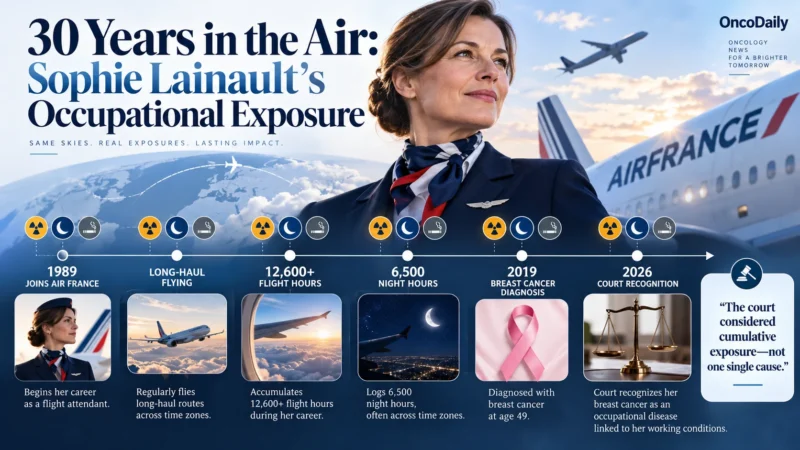
Lainault’s case brings those factors together in a way that has now received formal legal recognition. The ruling does not prove that aviation work inevitably causes breast cancer. It does, however, reinforce a broader principle of occupational medicine: cancer risk cannot always be separated from the environments in which people spend decades of their working lives.
You Can Also Read Talc and Cancer: What Johnson & Johnson’s $40 Million Verdict Means for Public Health by OncoDaily

Written by Aharon Tsaturyan, MD, Editor at OncoDaily Intelligence Unit
FAQ
Who Is Sophie Lainault?
Sophie Lainault is a former Air France flight attendant and purser who worked for the airline between 1989 and 2019. Her breast cancer was diagnosed in 2019 and was recognized by a French court in 2026 as an occupational disease.
How Many Hours Did Sophie Lainault Fly?
Mediapart reported that Lainault accumulated approximately 12,600 flight hours, including around 6,500 hours of night flying, during her 30-year career.
Did Cosmic Radiation Cause Sophie Lainault’s Breast Cancer?
The court considered cosmic radiation as one of several relevant occupational exposures. Scientifically, however, it is generally not possible to prove that one particular exposure caused an individual person’s breast cancer.
Is Cosmic Radiation Carcinogenic?
Yes. Ionizing radiation is an established carcinogenic hazard. Flight crews receive greater occupational exposure than people at ground level because radiation levels increase with altitude and can also be higher at high latitudes.
Do Flight Attendants Have a Higher Risk of Breast Cancer?
Several meta-analyses have found higher observed breast-cancer incidence among female flight attendants. A 2022 meta-analysis reported a standardized incidence ratio of 1.43, or approximately 43% above that expected in comparison populations. However, the researchers could not establish that cosmic radiation or circadian disruption alone explained the increase.
Is Night Shift Work Carcinogenic?
IARC classifies night shift work as probably carcinogenic to humans, Group 2A. This does not mean every night worker will develop cancer.
Does Secondhand Smoke Cause Breast Cancer?
Secondhand smoke is a proven human carcinogen and an established cause of lung cancer. However, current evidence does not establish a clear causal relationship between secondhand smoke and breast cancer specifically.
Does This Ruling Apply to All French Flight Attendants?
The decision applies to Lainault’s individual case and does not automatically classify all breast cancer among cabin crew as occupational disease.
Does Ordinary Air Travel Cause Breast Cancer?
There is no evidence that occasional commercial flying should be interpreted that way. The occupational concern involves cumulative exposure over thousands of flight hours and many years.