
The introduction of immune checkpoint inhibitors (ICIs) has transformed the treatment landscape across multiple tumor types, producing durable responses and meaningful survival improvements for many patients. However, a small subset of patients experience a paradoxical phenomenon known as hyperprogressive disease (HPD), characterized by an unexpectedly rapid acceleration of tumor growth shortly after the initiation of immunotherapy. Despite growing recognition of HPD, its true incidence, biological basis, and clinical implications remain incompletely understood. A recent multicenter French study, HYPERPROG, provides one of the largest real-world analyses of hyperprogression reported to date and offers important insights into its clinical behavior.
What Is Hyperprogressive Disease?
Hyperprogression was first described in 2017 when investigators observed that some patients treated with PD-1 or PD-L1 inhibitors experienced tumor growth that was substantially faster than expected from the natural history of their disease. Since then, multiple studies have attempted to characterize this phenomenon, but differing definitions have resulted in widely varying estimates of prevalence and inconsistent conclusions regarding its prognostic significance.
The HYPERPROG investigators focused on clinically meaningful cases by requiring both a marked increase in tumor growth rate and clinical deterioration. This approach was intended to identify patients experiencing true hyperprogression rather than conventional disease progression.
Real-World Incidence and Patient Characteristics
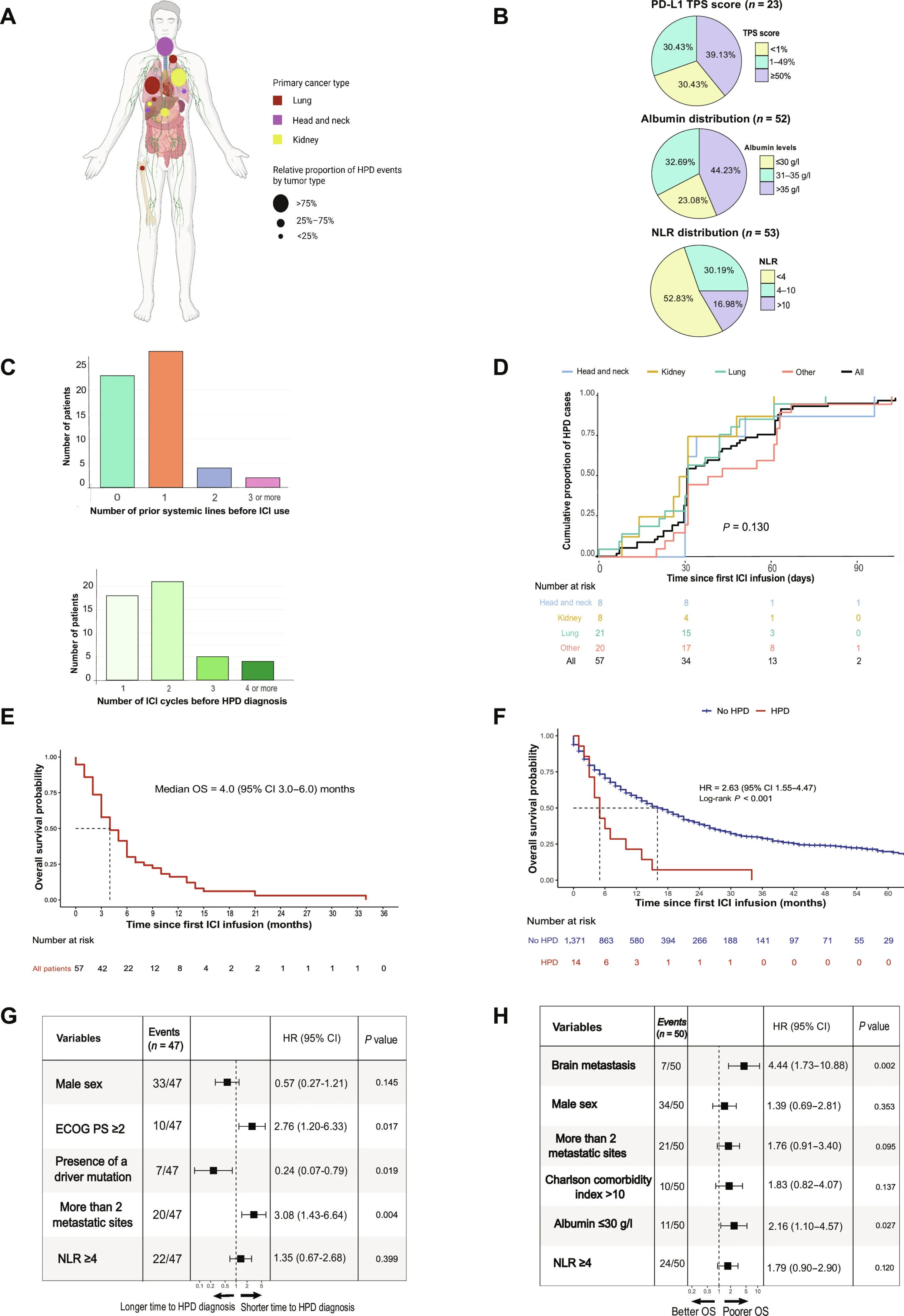
Among more than 13,000 patients treated with immune checkpoint inhibitors across four French cancer centers, only 57 patients fulfilled the study definition of hyperprogression. Clinician-documented HPD represented approximately 0.43% of all ICI-treated patients, highlighting that although hyperprogression is uncommon, it is a highly consequential event when it occurs.
Patients developing HPD were predominantly male, with a median age of 64 years. Most had metastatic disease and generally maintained good performance status before starting immunotherapy. Nearly half received ICIs as first-line treatment, while approximately half were treated in the second-line setting. Pembrolizumab and nivolumab were the most frequently administered agents.
Where Does Hyperprogression Occur?
The anatomical pattern of hyperprogression varied according to tumor type. Lung cancer represented the most common primary malignancy associated with HPD, accounting for nearly 37% of cases. Kidney cancer and head and neck cancer each contributed approximately 14% of cases.
- Lung cancer accounted for 36.8% of HPD cases.
- Kidney cancer accounted for 14.0% of cases.
- Head and neck cancer accounted for 14.0% of cases.
- In lung cancer, hyperprogression was predominantly locoregional, occurring in 95.2% of cases.
- In kidney cancer, distant progression involving the pleuropulmonary region occurred in 62.5% of cases.
Overall, the lung was the most frequent site of hyperprogressive growth.
Hyperprogression Happens Early
One of the most striking observations from the study was how rapidly hyperprogression developed after immunotherapy initiation. Most cases occurred within the first few treatment cycles, often before patients would typically undergo routine radiologic reassessment.
- Median time to hyperprogression was 31 days.
- 77.2% of cases occurred within the first two months of treatment.
- 31.6% developed HPD after only the first cycle of immunotherapy.
- 36.8% developed HPD after the second cycle.
These findings emphasize the importance of close clinical monitoring early during immunotherapy, particularly in patients with rapidly evolving symptoms.
Survival Outcomes
Hyperprogression was associated with poor outcomes. Median overall survival in the HPD population was only four months, underscoring the aggressive nature of this progression pattern. When compared with an independent cohort of ICI-treated patients without documented hyperprogression, survival was substantially worse.
- Median overall survival among HPD patients was 4.0 months.
- Twelve-month overall survival was only 19%.
- In an external comparison cohort, median overall survival was 5 months for HPD patients versus 16 months for non-HPD patients.
- Hyperprogression was associated with a 2.63-fold higher risk of death.
Factors Associated With Earlier Hyperprogression
The investigators also explored clinical factors associated with the timing of HPD development. Patients with greater disease burden and poorer performance status appeared particularly vulnerable to rapid deterioration.
- ECOG performance status ≥2 was associated with a significantly shorter time to HPD diagnosis (HR 2.76).
- More than two metastatic sites increased the risk of earlier HPD (HR 3.08).
- Presence of an oncogenic driver mutation was associated with a longer time before HPD developed (HR 0.24).
Factors Associated With Worse Survival
Not all patients with hyperprogression had the same prognosis. Certain baseline clinical characteristics were associated with particularly poor outcomes after HPD occurred.
- Brain metastases were associated with significantly worse survival (HR 4.44).
- Serum albumin ≤30 g/L was associated with poorer overall survival (HR 2.16).
These findings suggest that both tumor burden and patient frailty contribute substantially to outcomes once hyperprogression develops.
Clinical Implications
The HYPERPROG study reinforces that hyperprogression is a genuine clinical phenomenon with important consequences for patient management. Although uncommon, it typically occurs very early after initiation of immunotherapy and is associated with poor survival. The data support consideration of earlier imaging assessment in high-risk patients and heightened clinical vigilance during the first weeks of treatment.
Importantly, the study was not designed to determine whether immunotherapy directly causes hyperprogression. Instead, it highlights a subset of patients who experience unusually aggressive disease acceleration after treatment initiation and who may require rapid treatment modification, including consideration of chemotherapy-based rescue strategies.
Conclusion
The HYPERPROG study provides one of the most comprehensive real-world descriptions of hyperprogressive disease to date. Hyperprogression appears to be rare but clinically devastating, typically emerging within the first month of immunotherapy and leading to markedly inferior survival outcomes. Patients with poor performance status, extensive metastatic burden, brain metastases, or low serum albumin may represent particularly vulnerable populations. As immunotherapy continues to expand across oncology, improving recognition and understanding of hyperprogression will remain essential for optimizing patient care and guiding future research.

Pseudoprogression During Immune Checkpoint Inhibitor Therapy