
 Brazil
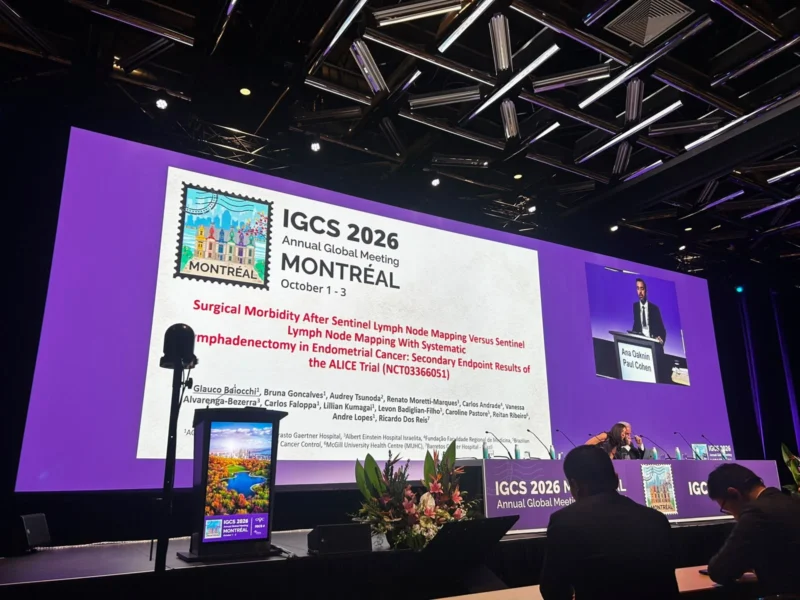
Surgical staging of endometrial cancer is undergoing a period of transition. At the IGCS 2026 Annual Global Meeting in Montreal, the Brazilian group led by Dr. Glauco Baiocchi, from A.C. Camargo Cancer Center, presented secondary endpoint results from the ALICE trial—a prospective, randomized noninferiority study designed to investigate whether systematic lymphadenectomy can be safely omitted in selected patients with high-intermediate- and high-risk, apparently uterine-confined endometrial cancer.
The study represents an important contribution from Brazilian gynecologic oncology researchers and may help inform future surgical staging strategies.
Who were the patients evaluated?
The ALICE trial enrolled patients with high-risk histologies — grade 3 endometrioid, serous, clear cell, and carcinosarcoma — or grade 1 and 2 endometrioid tumors with ≥50% myometrial invasion or cervical invasion on imaging, with disease apparently confined to the uterus and no suspicious lymph nodes on preoperative workup.
After total hysterectomy with bilateral salpingo-oophorectomy and sentinel lymph node (SLN) mapping, patients were randomized 1:1 into two arms:
- SLN only — no completion lymph node dissection;
- SLN + systematic pelvic and para-aortic lymphadenectomy up to the renal veins.
Mapping followed the algorithm established by the NCCN, with cervical injection of blue dye or indocyanine green and ultrastaging of all SLNs negative on hematoxylin and eosin. The study’s primary endpoint is 3-year disease-free survival; secondary endpoints include 5-year overall survival, surgical morbidity classified by the Clavien-Dindo system, lower limb lymphedema, and quality of life (EORTC QLQ-C30 and QLQ-CX24). Recruitment began in 2017, and the sample size projected in the published protocol was 178 patients.
A Brazilian study conducted across major oncology centers
One of the most highlighted aspects in Montreal was the national multicenter collaboration that made the ALICE trial possible. Participating institutions included:
- A.C. Camargo Cancer Center, São Paulo (coordinating center);
- Barretos Cancer Hospital (Fundação Pio XII), Barretos;
- Erasto Gaertner Hospital, Curitiba;
- Brazilian Institute for Cancer Control, São Paulo;
- Hospital Israelita Albert Einstein, São Paulo;
- Fundação Faculdade Regional de Medicina (FAMERP), São José do Rio Preto;
- McGill University Health Centre, Montreal, with Dr. Reitan Ribeiro, a Brazilian member of the group currently based in Canada.
This collaboration brings together gynecologic oncology services across Brazilian public and private healthcare settings and demonstrates the country’s capacity to conduct randomized surgical oncology trials.
A paradigm shift: why does this study matter?
For decades, systematic lymphadenectomy was considered a mandatory step in surgical staging. Although previous randomized trials have evaluated the role of systematic lymphadenectomy in endometrial cancer, randomized evidence comparing sentinel lymph node mapping alone with sentinel lymph node mapping followed by systematic lymphadenectomy has been lacking.
The ALICE trial was designed precisely to fill this gap and support the paradigm shift. Three other prospective trials are moving in the same direction worldwide (SELECT, in the US; SNEC, in China; and ENDO-3, in Australia and New Zealand) — but the ALICE trial was the first to present results.
Reduced surgical morbidity with sentinel lymph node staging
An interim analysis presented at IGCS 2021 demonstrated higher rates of early postoperative complications among patients undergoing SLN mapping plus lymphadenectomy compared with SLN mapping alone (32% versus 14.1%; p=0.011). Grade ≥3 complications occurred in 5% and 0.8% of patients, respectively.
The secondary endpoint findings presented at IGCS 2026 further highlighted the potential benefits of omitting systematic lymphadenectomy, including reduced surgical morbidity and lower limb lymphedema, alongside improved quality of life.
These findings support the potential benefits of less extensive surgical staging in appropriately selected patients. However, the primary disease-free survival analysis is necessary to establish whether omitting systematic lymphadenectomy achieves the trial’s predefined oncologic noninferiority criteria.
In practice, these findings suggest that selected patients with high-intermediate- and high-risk, apparently uterine-confined endometrial cancer may benefit from less extensive surgical staging, potentially offering:
- lower risk of lymphedema and lymphocysts;
- lower risk of neurovascular injury;
- fewer infectious complications and reoperations;
- better quality of life and faster return to daily activities.
You can also read:
20 Posts Not To Miss From IGCS 2026

FAQ
Does sentinel lymph node mapping replace lymphadenectomy in all cases?
No. The ALICE data apply to high-intermediate and high-risk patients with apparently uterine-confined disease and identified sentinel nodes. Extrauterine disease, suspicious nodes on imaging, and failure of mapping still warrant more extensive procedures.
What happens when the sentinel lymph node is positive?
Under the ALICE protocol, an intraoperative positive SLN led to study exclusion and management according to institutional practice. The management of the positive SLN remains a subject of ongoing investigation.
When will the survival results be published?
The formal analysis of the primary endpoint (3-year disease-free survival) is expected to be published after the data are presented at congresses — details to be announced by the coordinating group in a primary publication.