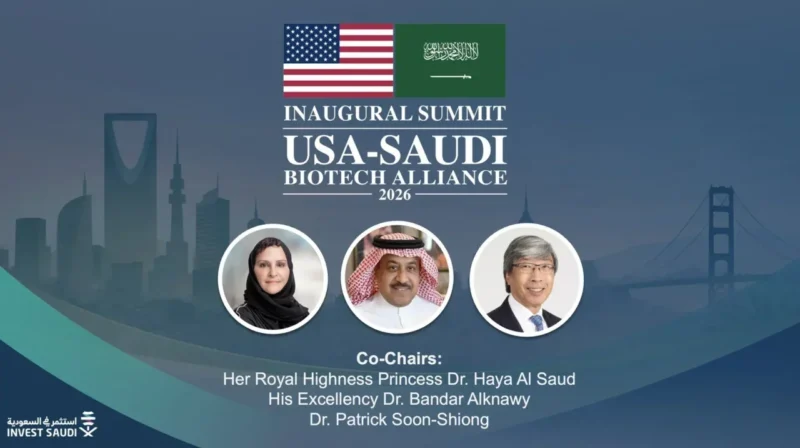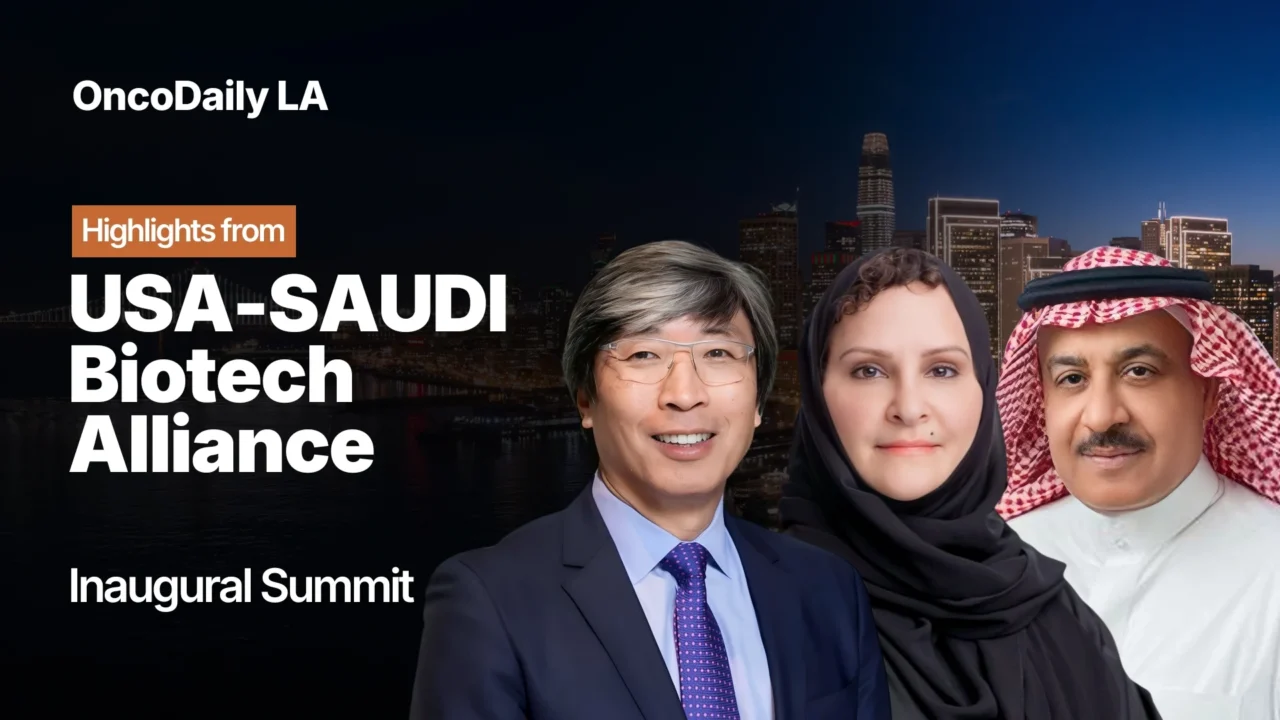
San Francisco, CA — The inaugural USA–Saudi Biotech Alliance Summit, a major biotech gathering co‑chaired by Dr. Patrick Soon‑Shiong, H.E. Dr. Bandar Alknawy, and Her Royal Highness Princess Haya bint Khaled Al Saud, brought together senior Saudi health leaders, U.S. scientists, biotech innovators, and global investors for a day of high‑level dialogue on the future of biotechnology, immunotherapy, and healthspan science. Director of OncoDaily LA, Dr. Martin Harutyunyan, attended the summit in person, documenting the discussions, interviewing key figures, and producing this report.
The gathering underscored a shared ambition: to build a new model of global collaboration that unites Saudi Arabia’s long‑term national vision with the United States’ deep scientific and biotech expertise.
How Is Saudi Arabia Positioning Healthspan at the Center of Vision 2030?
A defining theme of the USA–Saudi Biotech Alliance Summit was the shift from treating disease to extending healthy lifespan. Her Royal Highness Princess Haya bint Khaled Al Saud, speaking in her role at Hevolution, emphasized that the foundation’s mission is rooted in advancing science that improves the quality of life, not merely its duration. She described Hevolution’s focus on supporting the development of therapies that target the biology of aging, investing in technologies that accelerate translational research, and ensuring that emerging healthspan innovations reach broad populations.
Saudi Arabia’s demographic profile — with a majority of citizens under 30 — makes early prevention and healthspan science a national priority. Vision 2030 positions health, science, and innovation as essential pillars of a vibrant, productive society. Princess Haya highlighted that the Kingdom is investing not only in research but in USA–Saudi alliances that bring together scientists, policymakers, and innovators from around the world.
What Does Healthcare Transformation Look Like in Practice?
A senior Saudi health leader outlined how the Kingdom’s healthcare system has undergone a structural transformation in recent years. The Ministry of Health now serves as a strategic regulator rather than the primary provider of services, overseeing an ecosystem that includes hospitals, insurers, regulatory bodies, and specialized agencies.
The focus has shifted decisively toward measurable outcomes, including healthy life expectancy, equitable access, and disease prevention. Digital health, early detection, and integrated care models are central to this transformation, which forms the backbone of the country’s biotechnology ambitions and strengthens the foundation for USA–Saudi health collaboration.
What Is the Long‑Term Vision Behind Saudi Arabia’s National Biotechnology Strategy?
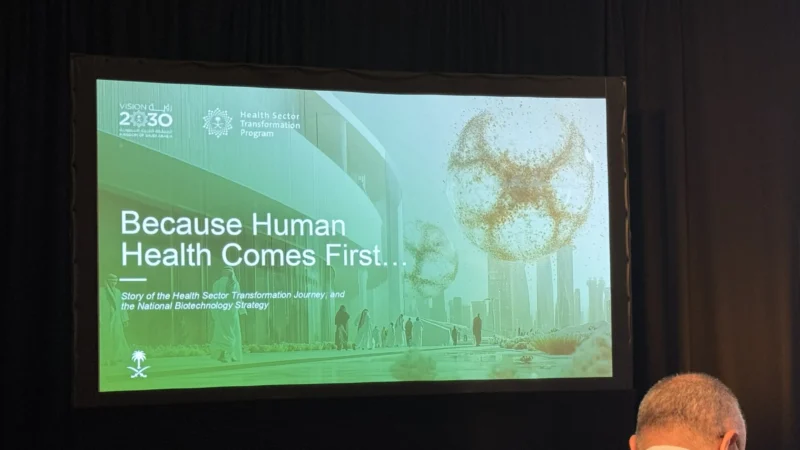
Saudi Arabia’s National Biotechnology Strategy was presented as a long‑range blueprint extending beyond 2030. The strategy aims to position the Kingdom as a regional biotech leader by 2030 and a global contributor by 2040. It focuses on vaccines, biomanufacturing, genomics, precision medicine, and advanced therapies such as cell and gene treatments.
Speakers emphasized that this strategy is backed by regulatory modernization, targeted funding, and dedicated R&D zones. It is not a theoretical plan; it is a coordinated national effort with clear milestones and strong political support — and a key pillar of the broader USA–Saudi biotech partnership.
How Is KMART / KFSHRC Building a World‑Class Translational Research Ecosystem?
One of the most detailed scientific presentations came from the King Faisal Specialist Hospital & Research Centre (KFSHRC) / KMART ecosystem, which described how its integrated research–clinical–education model enables rapid translation of scientific discoveries into patient care.
The system spans multiple regions of the country and supports a full pipeline from basic research to Phase I–III clinical trials. KMART hosts the only SFDA‑certified Phase I clinical trial unit in the Kingdom and currently runs more than 150 active clinical trials. Its researchers publish over 2,000 scientific papers each year, many in high‑impact journals, reflecting a strong culture of international collaboration — including growing USA–Saudi research partnerships.
A major highlight was the Saudi Biobank, which now includes more than 65,000 participants. The biobank integrates deep phenotyping, lifestyle data, and multi‑omics platforms — including genomics, proteomics, transcriptomics, metabolomics, and a national microbiome project. Tissue blocks linked to digital pathology and a growing iPSC program further strengthen its role as a cornerstone of precision‑medicine research and a valuable asset for USA–Saudi scientific cooperation.
The message to global partners was clear: the foundations are in place, the infrastructure is mature, and the Kingdom is ready for execution‑focused collaborations.
Why Was the SFDA’s Expedited Approval a Pivotal Moment?
One of the summit’s most significant announcements came from the Saudi Food and Drug Authority (SFDA), which granted an expedited approval for a first‑in‑class immunotherapy after extensive scientific review. The approval followed months of evaluation, multiple expert meetings, and a large technical dossier.
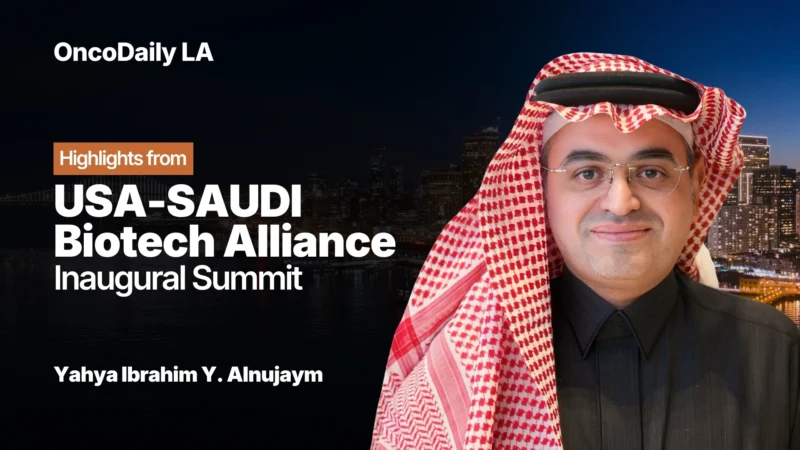
In his interview with OncoDaily LA, Yahya Alnujaym, Executive Director for Investment Development at the SFDA, emphasized that this regulatory milestone reflects the agency’s commitment to accelerating access to innovative therapies while maintaining global‑standard rigor. His remarks reinforced that Saudi Arabia is building a regulatory environment designed to enable biotech investment, clinical research, and international collaboration.
Speakers described this as a milestone for Saudi patients and a signal of the country’s regulatory sophistication. It also opens the door to new clinical trials and expanded research collaborations, strengthening the regulatory dimension of the USA–Saudi biotech alliance.
How Are NK Cells and iNKT Cells Redefining Immunotherapy?
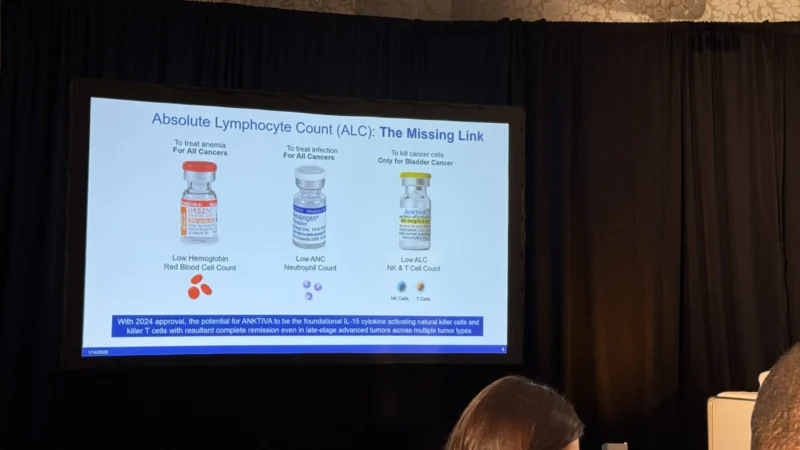
A central scientific theme of the USA–Saudi Biotech Alliance Summit was the rise of immune‑restoring therapies. Dr. Patrick Soon‑Shiong presented data on natural killer (NK) cells, describing them as an ancient defense mechanism capable of eliminating cancer cells from the outside, independent of mutational complexity. He shared clinical observations across multiple tumor types showing complete remissions, durable responses, and meaningful improvements in quality of life among patients who had exhausted conventional options.
He also emphasized the importance of the absolute lymphocyte count (ALC) — a straightforward measure of immune competence that strongly correlates with survival yet remains underutilized in routine oncology practice.
In parallel, Jennifer Buell’s work on invariant natural killer T (iNKT) cells — highlighted in her OncoDaily commentary on the USA–Saudi Biotech Alliance — underscored their unique immunologic role. She described iNKT cells as “one of the most highly conserved cells in immunity… a master coordinator of immunity,” reflecting their ability to orchestrate broad immune responses. Buell explained that her team’s platform can generate multiple therapeutic doses from a single donor without requiring lymphodepletion or HLA matching, and early clinical experience in oncology and critical illness demonstrates a strong safety profile with encouraging survival trends.
Together, these advances signal a shift toward immune‑centered oncology and precision medicine, where rebuilding immune resilience becomes as essential as directly targeting tumors.
What Could Automated Cell Therapy Manufacturing Mean for Global Access?
Looking ahead, Dr. Soon-Shiong described an emerging generation of automated, AI-assisted cell-therapy manufacturing systems designed to take a blood sample, expand NK and CAR-T cells, and produce large quantities with minimal human intervention.
He described this concept as an “immune bank” — a scalable platform that could broaden access to advanced therapies. Plans were discussed to deploy such systems in both the United States and Riyadh, creating a shared infrastructure for next‑generation cell therapies and deepening USA–Saudi innovation pathways.
What Are Researchers Learning About COVID Persistence and Long‑Term Health?
The summit also addressed the possibility that SARS‑CoV‑2 may persist in tissues and influence long‑term health outcomes. Researchers presented findings showing viral material in multiple organs after infection, raising concerns about chronic inflammation, immune exhaustion, and potential links to cancer outcomes.
While the science is still evolving, the discussion underscored the importance of immune‑restoring therapies and robust national biotech infrastructures for future health security — a priority shared across the USA–Saudi health partnership.
The USA–Saudi Biotech Alliance Summit revealed a new model of scientific partnership — one that is vision‑driven, infrastructure‑backed, regulation‑enabled, and scientifically ambitious. It reflects a shift from competition to shared construction of the future of medicine, centered on healthspan, immune resilience, and global collaboration.