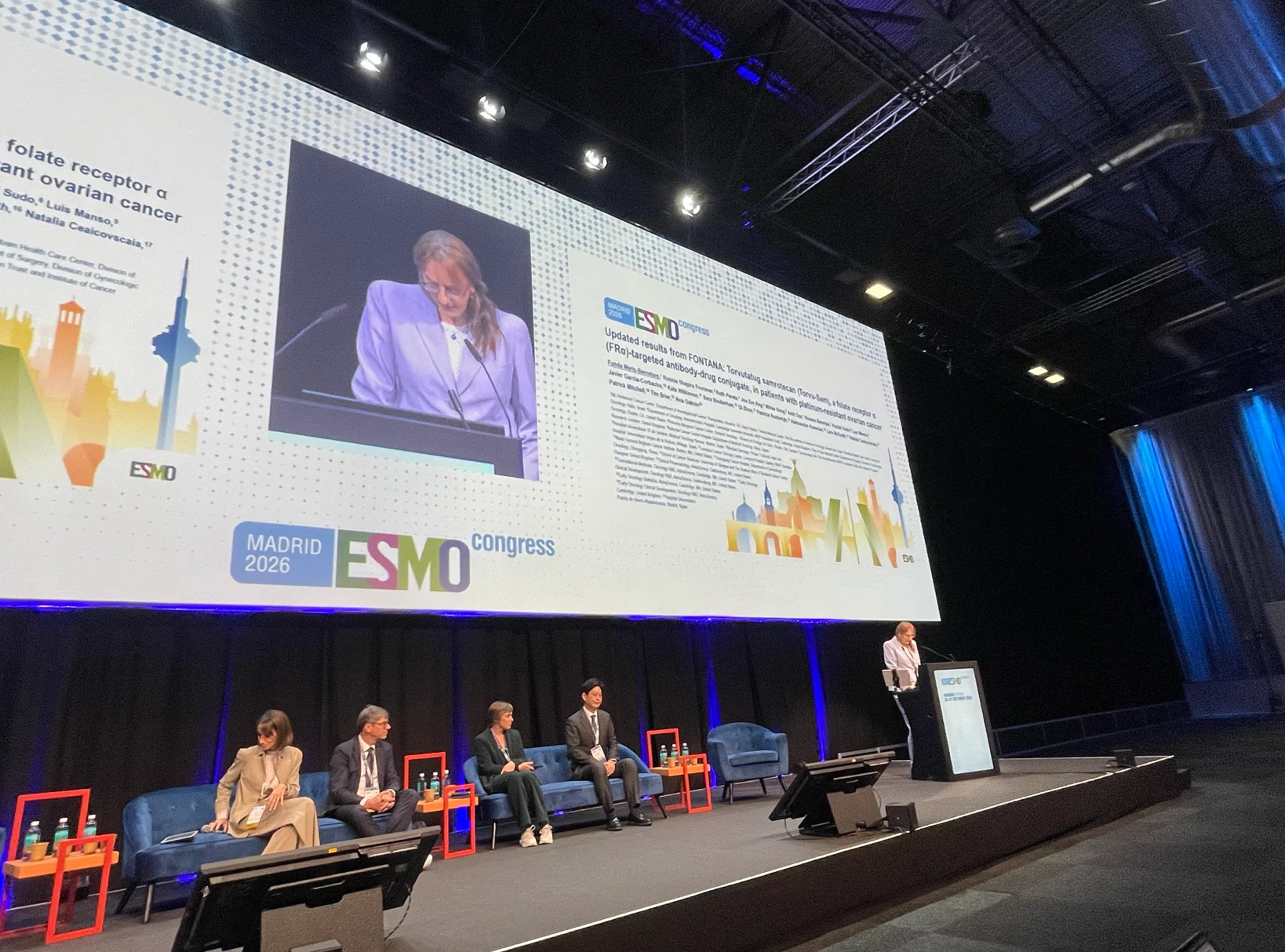
At the ESMO Congress 2026, Funda Meric-Bernstam (Houston, United States) presented updated findings from the phase I/IIa FONTANA trial (NCT05797168), evaluating torvutatug samrotecan (torvu-sam; AZD5335), a folate receptor alpha (FRα)-targeted antibody–drug conjugate (ADC), in patients with platinum-resistant ovarian cancer.
The investigational therapy demonstrated promising antitumor activity, achieving a confirmed objective response rate (ORR) of 56.6% across the pooled dose-expansion efficacy population, with responses observed across different levels of FRα expression.
Methods
FONTANA is a first-in-human, open-label phase I/IIa study evaluating the safety, tolerability, and preliminary efficacy of torvutatug samrotecan, an ADC designed to deliver a topoisomerase I inhibitor payload to FRα-expressing tumor cells.
The study enrolled adults with platinum-resistant ovarian cancer across dose-escalation and dose-expansion cohorts. Dose escalation included patients regardless of FRα expression or prior treatment lines, while dose expansion enrolled patients who had received no more than three previous lines of therapy.
Patients received intravenous torvu-sam every three weeks. The dose-expansion cohorts evaluated 1.6, 2.0, and 2.4 mg/kg across different FRα expression levels.
Safety and tolerability were the primary objectives, while preliminary efficacy and circulating tumor DNA (ctDNA) responses were assessed as secondary and exploratory outcomes.
Key Takeaways
At the March 16, 2026, data cutoff, 223 patients had received torvu-sam, with a median treatment exposure of 7.1 months.
- Overall confirmed ORR: 56.6% (81/143) across the pooled dose-expansion efficacy population.
- FRα-high tumors: Confirmed ORR of 61.7% (37/60).
- FRα-low tumors: Confirmed ORR of 57.1% (36/63).
- FRα-ultralow or FRα-null tumors: Confirmed ORR of 40.0% (8/20).
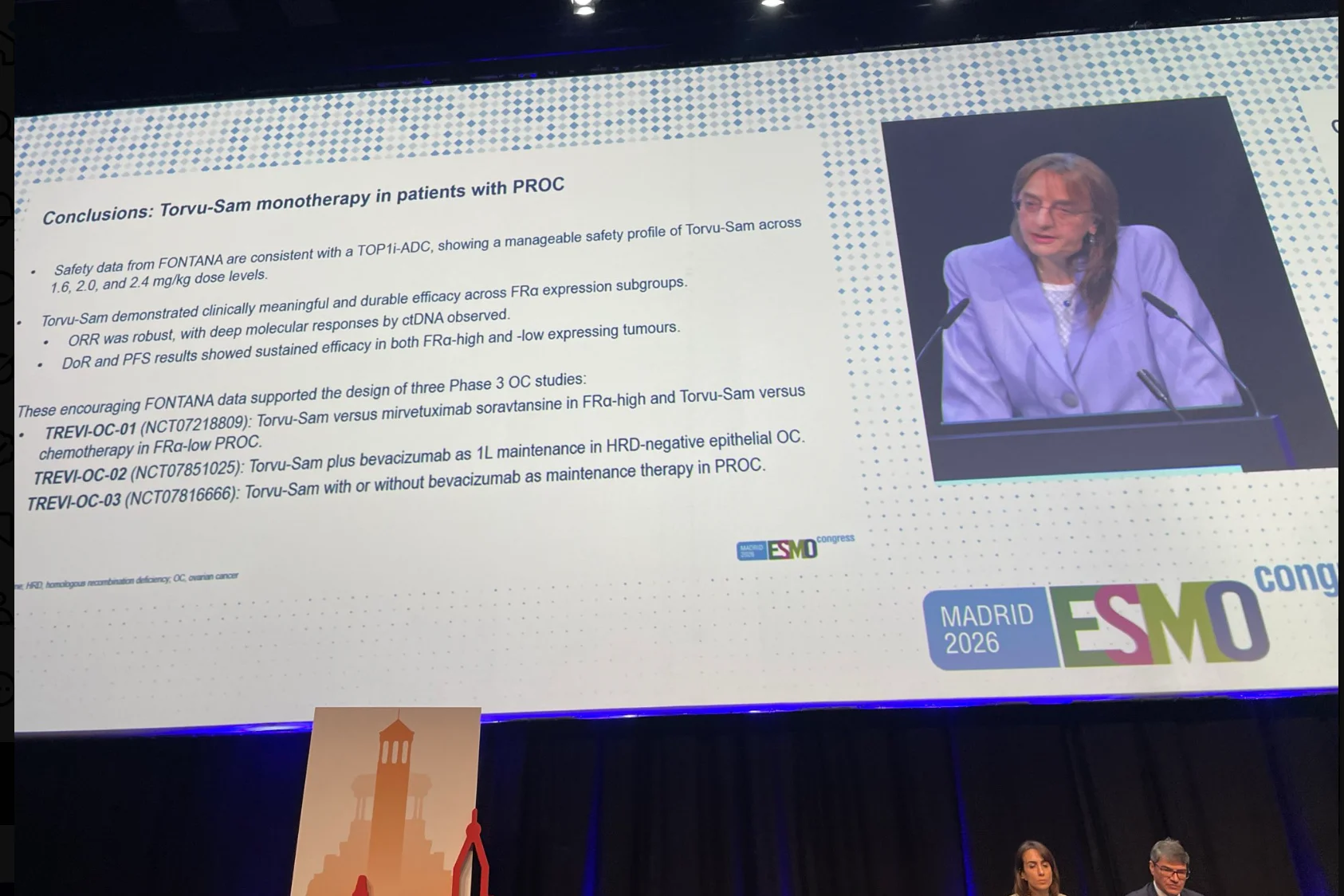
- Molecular response: ctDNA responses were observed across dose levels and FRα expression subgroups.
- Common adverse events: Nausea (76.7%), fatigue (59.2%), neutropenia (54.3%), vomiting (49.3%), and anemia (47.5%).
- Grade 3–4 adverse events: Neutropenia occurred in 25.6% of patients, followed by anemia (15.7%).
- Dose modifications: Treatment-emergent adverse events led to dose reductions in 26.5% and treatment discontinuation in 8.1% of patients.
Conclusion
The updated FONTANA findings demonstrated promising and sustained antitumor activity with torvutatug samrotecan in patients with platinum-resistant ovarian cancer, with a manageable safety profile across the evaluated dose levels.
The 56.6% confirmed response rate, together with evidence of durable efficacy across FRα expression subgroups and deep molecular responses, supports further clinical investigation. However, the early-phase, nonrandomized study design limits conclusions about comparative efficacy.
The findings have supported the development of three phase III studies:
- TREVI-OC-01 (NCT07218809): Evaluating torvutatug samrotecan against mirvetuximab soravtansine in FRα-high platinum-resistant ovarian cancer and against chemotherapy in FRα-low disease.
- TREVI-OC-02 (NCT07851025): Evaluating torvutatug samrotecan plus bevacizumab as first-line maintenance therapy in HRD-negative epithelial ovarian cancer.
- TREVI-OC-03 (NCT07816666): Evaluating torvutatug samrotecan with or without bevacizumab as maintenance therapy in platinum-resistant ovarian cancer.
These studies will further investigate the potential role of torvutatug samrotecan across different ovarian cancer treatment settings.
Source: ESMO Congress 2026, Abstract 1245RO; FONTANA trial (NCT05797168).
Jose Alejandro Perez Fidal shared on X: