A strategy targeting paired genetic weaknesses in cancer cells, where simultaneous disruption kills cancer cells while sparing normal cells, this is called synthetic lethality.
Advances in genome sequencing are transforming cancer treatment, enabling the rapid identification of genetic and epigenetic alterations that distinguish tumor cells from normal cells in individual patients. These tumor-specific changes not only illuminate the biological mechanisms driving cancer progression but also uncover vulnerabilities that can be exploited for targeted therapy. Personalized, genotype-driven cancer treatment offers the promise of highly specific therapies with fewer side effects, while minimizing overtreatment. Increasingly, such precision oncogenomic approaches are being implemented in clinical practice and have shown encouraging results, particularly for patients whose tumors do not respond to conventional treatments.
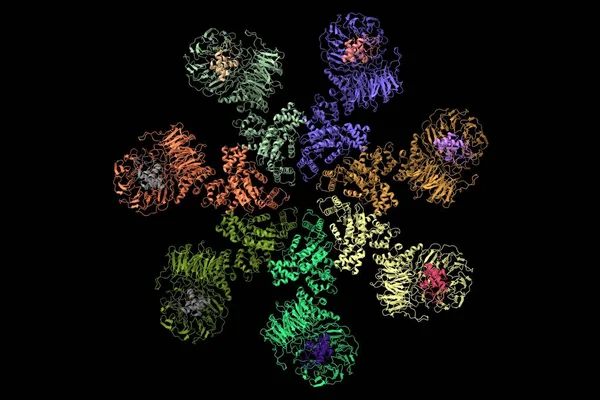
The structure of the Apaf-1 apoptosome with cytochrome c is shown.Photo: Depositphotos
Most current genotype-targeted cancer therapies exploit oncogene addiction, where a tumor relies on a specific oncogene or oncogenic pathway for survival. While small-molecule and antibody-based inhibitors have shown efficacy against certain tumor genotypes, many tumors lack targetable gain-of-function oncogenes, and therapeutic resistance frequently arises. In such cases, it may be possible to exploit both oncogenic and non-oncogenic mutations by identifying second-site targets that, when disrupted alongside a tumor-specific mutation, induce synthetic lethality.
O’Neil, N., Bailey, M. & Hieter, P. Synthetic lethality and cancer. Nat Rev Genet 18, 613–623 (2017).
What is Synthetic Lethality?
Every human has two copies (alleles) of most genes one from their mother and one from their father. If both copies are normal, the gene works properly and the person does not develop a disease. If one copy is mutated, the person can often still stay healthy because the other copy is doing the job, but they are already in a higher risk zone, since environmental factors or additional changes may damage the healthy copy. When both alleles are mutated, the gene loses its function completely; this can lead to disease, including cancer.
Synthetic lethality therapy is used when a person has one mutated allele and one already lost or non-functioning allele in critical repair genes (like BRCA); in this situation, blocking a second repair pathway (such as PARP) forces the cancer cell to die, while normal cells with two healthy alleles can still survive.
Synthetic lethality provides a conceptual framework for using this information to arrive at drugs that will preferentially kill cancer cells relative to normal cells. It also provides a possible way to tackle ‘undruggable’ targets. Two genes are synthetically lethal if mutation of either gene alone is compatible with viability but simultaneous mutation of both genes leads to death. If one is a cancer-relevant gene, the task is to discover its synthetic lethal interactors, because targeting these would theoretically kill cancer cells mutant in the cancer-relevant gene while sparing cells with a normal copy of that gene.
Why Does it Selectively Kill Cancer Cells?
Every cell in our body has more than one system to repair damage and keep itself alive. You can think of these systems as two support beams holding up a roof: even if one is missing, the other can usually hold the structure in place. In cancer cells, however, one of these essential supports is often already broken. That weakness doesn’t usually kill the tumor on its own, but it makes the cell much more dependent on the backup system that is still working.

Photo: Depositphotos
Synthetic lethality therapy takes advantage of this weakness. Instead of trying to repair the broken part, the treatment blocks the backup pathway that the tumor cell relies on. Once both supports are gone, the cancer cell can no longer cope with the constant damage that happens naturally as it grows and divides. The damage builds up until the cell cannot function anymore and dies.
How do BRCA Mutations Make Tumors Vulnerable?
We focus on the BRCA genes because they are the best-studied DNA repair genes linked to cancer, and harmful mutations in BRCA1 or BRCA2 greatly increase the risk of breast, ovarian, prostate, and pancreatic cancers. Since BRCA mutations create a natural weak spot in tumor cells, they have become the leading example of how synthetic lethality can be used in real patients. In fact, therapies that target BRCA-PARP interactions are among the primary gene-targeted synthetic lethality treatments approved by major global health organizations such as the FDA and EMA.
This vulnerability arises because BRCA-mutated cells lose their ability to repair double-strand DNA breaks through the high-fidelity homologous recombination pathway. As a result, they become heavily dependent on alternative, error-prone repair mechanisms to survive. When PARP, an enzyme responsible for repairing single-strand breaks, is inhibited in these cells, the DNA damage accumulates and eventually collapses into double-strand breaks. Since BRCA-deficient cells cannot properly fix these breaks, the damage becomes overwhelming and leads to selective cancer cell death, while healthy cells with intact BRCA function remain largely unaffected.
Clinically, this concept has led to the development and approval of PARP inhibitors such as olaparib, rucaparib, niraparib, and talazoparib, which have significantly improved outcomes for patients with BRCA-mutated ovarian, breast, prostate, and pancreatic cancers. These therapies represent one of the most successful applications of synthetic lethality in real-world cancer treatment. Still, researchers are working to overcome resistance, which can develop when tumors restore BRCA function or activate alternative DNA repair routes.
Looking ahead, new strategies aim to combine PARP inhibitors with other drugs—such as immunotherapies, ATR inhibitors, or platinum-based chemotherapies—to widen the scope and durability of synthetic lethality-based treatments, reflecting expanding trials and combinations in 2024-2025 trends.
Helleday T.Mol Oncol. 2011 Aug;5(4):387-93. doi: 10.1016/j.molonc.2011.07.001. Epub 2011 Jul 22. PMID: 21821475; PMCID: PMC5528309.
What Challenges Limit these Therapies?
A considerable advantage of these methods, from a biological discovery perspective, is that they are unbiased in that any protein-coding gene can potentially be identified as a SL target. Unfortunately, however, many of the identified targets may lack properties that make them suitable for drug development, with only ~15–20% of protein-coding genes ‘druggable’ using traditional small molecules or antibody-based approaches. Druggability is usually predicted on the basis of structural features of a protein; proteins that lack enzymatic activity or ligand binding sites are often considered undruggable by small molecule approaches.
Beyond the use of different cancer cell lines to assess whether a gene is selectively essential, there are no widely adopted approaches to identify potential toxicity to diverse cell types of a perturbation in non-cancerous cells. Ideally, in addition to the DepMap data, which report on the sensitivity of cancer cell lines to gene inhibition, we would have an analogous resource that reports on the sensitivity of healthy cells to gene inhibition, which would provide insight into potential toxicity associated with targeting different genes.
Some insight can be obtained from systematic mouse knockout studies, which report on which genes can be deleted without obvious developmental defects. Organoid models may also provide insights into which genes are essential across more physiologically relevant contexts and across healthy cell types.
Gonçalves, E., Ryan, C.J. & Adams, D.J. Synthetic lethality in cancer drug discovery: challenges and opportunities. Nat Rev Drug Discov (2025).
What is the Future of Synthetic Lethality in Oncology?
There are 235 preclinically validated SL pairs identified and 1,207 pertinent clinical trials found, with the number continuing to increase over time. About one-third of these SL clinical trials go beyond the typically studied DNA damage response (DDR) pathway, testifying to the recently broadening scope of SL applications in clinical oncology. SL oncology trials have a greater success rate than non-SL-based trials. However, about 75% of the preclinically validated SL interactions have not yet been tested in clinical trials.
Schäffer AA, Chung Y, Kammula AV, Ruppin E, Lee JS. A systematic analysis of the landscape of synthetic lethality-driven precision oncology. Med. 2024 Jan.
Synthetic lethality (SL) is one of the new age treatment methods being explored for combating resistance to anticancer agents. In this method, cell mutations are exploited for the development of new therapeutic agents, where, if there is loss of function of one gene, the cell mutations can still be fixed by alternative machinery but if two genes involved in DNA repair undergo loss of function, it causes lethality to the cell.
Yar MS, Haider K, Gohel V, Siddiqui NA, Kamal A. Synthetic lethality on drug discovery: an update on cancer therapy. Expert Opin Drug Discov. 2020 Jul;15(7):823-832.
You Can Also Read Epigenetic Modifiers in Cancer Therapy: Unlocking New Treatment Pathways by OncoDaily

Written by Anahit Mkrtchyan
FAQ
How is synthetic lethality different from chemotherapy or radiation?
Chemotherapy and radiation attack all fast-growing cells in the body, which is why they can affect healthy tissues like hair follicles, the stomach lining, or bone marrow. Synthetic lethality works very differently. It targets cancer cells based on the specific gene defects they carry. Because the treatment focuses on cells with these unique vulnerabilities, healthy cells are usually spared, and side effects are generally milder.
Who can benefit from this therapy?
Patients whose cancers contain certain gene mutations—most commonly BRCA1 or BRCA2—may benefit from synthetic lethality treatments. Doctors perform genetic testing on your tumor or blood. If these mutations are found, you may be eligible for medicines that use this approach, such as PARP inhibitors.
What are PARP inhibitors?
PARP inhibitors are a group of drugs that block an enzyme called PARP, which helps cells repair damaged DNA. Cancer cells with BRCA mutations already have trouble repairing their DNA. When PARP is blocked as well, the cancer cell becomes overwhelmed by damage and dies. This is the core principle of synthetic lethality.
Why doesn’t this treatment harm healthy cells?
Healthy cells still have working copies of DNA repair genes such as BRCA. Even when PARP is blocked, they can rely on these backup repair systems to survive. Cancer cells lack this safety net—so when both repair pathways are disabled, they cannot recover and eventually die.
For what cancers is synthetic lethality used today?
Right now, the approach is mainly used for breast, ovarian, prostate, and pancreatic cancers that have BRCA mutations or related DNA repair defects. Many clinical trials are underway to test similar strategies in other cancer types.
How do doctors know if I can receive this therapy?
Your doctor will perform genetic testing—either on your tumor tissue or through a blood sample—to check for mutations in genes involved in DNA repair, like BRCA1 and BRCA2. If these mutations are present, PARP inhibitor therapy may be recommended.
What medicines use this approach?
Several FDA- and EMA-approved PARP inhibitors use the synthetic lethality strategy. These include Olaparib (Lynparza), Rucaparib (Rubraca), Niraparib (Zejula), and Talazoparib (Talzenna). All of them are taken orally as pills.
What are the common side effects?
Most patients tolerate PARP inhibitors better than traditional chemotherapy. Common side effects can include fatigue, nausea, mild anemia, and decreased appetite. Doctors can manage most symptoms with supportive care and regular monitoring.
What’s next for synthetic lethality treatments?
Researchers are actively identifying new gene pairs that can be targeted using this approach. The long-term goal is to expand synthetic lethality beyond BRCA-related cancers and offer more personalized, safer treatment options to a wider range of patients.