


For someone living with cancer, few words carry as much meaning as remission, recurrence, and cure.
Hearing that cancer is in remission may bring relief after months of treatment. Learning that a tumor has responded to therapy can offer reassurance that treatment is having an effect. Yet medical reports often contain other terms, including complete response, stable disease, or no evidence of disease, that can be difficult to interpret without explanation.
Do these terms mean the cancer has disappeared? Is remission the same as being cured? And what does it mean when a doctor says the disease is stable?
Although these expressions are sometimes used interchangeably in everyday conversations, they describe different clinical situations.
Understanding the distinction can help patients interpret their medical results, participate in treatment discussions, and develop realistic expectations about their care.
What Does Remission Actually Mean?
Hearing that cancer is in remission can be one of the most reassuring moments for a patient. But what does remission actually mean? Does it mean the cancer is gone, or could it return?
Remission means that the signs and symptoms of cancer have decreased or disappeared. It is an important indication of disease response, but it does not always mean that the cancer has been cured.
There are two main types of remission:
- Complete remission: All detectable signs of cancer have disappeared. However, cancer cells may still remain at levels too small to be detected by available tests.
- Partial remission: The cancer has decreased in size or extent but remains detectable. The exact criteria depend on the cancer type and the method used to assess treatment response.
Doctors assess remission using appropriate examinations, imaging, laboratory tests, and sometimes molecular testing. The methods vary depending on the type of cancer.
How long does remission last? There is no single answer. Some patients remain in remission for many years, while others may experience recurrence. The likelihood of recurrence depends on factors such as cancer type, stage, tumor biology, and treatment response.
Remission also does not necessarily mean that treatment is finished. Some patients continue maintenance or other therapies, while others enter a period of regular follow-up.
The key distinction is that remission describes the current status of cancer, while cure implies that the disease is not expected to return. Understanding this difference helps patients interpret their results and discuss the next steps with their oncology team.
Complete Remission: When Cancer Is No Longer Detectable
Complete remission, also called complete response in certain clinical contexts, means that all detectable signs of cancer have disappeared following treatment.
For example, a patient may undergo systemic treatment and subsequently have imaging studies showing no detectable evidence of the previously identified disease.
This is an important treatment outcome, but it does not always mean the patient has been cured.
Current diagnostic methods have detection limits. Microscopic cancer cells may remain even when clinical examinations and imaging studies no longer identify active disease.
The significance of complete remission also varies across cancer types. Response assessment in leukemia, for example, uses disease-specific hematologic and sometimes molecular criteria, which differ from imaging-based criteria used for many solid tumors.
Partial Remission: When Treatment Reduces Cancer but Does Not Eliminate It
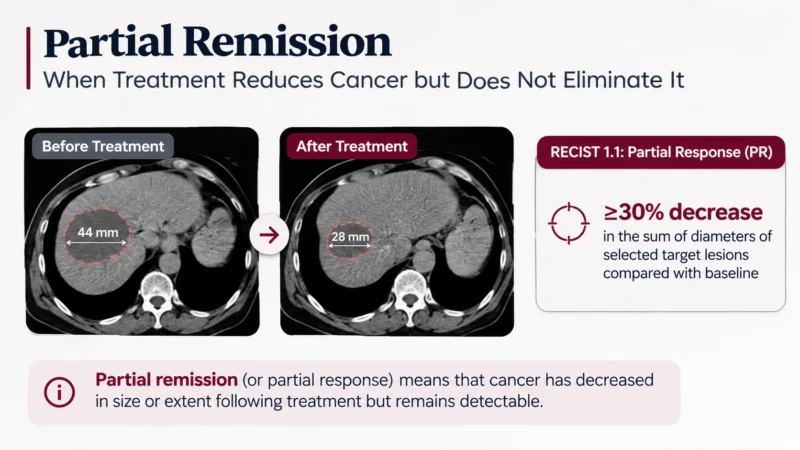
Partial remission, also called partial response (PR), occurs when cancer decreases in size or extent following treatment but remains detectable.
For many solid tumors, oncologists and clinical researchers use the Response Evaluation Criteria in Solid Tumors (RECIST 1.1) to assess treatment response.
Under RECIST 1.1, partial response requires at least a 30% reduction in the sum of diameters of selected target lesions compared with baseline, without findings that would establish overall progressive disease.
These criteria provide a standardized approach to evaluating tumor response, particularly in clinical trials. However, they are not universally applicable to all malignancies, and other disease-specific assessment systems may be required.
For example, a patient with metastatic colorectal cancer may undergo systemic treatment and demonstrate a substantial reduction in measurable tumor lesions on follow-up imaging. If the relevant response criteria are fulfilled, the result may be classified as a partial response.
Although the cancer remains detectable, this reduction may represent a clinically meaningful treatment benefit.
The importance of partial remission depends not only on tumor shrinkage but also on factors such as the duration of response, symptom control, treatment tolerability, and the patient’s overall clinical condition.
How Do Oncologists Assess Cancer Remission?
Remission is established through clinical assessment and appropriate diagnostic investigations rather than symptoms alone.
The methods used depend on the cancer type and treatment setting.
These may include:
- Imaging studies: CT, MRI, or other appropriate imaging modalities to evaluate changes in tumor burden.
- Blood tests: Disease-specific laboratory investigations, including relevant tumor markers when clinically indicated.
- Bone marrow examinations: Particularly important in selected hematologic malignancies.
- Molecular testing: Used in certain cancers to identify residual disease or assess the depth of treatment response.
- Clinical examinations: Assessment of physical findings, symptoms, and overall health.
No single test can reliably determine remission status in every type of cancer.
For example, normal tumor marker levels alone do not necessarily establish complete remission, just as a negative imaging study cannot always exclude microscopic residual disease.
The interpretation of results requires consideration of the entire clinical picture.
How Long Can Remission Last?
The duration of remission varies considerably.
Some patients remain in remission for months, while others experience sustained remission for many years.
Factors that may influence the likelihood and duration of remission include the type and stage of cancer, molecular characteristics, response to treatment, and the presence of residual disease.
In certain malignancies, long-lasting complete remission may be associated with a high likelihood of cure. In others, recurrence remains possible even after an extended disease-free interval.
Importantly, there is no universal period of remission after which every cancer can be considered cured.
The meaning of long-term remission must therefore be interpreted according to the specific malignancy and the patient’s clinical circumstances.
Can Cancer Return After Complete Remission?
Yes. Cancer can recur after a period of complete remission, although the likelihood varies considerably between patients and cancer types.
Recurrence may be classified according to where the disease returns:
- Local recurrence: Cancer returns at or near its original site.
- Regional recurrence: Cancer returns in nearby lymph nodes or surrounding tissues.
- Distant recurrence: Cancer appears in organs or tissues distant from the original tumor, representing metastatic spread of the original malignancy.
Recurrence should not be confused with a second primary cancer, which develops independently of the original malignancy.
The risk and timing of recurrence depend on factors such as tumor biology, initial stage, treatment response, and other disease-specific characteristics.
What About ctDNA Testing in Solid Tumors?
In solid tumors, researchers and clinicians are increasingly investigating circulating tumor DNA (ctDNA), which consists of tumor-derived DNA fragments found in the bloodstream.
After cancer treatment, detection of ctDNA may indicate the presence of molecular residual disease and, in certain settings, identify patients at increased risk of recurrence.
However, ctDNA testing is not universally recommended for routine surveillance or treatment decision-making across all solid tumors.
Its clinical utility depends on the specific cancer type, disease setting, assay performance, and evidence that acting on the result improves patient outcomes.
A positive ctDNA result does not always establish radiologically detectable recurrence, while a negative result cannot completely exclude residual cancer.
Can Cancer Be Completely Cured?
Yes. Many cancers are potentially curable, particularly when diagnosed at an early stage and treated effectively. Certain advanced malignancies may also be curable, depending on their biology and available treatment options.
However, not every cancer can be cured. In some situations, treatment focuses on controlling disease progression, prolonging survival, relieving symptoms, and maintaining quality of life.
Understanding the distinction between remission and cure helps patients interpret their medical results and develop realistic expectations about their prognosis.
Ultimately, cure is not defined by a single negative scan or a fixed number of years without cancer. It reflects the long-term likelihood that the original malignancy will not return, assessed in the context of each patient’s disease and treatment history.
Beyond Remission: Understanding What Comes Next
Remission is an important milestone in cancer care, but it is not always the end of the journey. Whether a patient achieves complete remission, partial remission, or long-term disease control, understanding what these outcomes mean is essential for making informed decisions about treatment and follow-up.
Advances in cancer diagnostics, molecular testing, and treatment continue to improve how clinicians assess disease response and monitor patients over time. However, every cancer diagnosis is different, and the significance of remission depends on the type of malignancy, its biological characteristics, and the individual clinical circumstances.
For patients, knowing the difference between remission, recurrence, and cure can help reduce uncertainty and encourage meaningful conversations with their healthcare teams.
Remission does not always mean cure, but it can represent an important step toward long-term disease control, improved quality of life, and, for some patients, lasting recovery.
Written by Mane Hovhannisyan, Editor at OncoDaily.