At the ESMO Congress 2026, Dr. Vaia Mentesidou and Dr. Ioannis Boukovinas, President of the Greek Sarcoma Group, together with their colleagues, presented Abstract 3790eP, describing the establishment and prospective evaluation of RareOnco Greece, a national digital advisory platform designed to improve multidisciplinary care for patients with sarcomas and other rare malignancies across Greece.
Developed by the Greek Sarcoma and Rare Cancers Group, the initiative integrates virtual multidisciplinary tumor boards, artificial intelligence (AI)-assisted literature retrieval, and structured patient follow-up to address disparities in access to specialized oncology expertise.
The project has completed initial beta-testing and is entering its pilot phase, with approximately 60–65 cases anticipated during its first operational year.
Authors: Vaia Mentesidou, Konstantinos Kostikas, Konstantia Kallara, Evangelia Karastergiou, Sotirios Botsios, Christos Papaterpos, and Ioannis Boukovinas.
Methods
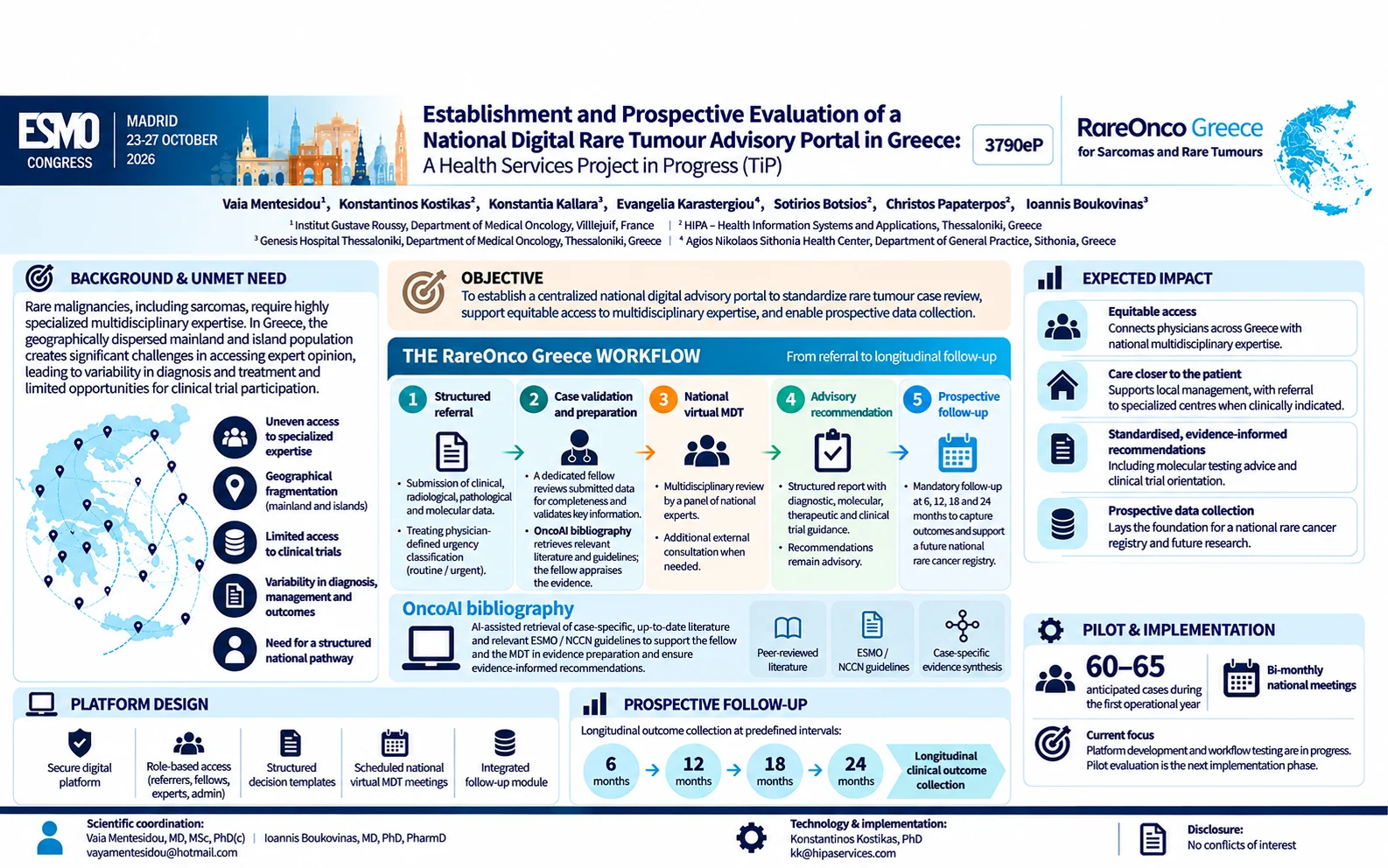
RareOnco Greece is a health services initiative designed to establish a centralized national digital advisory portal for the standardized review of rare tumor cases.
The platform enables physicians across Greece, including those working outside specialized oncology centers, to submit patient cases for multidisciplinary evaluation.
Its workflow includes structured clinical referrals, physician-defined urgency classification, case validation, national virtual multidisciplinary tumor board (MDT) review, and advisory recommendations.
To support clinical decision-making, an AI-assisted tool called oncoAI Bibliography retrieves patient-specific scientific literature and relevant ESMO and NCCN guidelines, helping clinicians prepare evidence-based case discussions.
The platform also incorporates prospective follow-up at 6, 12, 18, and 24 months to systematically collect clinical outcomes.
The primary endpoints include local recurrence rates and overall survival, while secondary objectives include clinical trial enrollment rates.
All MDT recommendations are advisory, allowing treating physicians to retain responsibility for individual patient management.
Key Takeaways
The project has completed initial development and beta-testing, with implementation and prospective clinical evaluation underway.
- National multidisciplinary access: The platform is designed to connect physicians across Greece with specialized expertise in sarcomas and rare tumors through virtual MDT meetings.
- AI-supported evidence retrieval: The oncoAI Bibliography tool provides patient-specific literature and guideline retrieval to support multidisciplinary case preparation.
- Structured referral system: Standardized clinical information and physician-defined urgency classification aim to improve case-review efficiency.
- Prospective follow-up: Clinical outcomes will be collected at 6, 12, 18, and 24 months, including recurrence, survival, and clinical trial participation.
- Pilot implementation: Approximately 60–65 cases are anticipated during the first operational year to assess usability and preliminary clinical adherence.
- Platform validation: Beta-testing has evaluated workflow feasibility, GDPR compliance, and integration of automated evidence retrieval into the MDT process.
- Future expansion: A phased national rollout is planned, with targeted outreach to regional hospitals and peripheral oncology departments.
Conclusion
RareOnco Greece introduces a national digital framework designed to improve access to specialized multidisciplinary expertise for patients with sarcomas and other rare malignancies, particularly those receiving care outside reference centers.
By integrating structured clinical referrals, AI-assisted evidence retrieval, virtual multidisciplinary tumor boards, and prospective follow-up, the platform aims to support standardized case review and facilitate collaboration between oncology specialists across Greece.
Initial beta-testing has demonstrated the feasibility of the proposed workflow, while the pilot phase will assess its implementation in routine clinical practice. Patient-level outcomes, including recurrence, overall survival, and clinical trial enrollment, have not yet been reported.
The initiative could provide a scalable model for improving coordination in rare cancer care, with opportunities for future national expansion and cross-border collaboration.
Affiliated institutions: Institut Gustave Roussy (France), HIPA – Health Information Systems and Applications (Greece), Genesis Hospital Thessaloniki (Greece), and Agios Nikolaos Sithonia Health Center (Greece).
Source: ESMO Congress 2026, Abstract 3790eP — Establishment and Prospective Evaluation of a National Digital Rare Tumour Advisory Portal in Greece: A Health Services Project in Progress (TiP).
Read more about ESMO 2026.