Aesthetic concerns after breast cancer treatment rarely emerge during the acute phase of care. They appear later — when survival is no longer the central question, and quality of life takes its place.
Patients begin asking:
- Is my body finished changing?
- Is it safe to correct asymmetry?
- Should I wait longer?
- Am I risking complications if I intervene now?
These are not cosmetic questions. They are biological, surgical, and psychological questions. And the answer depends largely on timing.
What Radiotherapy Actually Does to Tissue?
Radiotherapy induces progressive biological changes that may continue for months after treatment completion.
Well-described late effects include fibrosis with progressive tissue stiffening, microvascular injury, loss of elasticity, and a diminished capacity for wound healing.
Radiation-induced fibroatrophy is a documented pathophysiological process driven by chronic inflammation and oxidative stress pathways.
These changes affect vascular perfusion, collagen remodeling, and the mechanical properties of breast tissue.
This is why aesthetic or reconstructive procedures in irradiated tissue carry different risk profiles compared to non-irradiated tissue. Timing is not aesthetic preference. It is tissue biology.
Why Waiting Matters?
Multiple reconstructive studies suggest that complication rates differ depending on the interval between radiotherapy and intervention.
Evidence suggests that implant exchange performed within the first six months after radiotherapy may be associated with higher complication and failure rates in some series. Autologous reconstruction appears less dependent on exact timing, although adequate tissue stabilization remains important. Systematic reviews indicate that fat grafting in irradiated tissue is oncologically safe; however, prior radiotherapy may reduce graft retention and increase technical complexity.
A commonly accepted practical interval in clinical practice is: At least 6 months after radiotherapy, with many teams preferring 9–12 months, depending on tissue response and planned procedure.
This allows:
- Fibrotic processes to stabilize
- Edema to resolve
- Skin quality to declare itself
- Patient expectations to mature
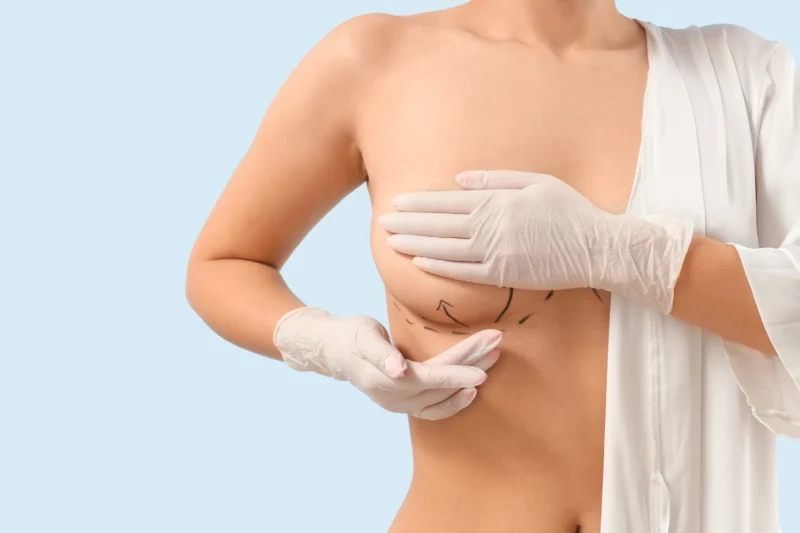
Not All Aesthetic Procedures Carry the Same Risk
After breast cancer treatment, aesthetic interventions vary significantly in biological demand.
Minor symmetry adjustments
Often lower surgical stress, but still influenced by irradiated tissue stiffness.
Implant-based revisions
Higher sensitivity to vascular compromise and capsular contracture in irradiated fields.
Autologous fat grafting
Supported by safety data regarding recurrence risk, but outcomes depend on vascular bed quality.
Scar revision
Scar maturation requires time. Early revision in evolving irradiated scars may worsen outcomes. Procedure selection must match tissue condition.
The Psychological Layer: Are We Correcting Tissue or Distress?
Many patients pursue aesthetic procedures for valid, thoughtful reasons:
- Clothing asymmetry
- Persistent tightness
- Visible contour irregularities
However, sometimes the motivation is less physical and more existential:
“I want to look like myself again.”
No intervention can fully reverse the cancer experience. Studies in survivorship show that satisfaction after aesthetic revision is highest when expectations are realistic and multidisciplinary counseling is provided.
Aesthetic care after cancer must integrate biological readiness, emotional preparedness, and clear oncologic status.
Multidisciplinary Planning Is Protective
Optimal decision-making requires close collaboration among the breast surgeon, plastic surgeon, and radiation oncologist, which helps reduce complication risk, align expectations, and minimize the likelihood of post-procedure regret. Professional society guidance supports structured patient counseling and individualized timing strategies rather than fixed universal timelines.
Choosing Not to Intervene Is Also Evidence- Consistent
Not every asymmetry requires correction.
Not every scar requires revision.
Some patients report stable quality of life without additional procedures.
The absence of intervention is not neglect — it can be a conscious, well-informed
decision.
Practical Evidence-Based Framework
Before considering aesthetic procedures after radiotherapy:
- Confirm oncologic follow-up plan is stable.
- Wait at least 6 months after radiotherapy (often 9–12 months preferred depending on tissue and procedure).
- Assess tissue quality clinically.
- Clarify patient motivation and expectations.
- Plan in multidisciplinary setting.
Aesthetic procedures after breast cancer treatment are not about vanity. They are about restoring balance — physically and psychologically. But safety depends less on technique and more on timing. Radiotherapy changes tissue behavior. Respecting that biology allows aesthetic interventions to support survivorship — rather than complicate it.
Written By Eftychia Tataridou, MD