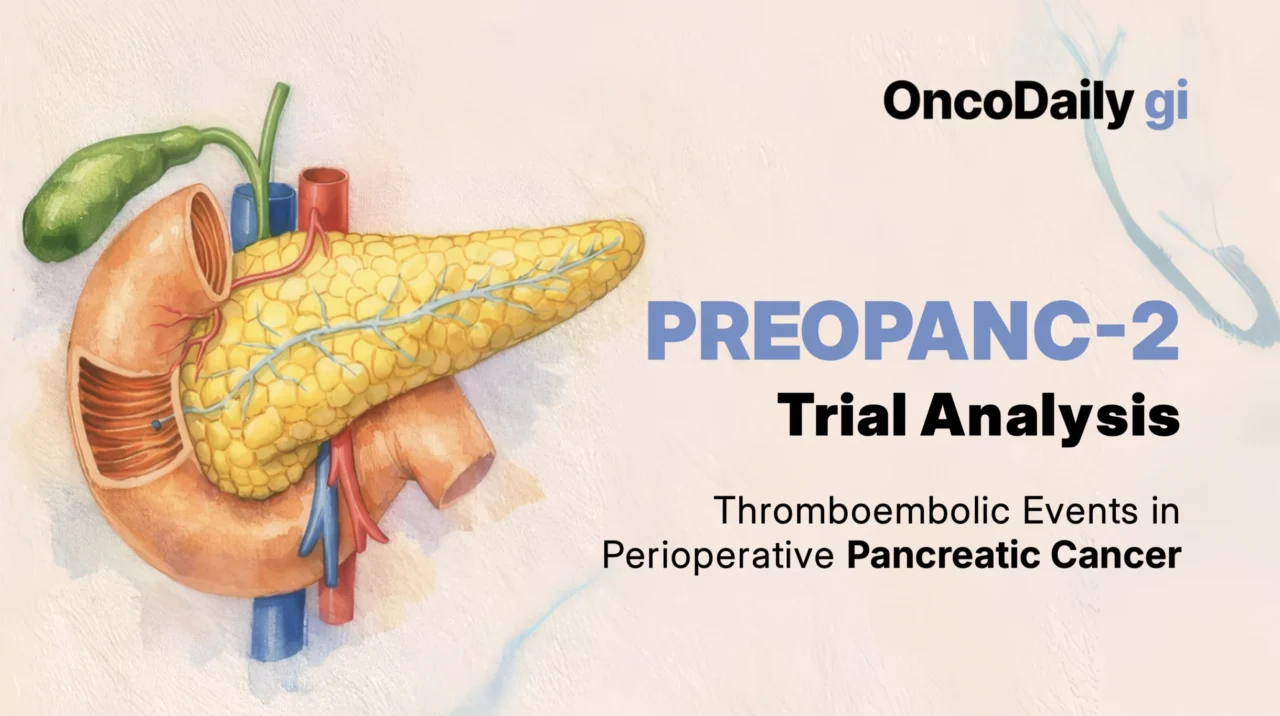
Pancreatic ductal adenocarcinoma (PDAC) carries the highest risk of venous thromboembolism (VTE) among solid tumors, with approximately 20% of patients affected. VTE contributes substantially to morbidity and is associated with worse overall survival (OS). Neoadjuvant therapy is increasingly adopted for resectable and borderline resectable PDAC, yet prospective data on thromboembolic events during perioperative treatment remain limited.
In this context, a secondary analysis of the phase III PREOPANC-2 trial was published on January 29, 2026, in the Journal of Clinical Oncology, evaluating the incidence of VTE in the year after random assignment and its association with survival outcomes.
Title: Thromboembolic Events During Perioperative Therapy for Resectable and Borderline Resectable Pancreatic Cancer in the PREOPANC-2 Trial
Authors: Ruth A.L. Willems, Aniek E. van Diepen, Esther N. Dekker, Quisette P. Janssen, Jacob L. van Dam, Nynke Michiels, Casper W.F. van Eijck, Karlijn E.P.E. Hermans, Bert A. Bonsing, Koop P. Bosscha, Stefan A.W. Bouwense, Olivier R. Busch, Hugo ten Cate, Peter-Paul L.O. Coene, Casper H.J. van Eijck, Nick van Es, Erwin van der Harst, Ignace H.J.T. de Hingh, Tom M. Karsten,
Geert Kazemier, Marion B. van der Kolk, Bas de Laat, Mike S.L. Liem, J. Sven D. Mieog, Vincent B. Nieuwenhuijs, Gijsbert A. Patijn, Mark Roest, Hjalmar C. van Santvoort, Liselot Valkenburg-van Iersel, Roeland F. de Wilde, Fennie Wit, Barbara M. Zonderhuis, Marc G. Besselink, Marjolein Y.V. Homs, Geertjan van Tienhoven, Johanna W. Wilmink, Bas Groot Koerkamp, Judith de Vos-Geelen
Read about PREOPANC-2 Phase 3 Trial in Resectable and Borderline Resectable Pancreatic Cancer on OncoDaily.
Methods
This study represents a secondary analysis of the investigator-initiated, multicenter, randomized phase III PREOPANC-2 trial conducted in the Netherlands between June 2018 and January 2021.
Eligible patients had histologically or cytologically confirmed resectable or borderline resectable PDAC without distant metastases. Participants were randomized to receive either:
- Neoadjuvant FOLFIRINOX (FFX) followed by surgery, or
- Neoadjuvant gemcitabine-based chemoradiotherapy (CRT), followed by surgery and adjuvant gemcitabine.
VTE was defined as objectively confirmed deep vein thrombosis (DVT), pulmonary embolism (PE), splanchnic vein thrombosis (SVT), or central venous access device (CVAD)–related thrombosis. Both incidental and symptomatic events were included. VTE occurrence was retrospectively evaluated from random assignment to 12 months after random assignment.
After excluding patients on baseline therapeutic anticoagulation or receiving thromboprophylaxis during neoadjuvant therapy, 325 patients were included in this analysis.
Cumulative VTE incidence was estimated using Fine-Gray competing-risk models with death as a competing event. Associations between VTE and overall survival (OS) or progression-free survival (PFS) were evaluated using time-dependent Cox regression analyses.
Results
Within one year after randomization, 28 of 325 patients (9%) developed VTE. The cumulative incidence at 12 months was 9% (95% CI, 6–12). Although numerically higher in the CRT arm (11%) compared with the FFX arm (6%), this difference did not reach statistical significance.
During the preoperative phase, 3% of patients developed VTE. The median time to event in this phase was 75 days. Of the 28 VTEs, 54% were symptomatic, including 4 of 9 preoperative events (44%) and 11 of 19 postoperative events (58%). VTE led to chemotherapy delay in some patients but did not result in permanent treatment discontinuation. Notably, patients who developed preoperative VTE had a significantly lower resection rate (44% vs 77%).
Nineteen of 247 resected patients (8%) developed VTE during the postoperative period, defined as from tumor resection to 1 year after random assignment. The postoperative incidence was significantly higher in the CRT arm (12%) compared with the FFX arm (3%, P = .02). Two patients died from PE-related causes, both in the CRT arm.

Read about Radiotherapy for Pancreatic Cancer: Types, Success Rate, Side Effects on OncoDaily.
In univariate Fine-Gray competing risk analyses, overweight and obesity were associated with higher VTE risk, as was a baseline CA 19-9 level >500 U/mL. WHO performance status 1 was associated with lower VTE risk (sHR 0.38).
Median overall survival for the cohort was 21 months (95% CI, 11–36). VTE occurrence was independently associated with worse OS (adjusted HR 2.13; P = .002) and worse progression-free survival (adjusted HR 1.94; P = .009). In time-dependent analyses, preoperative VTE was not significantly associated with overall survival (HR 1.68; P = .21), whereas postoperative VTE was significantly associated with reduced overall survival (HR 2.29; P < .001). Importantly, only two deaths were directly attributable to PE, supporting the interpretation that VTE may function primarily as a marker of aggressive disease rather than a direct cause of mortality.
Conclusion
In the PREOPANC-2 trial, 9% of patients with resectable or borderline resectable PDAC experienced a venous thromboembolic event during perioperative treatment. While cumulative VTE incidence did not differ significantly between neoadjuvant regimens, postoperative thromboembolic events were more frequent after gemcitabine-based chemoradiotherapy and were strongly associated with worse survival outcomes.
These findings indicate that VTE in this setting likely reflects aggressive tumor biology rather than serving as a direct cause of mortality. The study underscores the importance of standardized thromboembolic event reporting in neoadjuvant PDAC trials and highlights the need for future research to clarify the role of thromboprophylaxis in patients undergoing curative-intent treatment.
The full article is available in Journal of Clinical Oncology.