
Key takeaways
- High-dose methotrexate is a key component of osteosarcoma chemotherapy, particularly in younger patients.
- MAP chemotherapy combines methotrexate, doxorubicin, and cisplatin with surgery to improve treatment outcomes.
- Localized osteosarcoma has a long-term survival rate of approximately 60–70% with modern multimodal treatment.
- Kidney injury, mouth sores, and low blood counts are important side effects requiring careful monitoring.
- Leucovorin rescue helps reduce methotrexate toxicity, while methotrexate-free regimens are available for selected patients.
Methotrexate for osteosarcoma is an established chemotherapy treatment used primarily in children, adolescents, and young adults with high-grade bone cancer. Given at high doses, methotrexate is commonly combined with doxorubicin and cisplatin in the MAP chemotherapy regimen, which forms part of standard treatment alongside surgery.
The introduction of combination chemotherapy has substantially improved outcomes for patients with localized osteosarcoma. Contemporary treatment achieves long-term survival in approximately 60–70% of patients, although outcomes depend on disease stage, surgical resection, and response to chemotherapy. These survival rates reflect the combined treatment strategy rather than the effect of methotrexate alone (National Cancer Institute, 2024).
Despite its established role, high-dose methotrexate requires intensive monitoring because of the risk of kidney injury, delayed drug elimination, and damage to healthy tissues. Understanding how methotrexate works, how it is administered, and when alternative regimens are considered is important for patients undergoing osteosarcoma treatment.
What Is Methotrexate and How Does It Work?
Methotrexate is an antimetabolite chemotherapy drug that interferes with folate metabolism, a process essential for DNA synthesis and cell division. It is used to treat several cancers, including osteosarcoma, leukemia, and certain lymphomas. At considerably lower doses, methotrexate is also prescribed for inflammatory conditions such as rheumatoid arthritis and psoriasis (Brown et al., 2020).
Its primary anticancer mechanism involves inhibition of dihydrofolate reductase (DHFR), an enzyme responsible for regenerating active folate compounds needed to produce DNA. By disrupting this process, methotrexate limits the ability of rapidly dividing cancer cells to replicate.
In osteosarcoma, methotrexate is administered at substantially higher doses than those used for inflammatory diseases. These concentrations increase drug exposure within tumor cells, but also affect normal tissues, particularly the bone marrow and gastrointestinal lining. For this reason, high-dose treatment requires leucovorin rescue and monitoring of drug elimination (Bielack et al., 2024).
Why Is High-Dose Methotrexate Used for Osteosarcoma?
High-dose methotrexate (HD-MTX) is used in osteosarcoma because sufficiently high intracellular drug concentrations can inhibit DNA synthesis and overcome certain mechanisms of methotrexate resistance. Osteosarcoma cells may show reduced drug uptake or altered folate metabolism, limiting their sensitivity to lower methotrexate concentrations.
HD-MTX is an established component of the MAP regimen (methotrexate, doxorubicin, and cisplatin), widely used for high-grade osteosarcoma in younger patients. Chemotherapy is commonly administered before surgery to treat the primary tumor and address possible microscopic metastatic disease, and after surgery to reduce recurrence risk (National Cancer Institute, 2024).
Although MAP is a standard treatment approach, the independent contribution of methotrexate to survival remains difficult to establish because the drug is usually administered as part of combination chemotherapy. Its use is also more challenging in older adults, who may have reduced methotrexate clearance and a greater risk of toxicity.
How Is Methotrexate Given During Osteosarcoma Treatment?
In osteosarcoma, high-dose methotrexate is administered through an intravenous infusion, commonly at 12 g/m² (maximum 20 g per dose) over four hours, according to established MAP chemotherapy protocols. The dose is calculated using body surface area, and treatment schedules vary between protocols and institutions (FDA, 2024; eviQ).
Methotrexate is administered in planned cycles as part of the MAP regimen, which also includes doxorubicin and cisplatin. In patients with localized, high-grade osteosarcoma, chemotherapy is generally given before and after surgical resection to treat the primary tumor and eliminate microscopic cancer cells that may remain elsewhere in the body.
Because methotrexate is eliminated primarily through the kidneys, treatment requires intravenous hydration, urine alkalinization, and regular measurement of serum methotrexate concentrations. Kidney function, urine output, and fluid balance are closely monitored to detect delayed drug clearance and prevent serious toxicity.
Patients receive leucovorin rescue after each high-dose methotrexate infusion and remain under hospital monitoring until drug concentrations have decreased to an acceptable level. The exact discharge criteria depend on methotrexate clearance, renal function, and institutional protocols (eviQ; Bielack et al., 2024).
How Effective Is Methotrexate for Osteosarcoma?
High-dose methotrexate is an important component of treatment for localized, high-grade osteosarcoma, particularly in pediatric and young adult populations. Its use within combination chemotherapy has contributed to treatment strategies that achieve substantially better outcomes than surgery alone.
According to the National Cancer Institute, patients with localized osteosarcoma treated with surgery and chemotherapy have a 5-year overall survival rate of approximately 62–65%. Some clinical trial populations have reported higher survival rates, reflecting differences in patient selection, disease characteristics, and treatment protocols (National Cancer Institute, 2024).
Tumor response to preoperative chemotherapy is an important prognostic indicator. Patients whose resected tumors demonstrate at least 90% tumor necrosis generally have better outcomes than those with a poorer histological response. Disease stage, tumor location, complete surgical resection, and the presence of metastases also influence survival.
Although higher methotrexate exposure has been associated with improved outcomes in some studies, these findings do not establish a universally effective serum concentration or prove that increasing the dose improves survival for every patient.
The strongest clinical evidence supports methotrexate as part of a multimodal treatment strategy combining chemotherapy and surgery, rather than as an isolated treatment.
What Are the Side Effects of High-Dose Methotrexate?
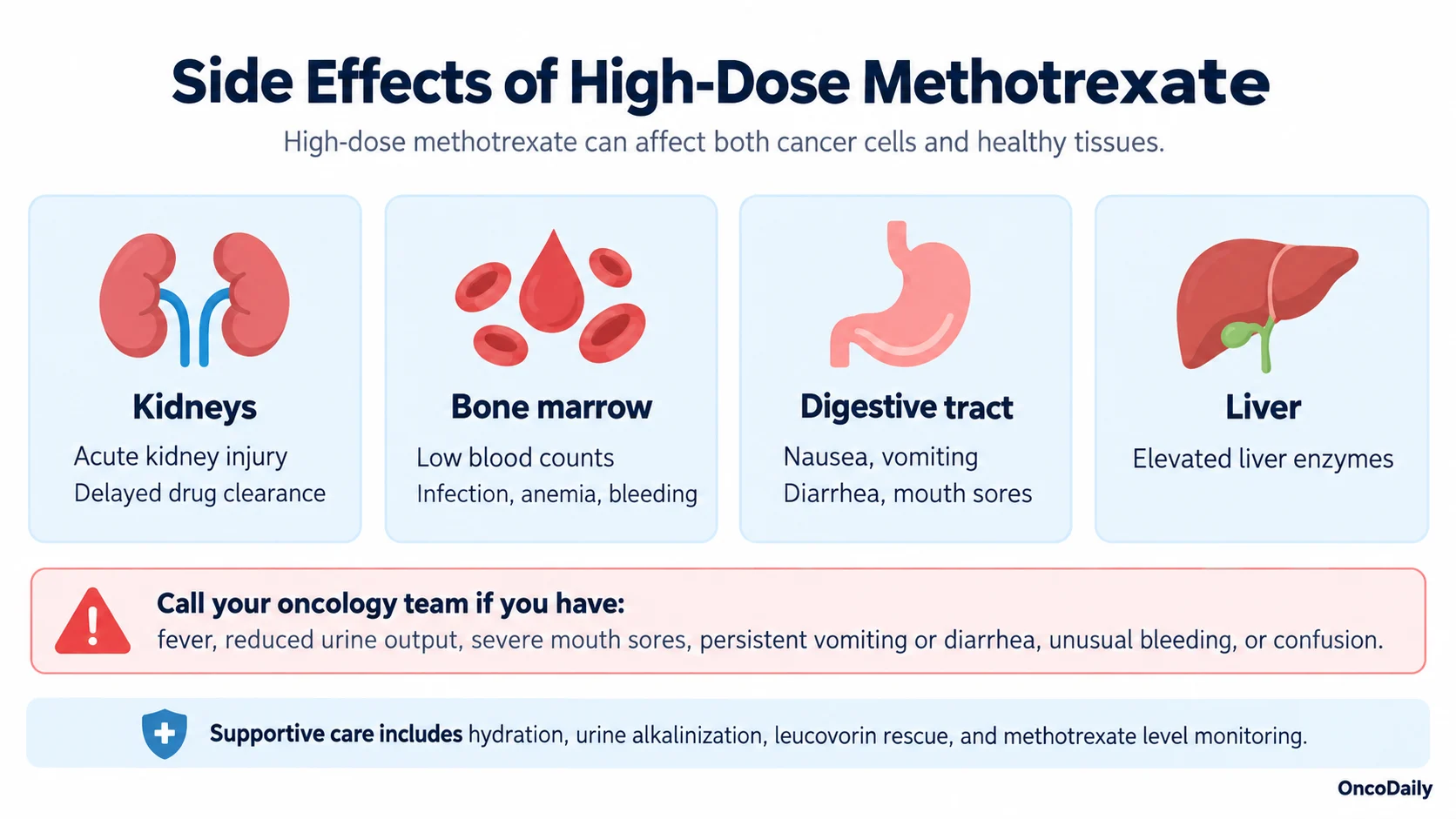
High-dose methotrexate can cause significant toxicity because it affects both malignant cells and healthy tissues. The principal adverse effects involve the kidneys, bone marrow, gastrointestinal tract, and liver. Their severity depends partly on drug exposure, renal function, and the rate at which methotrexate is eliminated (Bielack et al., 2024).
Common side effects include nausea, vomiting, fatigue, loss of appetite, diarrhea, and oral mucositis, which causes painful inflammation and ulceration of the mouth. Methotrexate can also suppress bone marrow function, resulting in neutropenia, anemia, or thrombocytopenia. These complications increase the risk of infection, fatigue, and bleeding.
One of the most clinically important complications is acute kidney injury, which can occur when methotrexate and its metabolites accumulate in the renal tubules. Impaired kidney function can then delay methotrexate elimination, increasing systemic exposure and the risk of severe toxicity. Transient elevations in liver enzymes are also common, while serious neurological complications, including confusion or seizures, occur less frequently (Bielack et al., 2024).
The prevention of serious toxicity relies on hydration, urine alkalinization, leucovorin rescue, and repeated measurements of serum methotrexate and kidney function. In cases of severe delayed elimination associated with kidney injury, additional treatment with glucarpidase, an enzyme that breaks down circulating methotrexate, may be required (Bielack et al., 2024).
Patients should immediately inform their oncology team if they develop fever, reduced urine output, severe mouth sores, persistent vomiting or diarrhea, unusual bleeding, or neurological symptoms.
What Is Leucovorin Rescue and Why Is It Needed?
Leucovorin rescue is an essential supportive treatment administered after high-dose methotrexate to reduce toxicity in healthy tissues. Leucovorin, also called folinic acid, supplies an active form of folate that bypasses the metabolic pathway blocked by methotrexate.
Methotrexate inhibits DHFR, disrupting the production of folate compounds required for DNA synthesis. Although this effect is important for targeting osteosarcoma cells, it also damages rapidly dividing normal cells, particularly those in the bone marrow and gastrointestinal tract. Leucovorin helps restore folate-dependent processes and reduces complications such as severe mucositis and bone marrow suppression (Bielack et al., 2024).
In many osteosarcoma protocols, leucovorin rescue begins 24 hours after the start of methotrexate infusion, although some protocols use a 24–36-hour interval. It is commonly administered every six hours, with subsequent doses adjusted according to serum methotrexate concentrations and renal function.
The timing of leucovorin is critical. Administration too early can interfere with methotrexate’s anticancer activity, whereas inadequate or delayed rescue increases the risk of serious toxicity. Leucovorin is continued until methotrexate concentrations reach a safe level according to the treatment protocol (Bielack et al., 2024).

Can Osteosarcoma Be Treated Without Methotrexate?
Yes. Methotrexate-free chemotherapy is an established option for selected patients with osteosarcoma, particularly older adults and patients who cannot tolerate high-dose methotrexate. However, MAP remains a widely used regimen for younger patients with high-grade disease, and methotrexate-free regimens are not automatically equivalent for every patient.
One alternative combines doxorubicin, ifosfamide, and carboplatin. The St. Jude OS99 trial evaluated this methotrexate-free approach in 72 eligible patients with newly diagnosed, localized, resectable osteosarcoma. The study reported a 5-year event-free survival rate of 66.7% and an overall survival rate of 78.9% (Daw et al., 2011).
Although these outcomes were encouraging, the study was not a randomized comparison against contemporary MAP chemotherapy. Therefore, its results cannot establish that omitting methotrexate provides equivalent survival outcomes.
Other regimens include doxorubicin and cisplatin, with or without ifosfamide. These approaches may be considered when kidney impairment, previous severe toxicity, patient age, or limited access to methotrexate monitoring makes high-dose therapy unsuitable (National Cancer Institute, 2024).
Regardless of the chemotherapy regimen, complete surgical resection remains essential for potentially curable localized osteosarcoma. Chemotherapy is used alongside surgery to address microscopic disease and reduce recurrence risk. Treatment selection should be individualized by a specialist sarcoma team.
What Are the Long-Term Risks of Methotrexate Treatment?
High-dose methotrexate can cause acute organ toxicity, some of which may have lasting consequences. However, evidence on long-term adverse effects specifically attributable to methotrexate in osteosarcoma survivors is limited, particularly because patients also receive other chemotherapy drugs.
Renal toxicity is one of the main concerns. Methotrexate is eliminated predominantly through the kidneys, and delayed clearance can cause acute kidney injury. Renal function recovers in many patients, but severe injury may result in persistent impairment. Liver enzyme elevations are also frequently observed during treatment and are generally reversible, although persistent abnormalities require further evaluation (Bielack et al., 2024).
Neurological complications are less common but may include cognitive changes and other central nervous system effects. Much of the evidence regarding long-term neurocognitive toxicity comes from patients treated with methotrexate for other malignancies, particularly acute lymphoblastic leukemia. These findings cannot be directly applied to all osteosarcoma survivors.
Methotrexate is also harmful to a developing fetus and must be avoided during pregnancy. Patients should receive appropriate contraception and pregnancy-planning advice. Fertility concerns should be discussed before treatment, although long-term reproductive effects in osteosarcoma survivors are more strongly associated with certain other chemotherapy agents than with methotrexate alone.
Long-term follow-up should address kidney and liver function, fertility and reproductive health, and potential late effects of the complete chemotherapy regimen. In particular, patients who receive MAP chemotherapy also require monitoring for doxorubicin-related cardiac toxicity and cisplatin-associated hearing impairment, which should not be attributed to methotrexate.
The long-term safety of osteosarcoma treatment is therefore best assessed in the context of the full chemotherapy regimen, cumulative drug exposure, and individual patient risk factors.
FAQ
Is Methotrexate a Chemotherapy Drug?
Yes. Methotrexate is a chemotherapy drug used to treat several cancers, including osteosarcoma, leukemia, and certain lymphomas. In osteosarcoma, it is administered at high doses to interfere with DNA production and slow cancer cell growth. It is commonly combined with doxorubicin and cisplatin in the MAP chemotherapy regimen.
How Many Cycles of Methotrexate Are Given for Osteosarcoma?
The number of methotrexate doses depends on the chemotherapy protocol, patient age, and treatment response. In the MAP regimen, high-dose methotrexate is typically given multiple times before and after surgery. The schedule may be adjusted if patients experience serious side effects or delayed drug clearance.
Can Methotrexate Cure Osteosarcoma?
Methotrexate alone is not considered a cure for osteosarcoma. However, when combined with other chemotherapy drugs and surgery, it forms part of a treatment approach that can cure many patients with localized disease. Approximately 60–70% of patients with localized osteosarcoma achieve long-term survival with modern multimodal treatment.
How Long Does Methotrexate Stay in Your Body After Chemotherapy?
Methotrexate is primarily eliminated through the kidneys, and its clearance varies between patients. After high-dose treatment, blood levels are monitored over several days until they fall below the protocol's safety threshold. Delayed methotrexate clearance can increase the risk of serious toxicity, particularly kidney injury and bone marrow suppression.
Is High-Dose Methotrexate Safe for Adults With Osteosarcoma?
High-dose methotrexate can be used in selected adults with osteosarcoma, but toxicity and delayed drug clearance become greater concerns with increasing age and reduced kidney function. Some older patients receive alternative chemotherapy regimens without methotrexate. Treatment decisions depend on overall health, kidney function, and specialist assessment.