Mebendazole has been used for decades as a prescription treatment for parasitic worm infections. More recently, however, mebendazole and cancer have become a growing area of research because of the drug’s effects on microtubules, cell division, tumor blood vessels, and several signaling pathways involved in cancer growth. That scientific interest has led researchers to explore whether mebendazole could be repurposed as an anticancer therapy. Laboratory and animal studies have produced encouraging findings, and early clinical trials have examined its safety in selected patients with difficult-to-treat cancers. But the evidence in humans remains limited.

Photo: Depositphotos
Mebendazole has not been proven to cure cancer, improve survival, or replace established treatments such as chemotherapy, targeted therapy, immunotherapy, radiotherapy, or surgery. Understanding the difference between a promising laboratory finding and a proven treatment is especially important as claims about mebendazole and cancer spread online. This article examines what researchers have actually found, which cancers are being studied, what early human trials show, and where common claims go beyond the available evidence.
What Is Mebendazole?
Mebendazole belongs to the benzimidazole class of medicines and has long been used to treat parasitic worm infections. It interferes with microtubules cell structures essential for division and intracellular transport which is one reason researchers have explored whether it may also affect rapidly dividing cancer cells. (Aliabadi et al., 2025) In cancer research, mebendazole is studied as a drug-repurposing candidate. This means scientists are testing whether an established medicine can be used for a new disease, rather than developing an entirely new anticancer drug from the beginning. (Aliabadi et al., 2025)
However, a drug that is safe for treating worms at approved doses is not automatically safe or effective as a cancer treatment. Cancer trials may use different doses, schedules, formulations, and drug combinations, all under close medical supervision. (Phan et al., 2025; Krystal et al., 2024)
Why Researchers Are Interested
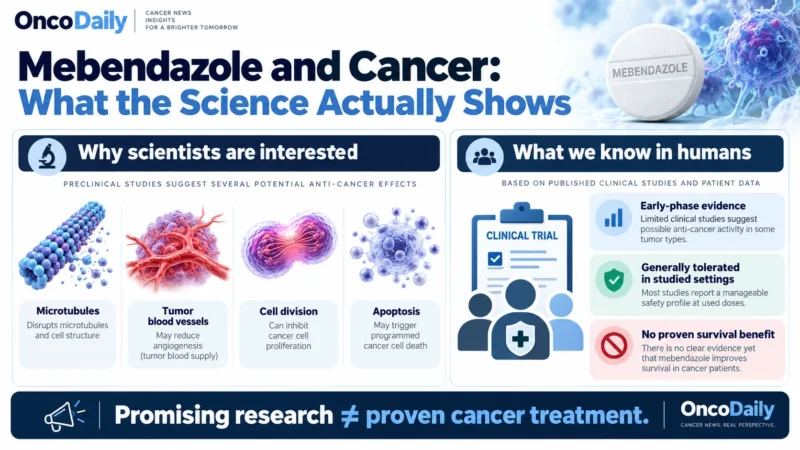
Laboratory studies suggest that mebendazole may have several anticancer effects. These include disrupting microtubules, blocking the formation of new tumor blood vessels, interfering with cell division, and promoting programmed cancer-cell death. (Aliabadi et al., 2025) Researchers have also reported effects on cancer-related signaling pathways, including Hedgehog signaling, which can play a role in tumor growth and resistance to treatment. (Aliabadi et al., 2025) These findings make mebendazole scientifically interesting. But an effect seen in cancer cells in a laboratory dish, or in an animal model, does not prove that the drug will work in people with cancer. (Phan et al., 2025)
What Cancers Are Being Studied?
Mebendazole has been investigated in preclinical models of several cancers, including brain tumors, breast cancer, pancreatic cancer, colorectal cancer, lung cancer, thyroid cancer, leukemia, prostate cancer, and head-and-neck cancers. (Aliabadi et al., 2025) Much of the clinical research has focused on brain tumors, particularly high-grade gliomas and other difficult-to-treat pediatric brain cancers. (Krystal et al., 2024; Phan et al., 2025) This does not mean that mebendazole has been proven to treat all—or even any—of these cancers in routine clinical practice. It means that researchers consider it a candidate worth testing in carefully designed studies. (Phan et al., 2025)
Mebendazole and Cancer : What Human Studies Show
The available human evidence is still early-stage and limited. Most published clinical studies are phase 1 trials designed mainly to assess safety, tolerability, and dosing not to prove that mebendazole can cure cancer. (Krystal et al., 2024; Phan et al., 2025) In a phase 1 study published in 2025, Phan and colleagues evaluated mebendazole in children and young adults with refractory, progressive, or recurrent brain tumors. The researchers found that the drug was generally well tolerated at the doses studied, but reported only limited evidence of effectiveness when mebendazole was used alone. (Phan et al., 2025)
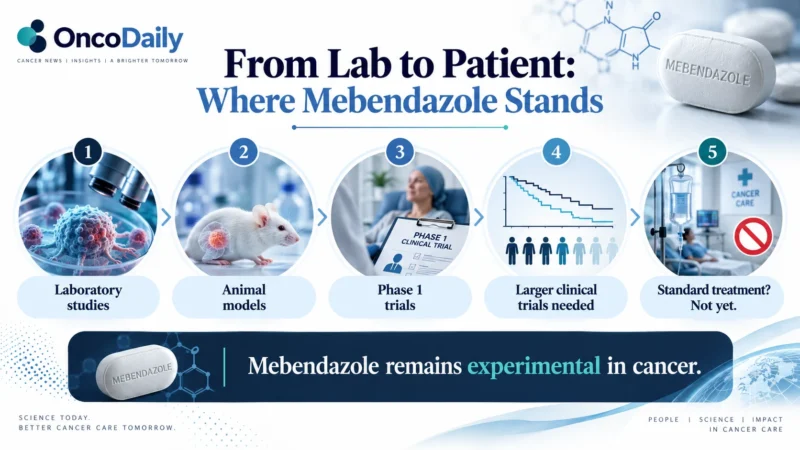
Another phase 1 study, published by Krystal and colleagues in 2024, examined mebendazole together with bevacizumab and irinotecan in children and young adults with high-grade gliomas. The trial found that mebendazole was safe and well tolerated in this combination, but it did not establish that the regimen improves survival or should become standard care. (Krystal et al., 2024)
What This Means for Patients
These studies are important because they show that mebendazole can be studied safely in selected groups of patients under medical supervision. They do not show that mebendazole is an effective stand-alone cancer treatment. (Phan et al., 2025; Krystal et al., 2024) A drug may be tolerated without meaning that it shrinks tumors, prevents recurrence, or extends life. Early-phase trials are designed to answer safety questions first; larger comparative trials are needed to determine whether a treatment provides a real clinical benefit. (Phan et al., 2025) For now, mebendazole should be viewed as an experimental cancer-research drug, not an established cancer therapy. (Phan et al., 2025; Krystal et al., 2024)
Myth 1: “Mebendazole Cures Cancer”
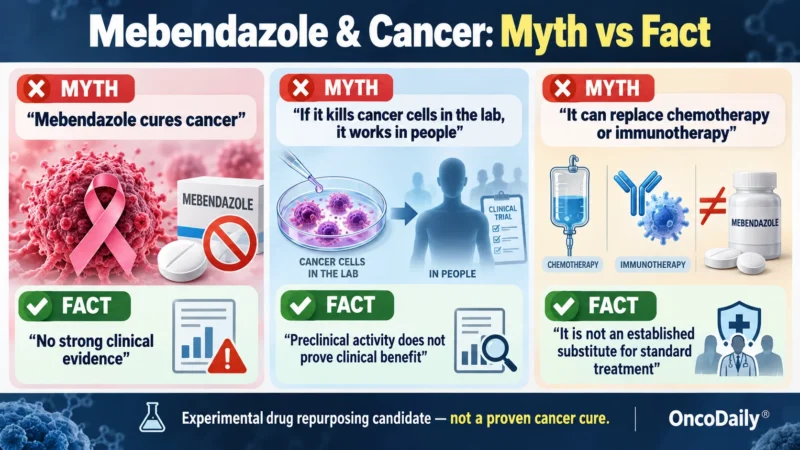
Fact: There is no strong clinical evidence that mebendazole cures cancer.
Early trials show possible tolerability and provide a rationale for further research, but they do not demonstrate that mebendazole alone produces durable tumor responses or improves overall survival. (Phan et al., 2025; Krystal et al., 2024) Claims that mebendazole is a “cure” usually confuse laboratory findings, animal research, or individual stories with proof of clinical effectiveness. Preclinical activity is a starting point for research—not proof that a treatment works in people. (Aliabadi et al., 2025; Phan et al., 2025)
Myth 2: “Mebendazole Is a Natural Cancer Remedy”
Fact: Mebendazole is a synthetic prescription medicine, not a natural supplement, herb, or alternative remedy.
It was developed and used as an anthelmintic drug for parasitic worm infections. Its possible use in cancer is an example of drug repurposing, not evidence that it is a natural or harmless cure. (Aliabadi et al., 2025) Patients should be especially cautious with products marketed online as “natural,” “detoxifying,” or “anti-cancer” versions of mebendazole. These claims are not supported by clinical evidence. (Phan et al., 2025)
Myth 3: “It Kills Cancer Cells in a Lab, So It Will Work in People”
Fact: Laboratory and animal studies can identify a promising biological mechanism, but they cannot prove clinical benefit.
Cancer cells in a dish do not fully represent a tumor in a human body. Tumors have different genetics, immune environments, blood supplies, drug penetration, and resistance mechanisms. (Aliabadi et al., 2025) That is why promising preclinical findings must be followed by carefully designed human trials measuring tumor response, progression, survival, quality of life, and side effects. (Phan et al., 2025; Krystal et al., 2024)
Myth 4: “Mebendazole Is Harmless Because It Is an Old Drug”
Fact: Mebendazole may be well tolerated in certain supervised trial settings, but “well tolerated” does not mean risk-free.
In the pediatric brain-tumor study by Phan and colleagues, mebendazole was generally well tolerated at the doses studied, with no dose-limiting toxicities reported. However, the study also found limited evidence that the drug worked as a single agent. (Phan et al., 2025) In the high-grade glioma trial by Krystal and colleagues, mebendazole was combined with bevacizumab and irinotecan. Combination cancer treatment can create additional risks, including cumulative toxicity and drug interactions, even when each drug has been used before. (Krystal et al., 2024)
Myth 5: “Patients Can Safely Self-Treat With Mebendazole”
Fact: Self-treating cancer with mebendazole can be dangerous.
There is no validated, universally effective mebendazole regimen for cancer patients. Doses used in clinical trials are carefully selected and monitored, while online protocols, veterinary products, or unprescribed medicines may involve unknown quality, incorrect dosing, or harmful interactions. (Phan et al., 2025; Krystal et al., 2024) The biggest danger is delayed evidence-based care. Cancer treatment is often time-sensitive, and replacing or delaying surgery, chemotherapy, radiotherapy, targeted therapy, or immunotherapy with an unproven remedy may allow the disease to progress. (Phan et al., 2025)
Myth 6: “Mebendazole Can Replace Chemotherapy or Immunotherapy”
Fact: There is no evidence that mebendazole should replace standard cancer treatment.
Current clinical research has tested mebendazole mainly for safety, sometimes in combination with other cancer drugs. It has not been shown to replace established treatments or improve outcomes when used instead of them. (Krystal et al., 2024; Phan et al., 2025) Patients should never stop or alter prescribed cancer therapy without speaking to their oncologist. Any interest in mebendazole should be discussed as part of a supervised treatment plan or clinical trial. (Phan et al., 2025)
What Scientists Still Need to Prove
Before mebendazole could become a standard cancer treatment, researchers would need larger and more rigorous clinical trials. These trials would need to show which cancers respond, which doses and schedules are best, whether the drug works alone or in combination, and whether it improves survival or quality of life. (Phan et al., 2025; Krystal et al., 2024) Researchers also need to identify biomarkers that can predict which patients are most likely to benefit.
This would help avoid exposing patients who are unlikely to respond to unnecessary treatment and side effects. (Aliabadi et al., 2025) Until such evidence exists, mebendazole remains an experimental repurposing candidate—not a proven cancer cure. (Phan et al., 2025; Krystal et al., 2024)
What Patients Should Do
Patients should discuss any interest in mebendazole with their oncology team before buying or taking it. This is particularly important for people receiving chemotherapy, targeted therapy, immunotherapy, or radiotherapy, because drug interactions and cumulative side effects can be difficult to predict. (Krystal et al., 2024; Phan et al., 2025) Patients may ask their oncologist whether a relevant clinical trial is available. ClinicalTrials.gov lists ongoing mebendazole cancer studies, including trials in pediatric brain tumors and gastrointestinal cancer or cancer of unknown origin. (ClinicalTrials.gov, 2026)
Do not use veterinary dewormers, unprescribed products, or social-media dosing protocols as cancer treatment. These products and protocols are not equivalent to medically supervised clinical care. (Phan et al., 2025; Krystal et al., 2024)
You Can Also Read Ivermectin and Cancer: Hope, Hype, and What the Evidence Really Shows by OncoDaily
Written by Aharon Tsaturyan, MD, Editor at OncoDaily Intelligence Unit.
FAQ
Can mebendazole cure cancer?
No. Current clinical evidence does not show that mebendazole cures cancer or improves survival. Most human studies so far have been early-phase trials focused mainly on safety and dosing.
Why is mebendazole being studied for cancer?
Mebendazole can interfere with microtubules and cell division, and laboratory studies suggest it may also affect tumor blood-vessel formation, apoptosis, and cancer-related signaling pathways. These findings make it an interesting drug-repurposing candidate.
What cancers are being studied with mebendazole?
Preclinical research has explored mebendazole in brain tumors, breast, pancreatic, colorectal, lung, thyroid and prostate cancers, leukemia, and head-and-neck cancers. Human research has focused particularly on difficult-to-treat brain tumors.
Has mebendazole been tested in cancer patients?
Yes. Early phase 1 studies have tested mebendazole in children and young adults with recurrent or refractory brain tumors and in combination with other treatments for high-grade gliomas. These studies mainly assessed safety rather than proving effectiveness.
Is mebendazole approved as a cancer treatment?
No. Mebendazole remains an experimental drug-repurposing candidate in oncology and is not an established standard cancer therapy.
Is mebendazole safe for cancer patients?
Some early trials found it generally well tolerated under medical supervision, but that does not mean it is risk-free. Cancer patients may face different doses, combinations, drug interactions, and cumulative toxicities.
What dose of mebendazole is used for cancer?
There is no validated or universally effective mebendazole dose for cancer. Doses and schedules used in clinical trials are selected and monitored carefully, so patients should not follow unverified online dosing protocols.
Can cancer patients take veterinary mebendazole or dewormers?
They should not use veterinary dewormers or unprescribed products as cancer treatment. Product quality, dosing, formulation, and safety may differ from medicines used in supervised clinical care.
Are there clinical trials studying mebendazole for cancer?
Yes. Clinical trials continue to investigate mebendazole in selected cancers, including pediatric brain tumors and some gastrointestinal cancers or cancers of unknown origin. Patients interested in these studies should discuss eligibility with their oncology team.
How does mebendazole work against cancer cells?
In laboratory studies, mebendazole can disrupt microtubules, which cancer cells need for division. It may also affect tumor blood-vessel formation, cell death pathways, and signaling such as Hedgehog. These effects are scientifically interesting, but laboratory activity does not prove that the drug will work in patients. Вставленный Markdown
Why isn’t mebendazole a standard cancer treatment yet?
Because the human evidence is still limited. Most published studies have been early phase 1 trials focused mainly on safety and dosing. Larger clinical trials are still needed to show whether mebendazole can shrink tumors, delay progression, or improve survival. Вставленный Markdown
What should cancer patients know before taking mebendazole?
Patients should speak with their oncologist before using it. Cancer-trial doses may differ from standard antiparasitic treatment, and interactions with chemotherapy or other cancer drugs are not fully understood. Mebendazole should currently be considered experimental, not a replacement for proven cancer therapy.