Ivermectin is a macrocyclic lactone antiparasitic medication used in both human and veterinary medicine. In humans, it is approved for specific parasitic infections, including strongyloidiasis and onchocerciasis, as well as certain other conditions depending on the formulation and country. Its discovery was recognized with the 2015 Nobel Prize in Physiology or Medicine.
Over the past several years, ivermectin has attracted attention in oncology because laboratory studies have reported effects on cancer-cell proliferation, apoptosis, signaling pathways, drug resistance, and the tumor microenvironment. These findings have raised interest in whether an established antiparasitic drug could potentially be repurposed for cancer treatment. But there is an important distinction between biological activity in the laboratory and clinical benefit in patients.

Photo: Depositphotos
As of 2026, ivermectin is not an approved cancer treatment, and clinical evidence remains limited. Recent reviews continue to describe a substantial gap between promising preclinical findings and evidence from human trials.
A Brief History of Ivermectin: From Soil Microbes to a Global Antiparasitic Drug
The story of ivermectin began in Japan in the 1970s, when microbiologist Satoshi Ōmura and his team at the Kitasato Institute searched thousands of soil samples for microorganisms that could produce medically useful compounds. One particularly important sample came from soil near a golf course in Ito City, Shizuoka Prefecture. From the bacterium Streptomyces avermitilis, researchers identified a new family of compounds called avermectins. Nobel Prize – Satoshi Ōmura biography
At Merck’s research laboratories in the United States, parasitologist William C. Campbell and colleagues investigated these compounds and discovered powerful activity against parasitic worms. Scientists then chemically modified avermectin B1 to produce ivermectin, a more potent semisynthetic derivative. Its origins were in veterinary medicine: it was introduced for animal health in 1981 and quickly became an important broad-spectrum antiparasitic drug. Nobel Prize – Advanced Information
Researchers soon recognized that the drug could also be used against parasites affecting humans. Clinical studies in the early 1980s demonstrated remarkable activity against Onchocerca volvulus, the parasite responsible for river blindness (onchocerciasis). Treatment could dramatically reduce the parasite’s microfilariae, helping prevent the inflammation and vision loss associated with the disease. Human approval followed, with France approving the drug for onchocerciasis in 1987. Nobel Prize – William C. Campbell and Satoshi Ōmura
Its impact soon became global. The medication was incorporated into large-scale programs targeting onchocerciasis and lymphatic filariasis, two devastating parasitic diseases affecting millions of people, particularly in tropical and resource-limited regions. The Nobel Committee recognized its enormous public-health impact, noting that the discovery has benefited hundreds of millions of people. Nobel Prize – 2015 Medicine Presentation Speech
The significance of the discovery was formally recognized in 2015, when Satoshi Ōmura and William C. Campbell received the Nobel Prize in Physiology or Medicine, jointly with Tu Youyou, for discoveries concerning therapies against infections caused by roundworm parasites.
This history is important when discussing the drug in oncology. Ivermectin is a legitimate human antiparasitic medicine with a remarkable history in global health. Its potential anticancer effects represent a much newer area of investigation. Laboratory findings have generated scientific interest, but they should not be confused with established evidence that the drug treats cancer in humans.
What Preclinical Studies Show About Ivermectin and Cancer
Ivermectin has demonstrated potentially interesting anticancer effects in cell-line and animal studies involving several tumor types, including breast, colorectal, lung, gastric, ovarian, melanoma, prostate, pancreatic, and liver cancers. Researchers have reported inhibition of cancer-cell proliferation, migration, and invasion, as well as induction of apoptosis and changes in cancer stem-like cell behavior.
A 2025 review summarized evidence suggesting that ivermectin can influence several oncogenic signaling networks, including Wnt/β-catenin, PI3K/Akt/mTOR, and STAT3, while also affecting mitochondrial function and cellular survival pathways. These findings make ivermectin scientifically interesting as a potential repurposed drug. However, preclinical activity does not establish that a drug will work against cancer in humans. The concentrations or exposures required to produce an effect in experimental models may not be achievable safely in patients.
Robalino KN, Vivanco-Galván O, Romero-Benavides JC, Jiménez-Gaona Y. Ivermectin as an Alternative Anticancer Agent: A Review of Its Chemical Properties and Therapeutic Potential. Pharmaceuticals. 2025;18(10):1459. Patel Y, Chawla J, Parmar MS. Ivermectin in Cancer Treatment: Should Healthcare Providers Caution or Explore Its Therapeutic Potential? Current Oncology Reports. 2025.
How Might Ivermectin Affect Cancer Cells?
Several mechanisms have been proposed to explain the anticancer activity observed in preclinical research.
PAK1, Akt/mTOR, and STAT3 Signaling
Ivermectin has been reported to interfere with signaling pathways involved in cancer-cell survival and proliferation, including PAK1, Akt/mTOR, and STAT3. These pathways regulate processes such as cell growth, metabolism, survival, and resistance to apoptosis. In laboratory models, altering these pathways has been associated with growth inhibition and cancer-cell death. However, the existence of a plausible molecular mechanism does not mean that the drug has demonstrated clinical efficacy.
Wnt/β-Catenin and YAP1 Pathways
The Wnt/β-catenin pathway is involved in proliferation, differentiation, stemness, and tumor development. YAP1 is another important regulator of tumor growth and cellular behavior. Preclinical research suggests ivermectin may affect these pathways and potentially reduce proliferation, epithelial-to-mesenchymal transition, invasion, and stem-like characteristics in certain cancer models. These findings remain experimental and require clinical validation.
Mitochondrial Dysfunction and Oxidative Stress
Another proposed mechanism involves the mitochondria. Experimental studies have reported that ivermectin can increase reactive oxygen species, alter mitochondrial membrane potential, and activate pathways associated with programmed cell death. These effects have been observed in several cancer-cell models. Again, these observations demonstrate biological activity rather than proven therapeutic benefit in patients.
Immune Modulation and Immunotherapy
Ivermectin has also attracted interest because of potential effects on the immune microenvironment. A 2021 study in breast cancer models reported that ivermectin could promote features associated with immunogenic cell death and increase immune-cell activity. The researchers also reported enhanced activity when ivermectin was combined with immune checkpoint blockade in experimental models. This has led to interest in whether ivermectin might eventually have a role as an adjunct to immunotherapy, rather than as a standalone treatment. That question remains under investigation.
Potential Effects on Treatment Resistance
Researchers have also investigated whether ivermectin could influence mechanisms of drug resistance, including drug-efflux transporters such as P-glycoprotein (P-gp). In laboratory models, modifying these mechanisms has sometimes increased sensitivity to chemotherapy agents. The concept is scientifically interesting, but there is currently insufficient clinical evidence to recommend ivermectin for overcoming treatment resistance in cancer patients.
Draganov D et al. NPJ Breast Cancer. 2021;7:22. Lee DE et al. Frontiers in Pharmacology. 2022;13:934746. Li MY et al. Cancer Chemotherapy and Pharmacology. 2024;93:41–54 Robalino KN et al. Pharmaceuticals. 2025;18(10):1459.
From the Laboratory to Patients: What Human Evidence Exists?
The central question is whether the effects observed in laboratory studies translate into meaningful benefits for people with cancer. So far, they have not been demonstrated. Recent reviews conclude that human clinical evidence remains extremely limited, with no large randomized controlled trials establishing ivermectin as an effective cancer treatment.
There is currently no established evidence that ivermectin improves:
- Overall survival
- Progression-free survival
- Objective tumor response
- Quality of life in patients with cancer.
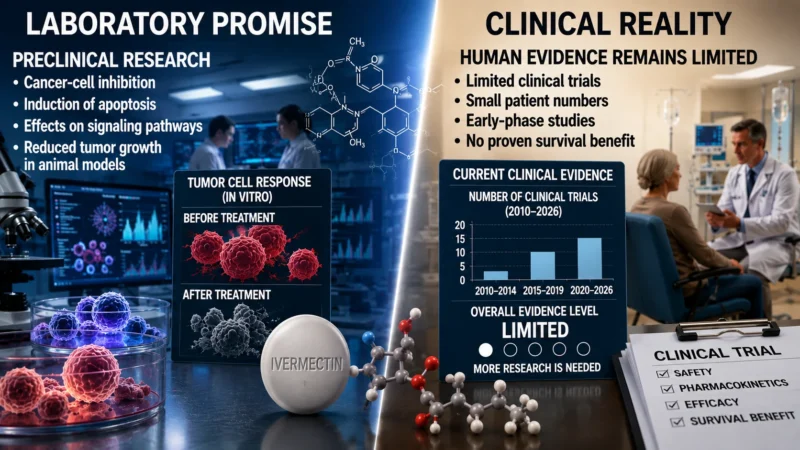
This distinction is critical. A drug can affect cancer cells in vitro and still fail clinically because of pharmacokinetics, toxicity, inadequate tumor exposure, biological heterogeneity, or other factors.
Patel Y, Chawla J, Parmar MS. Ivermectin in Cancer Treatment: Should Healthcare Providers Caution or Explore Its Therapeutic Potential? Current Oncology Reports. 2025.
Clinical Trials Investigating Ivermectin in Cancer
Research has begun moving beyond laboratory studies, but clinical investigation remains early. One current example is NCT07487805, the ICONIC trial, which is studying ivermectin in combination with immune checkpoint inhibition in cancer. ClinicalTrials.gov currently lists the study as not yet recruiting. Its primary objective includes evaluating changes in immune-cell activity, while safety and cytokine changes are among the secondary outcomes.
The trial is particularly important because it illustrates the current scientific question: researchers are not simply assuming ivermectin works. They are testing whether it can produce measurable biological and clinical effects when combined with established immunotherapy. Earlier clinical work has also explored ivermectin combined with anti-PD-1 therapy in metastatic triple-negative breast cancer. However, the available human data remain too limited to establish efficacy.
ClinicalTrials.gov. NCT07487805, Ivermectin Combined With Immune Checkpoint Inhibition in Cancer (ICONIC). Updated July 2026.
Why Laboratory Success Does Not Automatically Become a Cancer Treatment
The path from laboratory discovery to an approved oncology treatment is long. A potential anticancer drug must demonstrate that it can reach the tumor at an effective concentration, produce meaningful biological effects, and do so without unacceptable toxicity.
Laboratory models cannot fully reproduce the complexity of human cancers. Tumors contain different cell populations, immune cells, blood vessels, stromal components, and evolving resistance mechanisms. Ivermectin also has physicochemical characteristics that may affect its clinical development, including high lipophilicity and poor aqueous solubility. Recent reviews have therefore highlighted formulation and drug-delivery strategies as areas requiring further investigation.
Why Dose and Drug Exposure Matter in Cancer Research
One of the biggest challenges in translating laboratory findings into cancer treatment is determining whether the concentrations of a drug that affect cancer cells can actually be achieved safely in humans. In preclinical experiments, researchers may expose cancer cells directly to a compound at concentrations that produce measurable effects. Animal studies can also use doses and schedules that are carefully controlled for the experimental model. However, the human body processes drugs differently, and the concentration reached in the bloodstream or inside a tumor may be substantially different from the concentration used in a laboratory experiment.
This distinction is particularly important for ivermectin. Some anticancer effects reported in experimental studies have occurred at concentrations that may not correspond to exposures achievable with currently approved human dosing. As a result, demonstrating that a drug can kill cancer cells in a dish is only the beginning of the drug-development process.
Researchers must determine whether sufficient drug can reach the tumor while remaining within a safe exposure range. They also need to understand how the drug is absorbed, distributed, metabolized, and eliminated, and whether cancer patients receiving other medications could experience clinically important drug interactions. This is one reason that dose-escalation and pharmacokinetic studies are important components of early-phase clinical trials. Researchers need to establish what dose patients can safely receive before larger trials can determine whether the treatment actually improves cancer outcomes.
The same principle applies to drug repurposing more broadly. A medication that has already been approved for one disease has an advantage because its safety profile may be better understood, but that does not automatically establish a safe or effective dose for a completely different disease.
For ivermectin, the scientific question therefore extends beyond whether it has anticancer activity. Researchers must determine whether that activity can be reproduced at clinically achievable exposures and whether doing so provides a meaningful benefit without unacceptable toxicity. Until those questions are answered through properly designed human studies, preclinical findings should be viewed as hypothesis-generating evidence rather than proof of an effective cancer treatment.
Robalino KN, Vivanco-Galván O, Romero-Benavides JC, Jiménez-Gaona Y. Ivermectin as an Alternative Anticancer Agent: A Review of Its Chemical Properties and Therapeutic Potential. Pharmaceuticals. 2025;18(10):1459. Patel Y, Chawla J, Parmar MS. Ivermectin in Cancer Treatment: Should Healthcare Providers Caution or Explore Its Therapeutic Potential? Current Oncology Reports. 2025.
Ivermectin Safety: Approved Uses vs Cancer Claims
Ivermectin is not an animal-only drug. It is an established antiparasitic medication with approved human uses. However, human and veterinary formulations are not interchangeable. Veterinary products may contain different concentrations, formulations, or excipients and are not intended for human use. Most importantly, ivermectin is not approved as a cancer treatment, and there is no established anticancer dose or treatment schedule.
Risks of Self-Medicating With Ivermectin for Cancer
The greatest concern is not scientific interest in ivermectin itself, but the use of unproven dosing or formulations outside medical supervision. Taking ivermectin for cancer could create several problems. It may expose patients to unnecessary toxicity, interact with other medications, or most importantly delay effective cancer treatment.
This is particularly relevant in oncology, where patients may already be receiving several medications and where treatment timing can be clinically important. High or inappropriate doses can cause adverse effects, including gastrointestinal and neurological symptoms, while drug interactions may also be relevant because ivermectin is affected by metabolic and transport pathways. The appropriate response to interest in ivermectin is therefore not to dismiss the underlying scientific question, but to distinguish clinical research from unsupported treatment claims.
Where Could Ivermectin Research Go Next?
Ivermectin remains an interesting subject for drug-repurposing research. Future studies may investigate whether specific tumor types or molecular subgroups are more likely to respond, whether ivermectin can enhance immunotherapy or chemotherapy, and whether new formulations can improve drug delivery.
Researchers are also studying mechanisms involving PAK1/Akt/mTOR, Wnt/β-catenin, STAT3, mitochondrial signaling, immune modulation, and treatment resistance. However, these questions require well-designed clinical trials with meaningful endpoints before ivermectin could have a place in routine oncology. The most important question is therefore not “Does ivermectin kill cancer cells in a laboratory?” It can under certain experimental conditions. The clinically relevant question is “Does ivermectin safely improve outcomes for people with cancer?” That answer remains unknown.
Robalino KN et al. Pharmaceuticals. 2025;18(10):1459. 2026 scoping review of ivermectin molecular targets in cancer. ClinicalTrials.gov, NCT07487805.
What Patients and Caregivers Should Know
Ivermectin has generated legitimate scientific interest because of its effects in cancer-cell and animal models. But those findings should not be confused with evidence that the drug treats cancer in humans. At present, there is no established clinical evidence supporting ivermectin as a standalone cancer treatment or as a replacement for standard oncology therapy.
Patients should not replace surgery, chemotherapy, radiation therapy, immunotherapy, targeted therapy, endocrine therapy, or other evidence-based treatments with ivermectin. For patients interested in experimental approaches, the safest path is to discuss the question with their oncology team and, when appropriate, consider participation in a properly designed clinical trial.
Why Do People Recommend Ivermectin for Cancer?
Ivermectin’s reputation as a potential cancer treatment is partly driven by the gap between preclinical research and clinical evidence. When laboratory studies show that a drug can kill cancer cells or slow tumor growth in experimental models, those findings can easily be interpreted online as proof that the drug treats cancer in people. Social media posts, testimonials, and anecdotal reports can further amplify these claims, even when they are not supported by clinical trials.
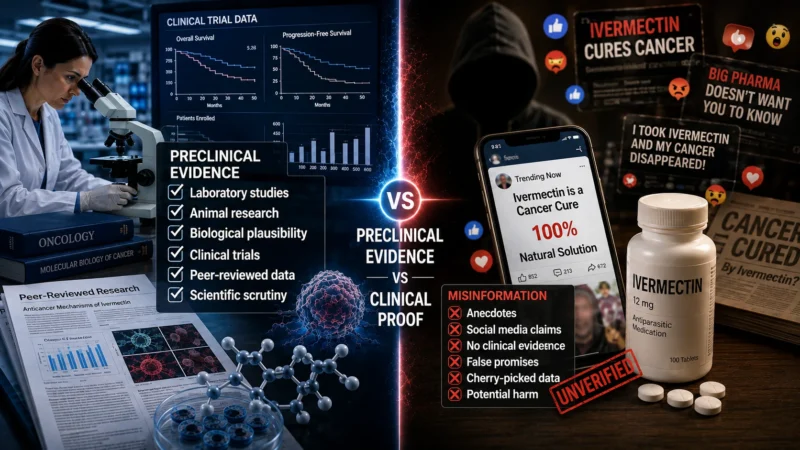
Friends and family members may also recommend ivermectin with good intentions. They may see a study, video, or personal story suggesting that ivermectin has anticancer properties and believe they are offering another treatment option to someone with cancer. The problem is that a laboratory finding or individual experience cannot establish whether a treatment is effective or safe for cancer patients.
Why Can This Be Dangerous for Cancer Patients?
The greatest risk is that an unproven treatment may delay or replace effective cancer care. Cancer treatment is often time-sensitive, and postponing surgery, chemotherapy, radiation therapy, immunotherapy, targeted therapy, or endocrine therapy can allow disease to progress. Ivermectin can also cause adverse effects and interact with other medications. Using formulations intended for animals or taking doses that have not been established for cancer treatment creates additional safety concerns.
For this reason, patients should not start ivermectin because a friend, family member, social media post, or online testimonial recommends it. If someone with cancer is considering ivermectin, the appropriate step is to discuss the evidence and potential risks with their oncology team. Good intentions do not make an unproven cancer treatment safe, and hope should never come at the expense of evidence-based care.
You Can Also Read Cancer Misinformation in 2025: How Viral Narratives Are Putting Patients at Risk by OncoDaily
Written by Aharon Tsaturyan, MD, Editor at OncoDaily Intelligence Unit.
FAQ
Does ivermectin treat cancer?
There is currently no high-quality clinical evidence showing that ivermectin treats or cures cancer in humans. Laboratory and animal studies have reported anticancer effects, but these findings have not established a clinical benefit. It should not replace evidence-based cancer treatments.
Can ivermectin cure cancer?
No, there is no established evidence that this drug can cure cancer. Some experimental studies have shown effects on cancer cells, but laboratory activity does not demonstrate improved survival or tumor control in patients. Claims that it is a cancer cure go beyond the available clinical evidence.
Is ivermectin approved for cancer treatment?
No. Ivermectin is an approved antiparasitic medication for certain human infections, but it is not approved as a cancer treatment. Researchers are investigating whether it could have a future role in combination with established therapies.
Why do people say ivermectin works against cancer?
Interest largely comes from laboratory studies showing effects on cancer-cell growth, apoptosis, signaling pathways, and immune responses. These findings can be amplified through social media, personal testimonials, and misunderstandings about early-stage research. A promising laboratory result does not mean that a treatment has been proven effective in people.
What does ivermectin do to cancer cells?
Preclinical research suggests the drug may affect pathways involved in cell proliferation, apoptosis, mitochondrial function, and immune signaling. Studies have investigated pathways including PAK1, Akt/mTOR, STAT3, and Wnt/β-catenin. These mechanisms remain subjects of research and have not established a standard cancer treatment.
Are there clinical trials studying ivermectin for cancer?
Yes. Clinical research is investigating the drug, particularly in combination with immune checkpoint inhibitors. For example, the ICONIC Phase 2 trial is studying its safety and potential immune effects in adults with solid tumors receiving checkpoint inhibition; the trial was listed as not yet recruiting in July 2026.
Is ivermectin being studied with immunotherapy?
Yes. Researchers are investigating whether the drug could influence the immune response and potentially enhance checkpoint inhibitor activity. An earlier Phase 2 study combining it with pembrolizumab in metastatic triple-negative breast cancer was withdrawn, while newer research such as ICONIC is continuing to investigate the question.
Is ivermectin safe for cancer patients?
Safety depends on the dose, formulation, other medications, and the patient's overall health. Cancer patients may have a higher risk of medication interactions because they can be taking chemotherapy, targeted therapies, immunotherapy, and supportive medications simultaneously. Taking an unapproved dose for cancer without medical supervision can create unnecessary risks.
Can cancer patients take ivermectin instead of chemotherapy?
No. Replacing proven cancer treatment with an unproven therapy can delay treatment that has demonstrated benefits for survival or disease control. Patients interested in experimental approaches should discuss them with their oncology team rather than stopping or changing prescribed treatment.
What should cancer patients do if someone recommends ivermectin?
Patients should ask their oncologist about the evidence, potential interactions, and whether a relevant clinical trial is available. Friends and family may recommend treatments because they genuinely want to help, but personal testimonials cannot establish whether a treatment works. The safest approach is to evaluate any proposed cancer therapy using clinical evidence and guidance from the treating oncology team.