The U.S. Food and Drug Administration has approved Jideytro, also known as zidesamtinib, for adults with locally advanced or metastatic ROS1-positive non-small cell lung cancer who have received a prior ROS1 kinase inhibitor.
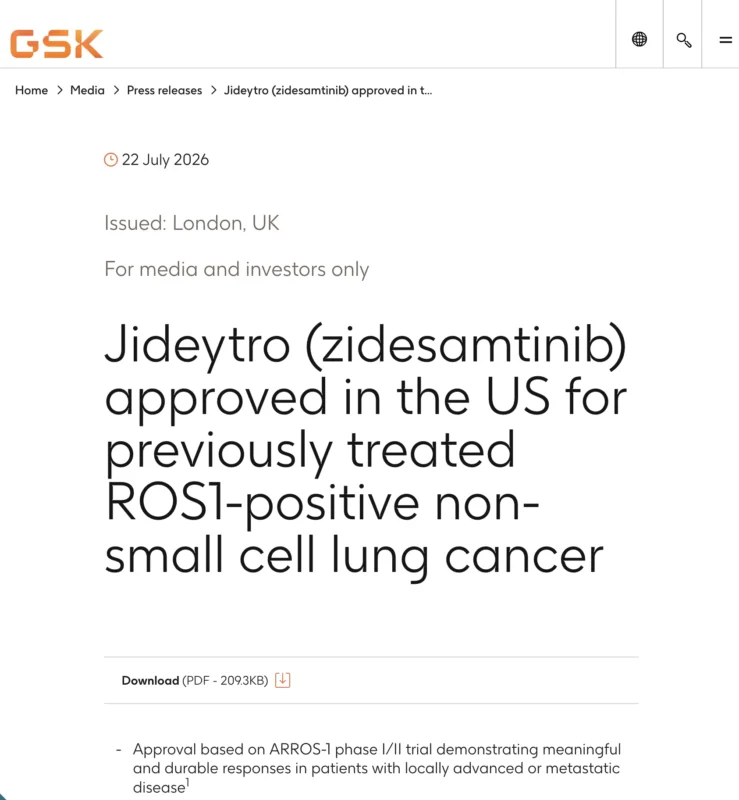
The approval was announced by GSK on July 22, 2026, and marks the company’s first approved medicine in lung cancer. It also follows GSK’s recently completed acquisition of Nuvalent, the company that developed zidesamtinib.
For patients with ROS1-positive NSCLC, the approval adds a new targeted option in a setting where resistance mutations, brain progression, and treatment tolerability remain persistent clinical challenges.
Why ROS1-Positive NSCLC Needs More Options
ROS1-positive NSCLC is a relatively uncommon but clinically important molecular subtype of lung cancer. According to GSK, approximately 50,000 people worldwide are diagnosed each year with ROS1-positive NSCLC, often affecting nonsmokers in their 40s and 50s.
Targeted therapy has changed the treatment landscape for ROS1-positive disease, but patients can still develop resistance after ROS1 kinase inhibitors. Disease progression in the brain is also a major concern, partly because the central nervous system can function as a sanctuary site.
This makes the development of next-generation ROS1 inhibitors clinically important.
A Next-Generation ROS1-Selective Inhibitor
Zidesamtinib was designed as a ROS1-selective inhibitor with three key goals:
- broad activity against ROS1 resistance mutations,
- blood-brain barrier penetration,
- and a tolerable safety profile.
According to GSK, the drug’s next-generation design aims to address both efficacy and tolerability challenges that can emerge over time in ROS1-positive NSCLC treatment.
ARROS-1 Supported the Approval
The FDA approval was based on results from the global, single-arm ARROS-1 phase I/II trial, which evaluated zidesamtinib in patients with advanced ROS1-positive NSCLC and other ROS1-positive solid tumors.
For the approval population, the analysis included 117 patients with ROS1-positive NSCLC previously treated with a ROS1 inhibitor.
In this group, the objective response rate was 44%.
Responses were also durable, with duration of response rates of:
- 82% at 6 months
- 69% at 12 months
The press release notes that meaningful and durable responses were observed, including in patients with brain metastases and ROS1 resistance mutations.
Safety Profile
In the pooled safety population of 446 patients, the most common adverse reactions occurring in at least 15% of patients included:
- oedema,
- peripheral neuropathy,
- constipation,
- fatigue,
- and dyspnoea.
The U.S. Prescribing Information is expected to provide the full safety, dosing, and monitoring details.
More Lung Cancer Assets in GSK’s Pipeline
Jideytro is GSK’s first approved lung cancer medicine, but it is not the only lung cancer program in the company’s expanding oncology portfolio.
GSK noted that neladalkib, also known as NVL-655, is currently under FDA review for ALK-altered NSCLC, with a target decision date of November 27, 2026. The company is also advancing NVL-330 for HER2-altered NSCLC and risvutatug rezetecan, a B7-H3-directed antibody-drug conjugate in late-stage development for small cell lung cancer.
What This Approval Means Clinically
The approval of zidesamtinib is important because it strengthens the treatment landscape for patients with ROS1-positive NSCLC after prior ROS1-directed therapy.
The key clinical value lies in three areas:
- first, activity in a previously treated population;
second, durability of response; - and third, the intended ability to address resistance mutations and CNS disease.
However, several questions remain. ARROS-1 is a single-arm study, so comparative data against other available post-ROS1 inhibitor strategies are still needed. The optimal sequencing of zidesamtinib relative to other ROS1 inhibitors will also require more clinical experience.
Zidesamtinib continues to be studied in ARROS-1, including in the first-line setting for patients who have not previously received a ROS1 inhibitor.
The Bottom Line
The FDA approval of Jideytro/zidesamtinib gives patients with previously treated ROS1-positive advanced NSCLC a new targeted therapy option.
In ARROS-1, zidesamtinib achieved an ORR of 44% in patients previously treated with a ROS1 inhibitor, with 69% of responses ongoing at 12 months.
For a molecular subtype where resistance, brain metastases, and long-term tolerability are central concerns, this approval represents a meaningful addition to precision lung cancer care.
References
- GSK. Jideytro (zidesamtinib) approved in the US for previously treated ROS1-positive non-small cell lung cancer. Press release. Issued July 22, 2026.
- ClinicalTrials.gov. A study of zidesamtinib (NVL-520) in patients with advanced NSCLC and other solid tumors harboring ROS1 rearrangement, ARROS-1. NCT05118789.
- Solomon B. Validating ROS1 rearrangements as a therapeutic target in non-small-cell lung cancer. Journal of Clinical Oncology. 2015;33:972-974.
- Duma N, Santana-Davila R, Molina JR. Non-small cell lung cancer: epidemiology, screening, diagnosis, and treatment. Mayo Clinic Proceedings. 2019;94:1623-1640.