Resistance remains the central challenge in EGFR-mutant non-small cell lung cancer.
Osimertinib can produce substantial and often durable responses, but residual tumor cells may survive initial treatment and later seed relapse. These surviving cells, known as drug-tolerant persister cells, are increasingly recognized as an early reservoir from which resistant disease can emerge.
A new study published in Cancer Cell identifies TROP2 as a potential vulnerability within these cells. The investigators found that TROP2 becomes dynamically upregulated during EGFR tyrosine kinase inhibitor-induced drug-tolerant persister cell formation and contributes to the survival of this resistant cell state.
In preclinical models, combining the TROP2-directed antibody–drug conjugate sacituzumab tirumotecan with osimertinib suppressed the emergence of persister cells and delayed tumor relapse.
The findings provide a biological rationale for combining an EGFR-TKI with a TROP2-targeted ADC earlier in the course of EGFR-mutant NSCLC.
Why Drug-Tolerant Persister Cells Matter
EGFR-mutant NSCLC is typically highly sensitive to EGFR tyrosine kinase inhibitors. However, even when imaging shows a major response, a small population of tumor cells can survive treatment.
These cells are not necessarily resistant because of a stable genetic resistance mutation at the time they first persist. Instead, they may enter a reversible, slow-growing, drug-tolerant state.
Over time, this population can acquire or select for mechanisms that allow the tumor to resume growth despite continued EGFR inhibition.
Finding ways to eliminate drug-tolerant persister cells before overt progression occurs could therefore change how resistance is approached. Rather than treating resistance only after it develops, combination therapy may be able to delay its emergence.
TROP2 Was Upregulated During the Drug-Tolerant State
The investigators used comprehensive analyses to study molecular changes during the formation of EGFR-TKI-induced drug-tolerant persister cells.
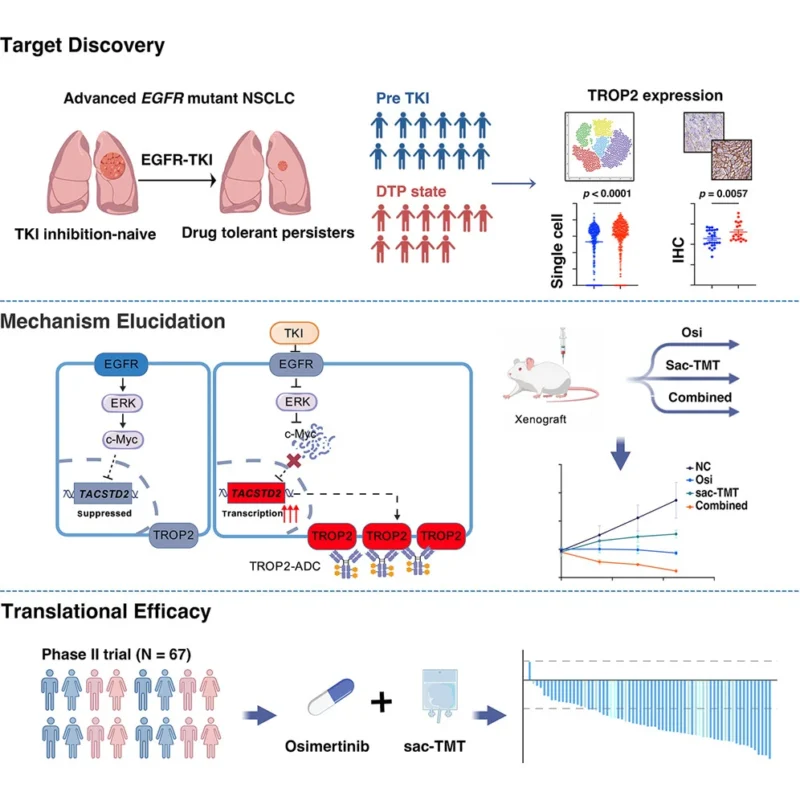
TROP2 expression increased dynamically as persister cells emerged under EGFR-TKI exposure. This increase was reversible, falling again when cells exited the drug-tolerant state.
Mechanistically, the study linked this process to c-Myc.
Under active MAPK signaling, c-Myc acted as a transcriptional repressor of TROP2. EGFR-TKI treatment reduced MAPK pathway activity and lowered c-Myc levels, releasing this repression and allowing TROP2 expression to increase.
This finding is notable because it links a treatment-induced adaptive state to the emergence of a potentially actionable surface target.
TROP2 Helped Support Persister Cell Survival
The study showed that TROP2 was not merely a marker of the drug-tolerant state.
TROP2 upregulation also contributed functionally to the maintenance and survival of persister cells. This suggests that TROP2-positive cells may represent a biologically relevant population that survives osimertinib exposure and contributes to later relapse.
The investigators therefore tested whether a TROP2-directed antibody–drug conjugate could target this vulnerable state.
Sacituzumab tirumotecan, also known as sac-TMT, is a TROP2-targeted ADC that delivers a cytotoxic payload to TROP2-expressing tumor cells.
Sac-TMT Plus Osimertinib Suppressed Persister Cells
In preclinical models, the combination of sacituzumab tirumotecan and osimertinib was more effective than either treatment alone at suppressing drug-tolerant persister cell emergence.
The combination also delayed tumor relapse in experimental models.
These findings support a complementary treatment strategy.
Osimertinib targets the EGFR-dependent tumor population and suppresses the signaling pathway that drives the cancer. Sac-TMT may help eliminate the TROP2-upregulated persister population that survives during EGFR inhibition.
Together, the treatments aim to address both the dominant EGFR-driven cancer cells and the residual cells that may later enable resistance.
A Shift From Treating Resistance to Preventing It
Most strategies for EGFR-mutant NSCLC focus on treating resistance after it becomes clinically apparent.
This study instead focuses on an earlier biological window. The aim is to target cells that survive initial EGFR-TKI exposure before they evolve into a clinically resistant tumor population.
The approach is conceptually important because resistance is often heterogeneous. By the time progression occurs, multiple resistant clones or pathways may coexist.
Targeting an adaptive cell state early could potentially reduce the number of residual cells available to generate later resistance mechanisms.
However, this hypothesis will need validation in prospective clinical trials.
Early Clinical Evaluation Is Underway
The authors report preliminary activity from an ongoing phase 2 study evaluating first-line sacituzumab tirumotecan plus osimertinib in advanced EGFR-mutant NSCLC.
The current report does not establish the combination as a new standard of care. Clinical efficacy, safety, optimal sequencing, dose intensity, and patient selection remain to be defined.
A prospective phase 2 study is evaluating the safety and efficacy of sacituzumab tirumotecan with osimertinib in advanced EGFR-mutant NSCLC.
Important Questions Ahead
The translational findings raise several practical questions.
It will be important to determine whether baseline TROP2 expression, treatment-induced TROP2 upregulation, or other molecular features identify patients most likely to benefit from the combination.
The safety profile will also be critical. Combining an EGFR-TKI with an ADC may introduce overlapping or cumulative toxicity that must be weighed against any potential delay in resistance.
In addition, the optimal timing remains uncertain. The strategy could be explored in the first-line setting, in molecular residual disease-guided approaches, or in patients with early evidence of subclinical resistance.
Key Takeaway
This Cancer Cell study identifies TROP2 as a treatment-induced vulnerability in EGFR-TKI drug-tolerant persister cells.
TROP2 was upregulated through c-Myc derepression after EGFR-TKI-mediated MAPK inhibition. In preclinical models, combining the TROP2-targeted ADC sacituzumab tirumotecan with osimertinib suppressed persister cell emergence and delayed tumor relapse.
The results provide a rationale for clinical development of TROP2-ADC plus EGFR-TKI combinations as a strategy to delay resistance in EGFR-mutant NSCLC.