
An investigational antibody-drug conjugate targeting epidermal growth factor receptor has shown preliminary antitumor activity across several previously treated non-small cell lung cancer populations, including both EGFR-mutant and EGFR wild-type disease.
Results from the first-in-human Phase I study of SYS6010 showed an objective response rate of 34.7% among patients with classical EGFR-mutant NSCLC previously treated with both EGFR tyrosine kinase inhibitors and platinum-based chemotherapy. In this population, median progression-free survival reached 7.6 months, while median overall survival was 19.4 months.
Activity was also observed outside classical EGFR-mutant disease. The objective response rate was 45.7% among patients with EGFR-mutant NSCLC treated previously with EGFR TKIs but not platinum chemotherapy, 35.7% among patients with EGFR wild-type nonsquamous NSCLC, and 20.0% among those with EGFR wild-type squamous disease (Li et al., 2026).
The study, registered as ChiCTR2300072141, evaluated SYS6010 across a broad NSCLC population and identified 4.2–4.8 mg/kg every 3 weeks as the recommended Phase II dose range.
The findings are particularly notable because SYS6010 is being developed not simply as another inhibitor of EGFR signaling, but as an EGFR-directed delivery system for a topoisomerase I inhibitor payload.
What Is SYS6010?
SYS6010 is an antibody-drug conjugate, or ADC, designed to recognize EGFR on tumor cells and deliver the cytotoxic payload JS-1.
The molecule consists of a humanized anti-EGFR IgG1 antibody connected through a tetrapeptide-based cleavable linker to JS-1, a topoisomerase I inhibitor.
SYS6010 has a relatively high drug-to-antibody ratio of approximately 8, meaning that each antibody carries multiple payload molecules.
The linker is designed to remain stable in circulation but release the payload after the ADC reaches its target. JS-1 is membrane permeable, allowing it to produce a bystander effect, in which cytotoxic activity can extend beyond the directly targeted tumor cell (Li et al., 2026).
Preclinical testing described by the investigators also showed antitumor activity in an osimertinib-resistant NSCLC patient-derived xenograft model.
The development strategy therefore differs fundamentally from conventional EGFR TKIs.
Instead of relying exclusively on inhibition of EGFR signaling, SYS6010 uses EGFR as a tumor-associated target for cytotoxic drug delivery.
Why Target EGFR After EGFR TKI Resistance?
EGFR-mutant NSCLC has been transformed by increasingly effective EGFR TKIs, particularly third-generation agents.
However, acquired resistance eventually develops in most patients.
Following progression on EGFR-targeted therapy, platinum-based chemotherapy has historically represented an important subsequent treatment option, although the duration of disease control remains limited.
ADC development has therefore become an increasingly important area of investigation in EGFR-mutant lung cancer.
Several strategies targeting TROP2 and HER3 have already been evaluated after EGFR TKI resistance. SYS6010 takes a different approach by directly targeting EGFR itself while delivering a topoisomerase I inhibitor payload (Li et al., 2026).
The trial also examined another clinically important question: whether an EGFR-targeting ADC could show activity in tumors that do not harbor an activating EGFR mutation.
That distinction became one of the most interesting findings of the study.
How Was the Phase I Study Designed?
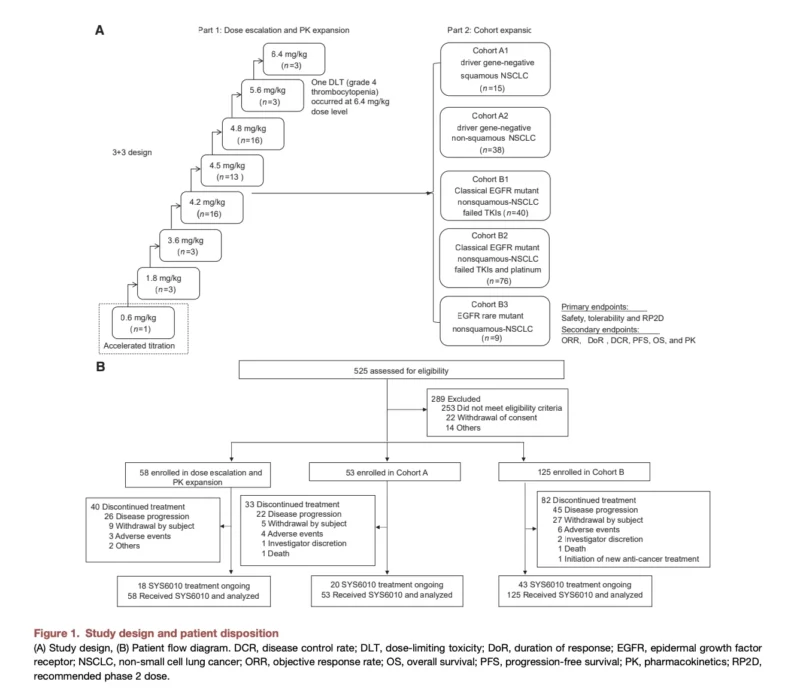
The multicenter, open-label Phase I trial was conducted across 33 sites in China.
The study included dose escalation, pharmacokinetic expansion, and subsequent disease-specific cohort expansion.
A total of 236 patients received SYS6010. Of these, 230 had NSCLC, while six patients with colorectal cancer were included in the dose-escalation component.
Eight SYS6010 dose levels were investigated:
- 0.6 mg/kg, 1.8 mg/kg, 3.6 mg/kg, 4.2 mg/kg, 4.5 mg/kg, 4.8 mg/kg, 5.6 mg/kg, and 6.4 mg/kg every three weeks.
The expansion phase concentrated primarily on 4.2, 4.5, and 4.8 mg/kg Q3W (Li et al., 2026).
The study included several biologically and clinically distinct NSCLC populations.
Patients with driver-negative disease included both squamous and nonsquamous tumors that had progressed after prior immunotherapy and platinum-based chemotherapy.
The EGFR-mutant cohorts included patients with classical EGFR mutations after EGFR TKI therapy, patients previously exposed to both EGFR TKIs and platinum chemotherapy, and small cohorts with uncommon EGFR alterations including exon 20 insertions and P-loop and αC-helix compressing, or PACC, mutations.
Who Was Included in the NSCLC Population?
Among the 230 patients with NSCLC, median age was 59 years, and the median number of previous treatment lines was 2, with a range of 1 to 10.
A total of 166 patients had EGFR-mutant NSCLC, while 64 had EGFR wild-type disease.
Among the EGFR-mutant population, 152 patients had classical mutations, eight had EGFR exon 20 insertions, and six had PACC mutations.
Among the 152 patients with classical EGFR-mutant disease, 47 had previously received EGFR TKIs alone, while 105 had received both EGFR TKIs and platinum-based chemotherapy.
All patients with EGFR wild-type NSCLC had driver-negative disease. These included 21 patients with squamous carcinoma and 43 with nonsquamous disease, all of whom had previously received a PD-1 or PD-L1 inhibitor together with platinum-based chemotherapy (Li et al., 2026).
What Happened After EGFR TKIs and Platinum Chemotherapy?
This was one of the central efficacy populations in the study.
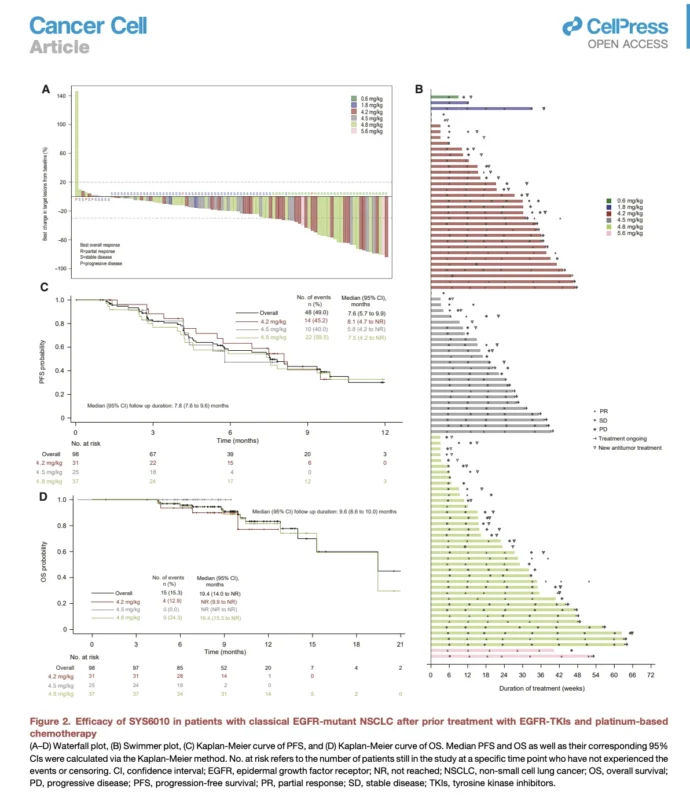
Among 98 efficacy-evaluable patients with classical EGFR-mutant NSCLC previously treated with both EGFR TKIs and platinum-based chemotherapy, SYS6010 produced an objective response rate of:
- 34.7%
The disease control rate was:
- 93.9%
Median duration of response was:
- 8.5 months
Median progression-free survival was:
- 7.6 months
Median overall survival was:
- 19.4 months (Li et al., 2026).
Responses were observed across the three principal expansion doses.
- At 4.2 mg/kg, the ORR was 45.2%.
- At 4.5 mg/kg, it was 20.0%.
- At 4.8 mg/kg, the ORR was 35.1%.
Because this was a Phase I, nonrandomized trial with relatively small numbers within individual dose cohorts, these differences cannot establish superiority of one dose over another.
What Happened in Patients Treated Only With Previous EGFR TKIs?
Another 46 efficacy-evaluable patients with classical EGFR-mutant NSCLC had previously received EGFR TKIs but had not yet received platinum-based chemotherapy.
In this group, the objective response rate was higher:
- 45.7%
The disease control rate was:
- 95.7%
Median duration of response was:
- 6.2 months
Median progression-free survival was:
- 7.8 months
Median overall survival had not been reached at the time of analysis (Li et al., 2026).
These data provide another signal of activity, although the clinical context differs from that of patients who had already progressed through both targeted therapy and chemotherapy.
Did SYS6010 Work in EGFR Wild-Type NSCLC?
One of the more provocative observations from the trial was that activity was not confined to tumors carrying EGFR mutations.
Among 42 efficacy-evaluable patients with EGFR wild-type nonsquamous NSCLC, all of whom had previously received immunotherapy and platinum chemotherapy, the objective response rate was:
- 35.7%
The disease control rate reached:
- 88.1%
Median progression-free survival was:
- 5.3 months
Median duration of response and median overall survival had not been reached at the reported analysis (Li et al., 2026).
The waterfall plot presented in the study also demonstrated measurable tumor shrinkage across a substantial proportion of this EGFR wild-type nonsquamous cohort.
This finding raises an important biological question: does SYS6010 activity depend more on the amount of EGFR expressed on the tumor surface than on whether an activating EGFR mutation is present?
The investigators explored exactly that possibility.
Was Activity Different in Squamous NSCLC?
Activity was also seen in EGFR wild-type squamous NSCLC, although results were less pronounced.
Among 20 efficacy-evaluable patients, the objective response rate was:
- 20.0%
The disease control rate was:
- 75.0%
Median progression-free survival was:
- 2.9 months
Median overall survival had not been reached (Li et al., 2026).
The relatively small number of patients means that these results remain exploratory.
Nevertheless, the inclusion of both squamous and nonsquamous disease demonstrates the breadth of the development strategy being investigated for an EGFR-directed ADC.
What Happened in EGFR Exon 20 Insertion Disease?
The trial also included a small cohort of patients with uncommon EGFR alterations.
Among eight patients with EGFR exon 20 insertions, three achieved partial responses, corresponding to an ORR of:
- 37.5%
Median PFS was 7.6 months.
All three responding patients had received three previous lines of therapy.
However, with only eight patients included, the investigators emphasized that these results require confirmation in a substantially larger population (Li et al., 2026).
Six patients with PACC mutations were also evaluable. One achieved a partial response, corresponding to an ORR of 16.7%, while the disease control rate was 83.3%.
Could EGFR Expression Matter More Than EGFR Mutation?
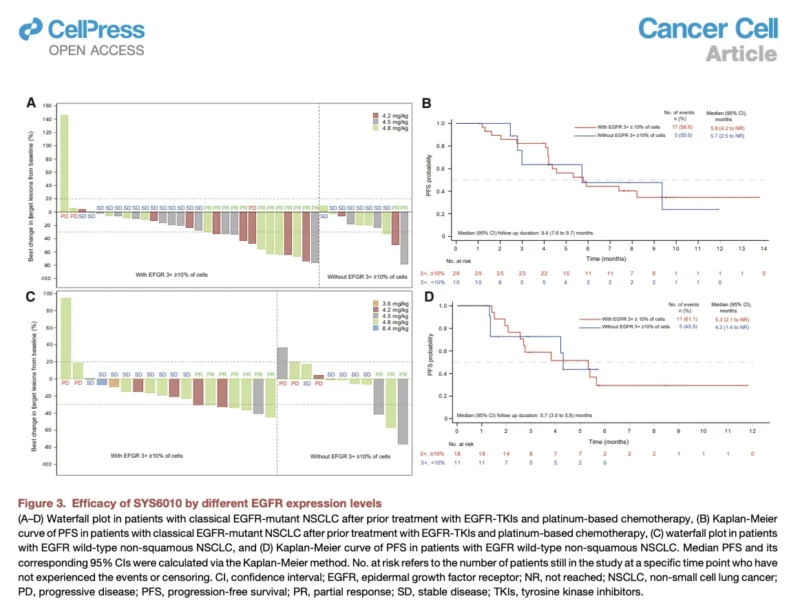
Perhaps the most biologically interesting exploratory analysis examined tumor EGFR expression.
The investigators defined high EGFR expression as:
EGFR IHC 3+ staining in ≥10% of tumor cells.
Among patients with EGFR-mutant disease previously treated with EGFR TKIs and platinum chemotherapy who had evaluable EGFR expression data, the objective response rate was:
- 41.4% in tumors with high EGFR expression
versus
- 20.0% in tumors that did not meet that expression threshold.
Among patients with EGFR wild-type nonsquamous NSCLC, the corresponding ORRs were:
- 38.9% with high EGFR expression
versus
- 27.3% without high expression (Li et al., 2026).
Notably, among tumors with high EGFR expression, response rates were relatively similar whether an activating EGFR mutation was present or absent.
This led the investigators to propose that SYS6010 activity may be driven more strongly by EGFR expression than by EGFR mutation status itself.
That remains a hypothesis rather than a validated predictive biomarker.
The analysis involved small subsets, tissue availability was incomplete, and the study was not designed to prospectively validate an EGFR expression threshold.
Still, this observation could become highly relevant to future development because it raises the possibility of selecting patients for an EGFR ADC according to target abundance, rather than limiting treatment to mutation-defined disease.
Why Were 4.2–4.8 mg/kg Selected?
The recommended Phase II dose was not defined as a single dose.
Instead, investigators selected a range of 4.2–4.8 mg/kg every three weeks based on integrated pharmacokinetic, efficacy, and safety analyses.
One dose-limiting toxicity-Grade 4 thrombocytopenia-occurred at 6.4 mg/kg.
The maximum tolerated dose was not reached.
However, dose reductions became more frequent as dose increased.
- At 4.2 mg/kg, dose reduction occurred in 22.6% of patients
- At 4.5 mg/kg, the rate was 27.5%
- At 4.8 mg/kg, it increased to 42.7%
All six patients treated at 5.6 or 6.4 mg/kg required dose reductions.
Dose/exposure-response modeling similarly suggested that higher exposure was associated with greater response probability but also greater toxicity.
The predicted probability of Grade ≥3 treatment-related adverse events increased from 44% at 4.2 mg/kg to 79% at 4.8 mg/kg, while predicted ORR increased from approximately 32% to 43%.
These competing efficacy and toxicity relationships contributed to selection of the 4.2–4.8 mg/kg range for subsequent development (Li et al., 2026).
What Was the Safety Profile of SYS6010?
Treatment-related adverse events occurred in 99.6% of the 236 treated patients.
Grade 3 or higher treatment-related adverse events occurred in 57.2%.
The most common Grade ≥3 treatment-related events were predominantly hematologic:
- Neutropenia — 30.9%
- Leukopenia — 25.0%
- Thrombocytopenia — 17.4%
- Anemia — 9.7%
- Asthenia — 8.9%
- Lymphopenia — 7.6% (Li et al., 2026).
Serious treatment-related adverse events occurred in 24.2% of patients.
Treatment-related adverse events resulted in dose interruption in 32.2%, dose reduction in 35.2%, and permanent treatment discontinuation in 5.1%.
The safety data therefore indicate meaningful toxicity requiring active dose management, particularly hematologic toxicity.
Were Typical EGFR-Related Skin Toxicities Common?
Interestingly, the safety profile did not appear dominated by the dermatologic toxicities typically associated with conventional EGFR-targeted therapies.
Any-grade rash occurred in 28.4% of patients, while Grade ≥3 rash occurred in only 0.4%.
Stomatitis occurred in 20.8%, with Grade ≥3 stomatitis in 2.5%.
The authors described the incidence of characteristic EGFR-targeted therapy-associated skin toxicity as relatively low compared with historical experience with conventional EGFR-directed treatments (Li et al., 2026).
This could reflect the different pharmacologic behavior of an ADC compared with continuous pathway inhibition by a TKI or conventional receptor-blocking antibody.
However, cross-trial safety comparisons require caution.
What About Interstitial Lung Disease?
Interstitial lung disease is an important adverse event to monitor with several ADCs.
In the SYS6010 trial, drug-related ILD was reported in 9 of 236 patients, or 3.8%.
Three cases occurred at 4.2 mg/kg, three at 4.5 mg/kg, and three at 4.8 mg/kg.
The three cases occurring at 4.8 mg/kg were Grade 3.
Four patients discontinued treatment because of ILD.
The median time to onset was 42 days, with a range of 17 to 170 days (Li et al., 2026).
Six of the nine affected patients had at least one reported predisposing factor, including renal impairment, previous thoracic radiotherapy, or both.
The investigators reported that monitoring and management measures were implemented during development.
What Makes the SYS6010 Payload Different?
SYS6010 carries JS-1, a topoisomerase I inhibitor.
According to preclinical data included in the paper, JS-1 demonstrated greater topoisomerase I inhibitory activity than deruxtecan in the specific laboratory assay used by the investigators.
JS-1 also differs in another potentially relevant pharmacologic characteristic.
The authors report that it is not a substrate for P-glycoprotein or breast cancer resistance protein, two drug efflux transporters involved in multidrug resistance.
By contrast, the paper notes that DXd is a substrate for both transporters.
The investigators hypothesize that this characteristic could help SYS6010 retain activity in multidrug-resistant tumors, although this remains a mechanistic rationale rather than a clinically established comparative advantage (Li et al., 2026).
The antibody component was also engineered for high EGFR affinity, while the high drug-to-antibody ratio and membrane-permeable payload were designed to enhance cytotoxic delivery and bystander killing.
What Did the Pharmacokinetic Analysis Show?
Exposure to SYS6010 and total antibody increased approximately linearly across the evaluated 0.6–6.4 mg/kg dose range.
At 4.2, 4.5, and 4.8 mg/kg, the reported SYS6010 half-lives were approximately 65.4, 64.2, and 58.2 hours, respectively.
Systemic exposure to free JS-1 remained substantially lower than exposure to the intact ADC or total antibody, which the investigators interpreted as evidence of circulating stability.
Treatment-emergent antidrug antibodies were uncommon.
Only one patient, representing 0.4%, developed treatment-emergent ADA positivity (Li et al., 2026).
What Are the Main Limitations?
The findings need to be interpreted within the context of an early-phase study.
First, the trial was single-arm, so efficacy cannot be directly compared with another active treatment.
Second, all participants were enrolled in China. Whether the efficacy, pharmacokinetics, and safety profile will be identical across broader global populations remains unknown.
Third, follow-up remained relatively short and differed between dose cohorts because patients entered the study at different times.
Some survival endpoints therefore remained immature.
The trial also included several biologically distinct NSCLC populations, and some subgroups, including uncommon EGFR mutations, contained very few patients.
Finally, fresh tissue was not mandatory. EGFR mutation and expression status were therefore often determined using archival material, which could fail to capture molecular evolution occurring after prior therapies (Li et al., 2026).
These limitations are particularly important when interpreting the exploratory relationship between EGFR expression and response.
Where Is SYS6010 Going Next?
The Phase I results provide the basis for further clinical development rather than establishing SYS6010 as a standard treatment.
According to the investigators, the global SYS6010 development program is ongoing.
This includes a pivotal Phase III study in China, NCT06927986, evaluating the agent in EGFR-mutated NSCLC after EGFR TKI failure.
An international early-phase study, NCT05948865, is also evaluating SYS6010 across more diverse patient populations (Li et al., 2026).
Future studies will need to answer several questions.
Can the efficacy observed after EGFR TKI and platinum chemotherapy be confirmed in randomized trials?
Which dose within the 4.2–4.8 mg/kg range offers the optimal therapeutic index?
Can hematologic toxicity and ILD be effectively managed during longer treatment?
And perhaps most importantly, could EGFR protein expression become a treatment-selection biomarker for an EGFR ADC independently of EGFR mutation status?
The Bottom Line
The first-in-human study of SYS6010 introduces a new approach to targeting EGFR in advanced NSCLC.
Rather than functioning primarily as an inhibitor of EGFR signaling, SYS6010 uses EGFR to deliver a topoisomerase I inhibitor directly to tumor cells.
Among patients with classical EGFR-mutant NSCLC previously treated with both EGFR TKIs and platinum chemotherapy, SYS6010 produced a 34.7% objective response rate, 8.5-month median duration of response, 7.6-month median PFS, and 19.4-month median OS.
Activity was also observed in EGFR-mutant disease after TKI therapy alone, EGFR wild-type nonsquamous NSCLC after chemoimmunotherapy, squamous NSCLC, and small cohorts with uncommon EGFR alterations.
The exploratory biomarker analysis adds another dimension: tumors with higher EGFR protein expression appeared to have higher response rates, including in EGFR wild-type disease.
At the same time, treatment was associated with substantial hematologic toxicity. Grade ≥3 treatment-related adverse events occurred in 57.2% of patients, particularly neutropenia, leukopenia, and thrombocytopenia. Drug-related ILD occurred in 3.8%.
The Phase I study therefore does not establish SYS6010 as a new treatment standard.
It does, however, provide an early signal that EGFR-directed ADC therapy could extend the concept of EGFR targeting beyond mutation-driven pathway inhibition.
The next phase of development will determine whether that signal translates into a reproducible clinical benefit, and whether EGFR expression can ultimately identify which patients are most likely to benefit.
References
- Li ZM, Zhou Z, He ZY, et al. SYS6010, epidermal growth factor receptor-targeting antibody-drug conjugate for advanced non-small cell lung cancer: A phase 1 trial. Cancer Cell. 2026. doi:10.1016/j.ccell.2026.07.012.
- Soria JC, Ohe Y, Vansteenkiste J, et al. Osimertinib in untreated EGFR-mutated advanced non-small-cell lung cancer. N Engl J Med. 2018;378:113–125.
- Cho BC, Lu S, Felip E, et al. Amivantamab plus lazertinib in previously untreated EGFR-mutated advanced NSCLC. N Engl J Med. 2024;391:1486–1498.
- Planchard D, Jänne PA, Cheng Y, et al. Osimertinib with or without chemotherapy in EGFR-mutated advanced NSCLC. N Engl J Med. 2023;389:1935–1948.
- Ahn MJ, Tanaka K, Paz-Ares L, et al. Datopotamab deruxtecan versus docetaxel for previously treated advanced or metastatic non-small cell lung cancer: TROPION-Lung01. J Clin Oncol. 2025;43:260–272.
- Sands J, Ahn MJ, Lisberg A, et al. Datopotamab deruxtecan in advanced or metastatic NSCLC with actionable genomic alterations: TROPION-Lung05. J Clin Oncol. 2025;43:1254–1265.
- Fang W, Wu L, Meng X, et al. Sacituzumab tirumotecan in EGFR-TKI-resistant, EGFR-mutated advanced NSCLC. N Engl J Med. 2026;394:13–26.
- Yu HA, Goto Y, Hayashi H, et al. HERTHENA-Lung01: Patritumab deruxtecan in EGFR-mutated NSCLC after EGFR TKI therapy and platinum-based chemotherapy. J Clin Oncol. 2023;41:5363–5375.