
Maintenance pemetrexed plus pembrolizumab remains a guideline-recommended approach after induction chemoimmunotherapy for advanced or metastatic nonsquamous non-small cell lung cancer.
But a new real-world analysis raises an important question: does pemetrexed continue to add meaningful benefit once patients transition to maintenance pembrolizumab?
In a propensity score-weighted study of US Veterans Affairs data, maintenance pemetrexed plus pembrolizumab was not associated with improved overall survival compared with maintenance pembrolizumab alone. The combination was, however, associated with higher risks of acute kidney injury, neutropenia, and anemia.
The findings, published in JCO Oncology Practice, suggest that the incremental value of maintenance pemetrexed deserves prospective reassessment in the immunotherapy era.
Why This Question Matters
For patients with non-oncogene-driven nonsquamous NSCLC, first-line treatment commonly includes platinum chemotherapy, pemetrexed, and pembrolizumab.
After four induction cycles, many patients continue on maintenance pemetrexed plus pembrolizumab. This strategy was established through landmark chemoimmunotherapy trials and remains incorporated into treatment guidelines.
However, the contribution of ongoing pemetrexed during maintenance is uncertain.
Maintenance treatment can continue for many months. Even when patients are doing well clinically, additional chemotherapy may add cumulative toxicity, infusion burden, monitoring requirements, and financial cost.
This study examined whether maintenance pemetrexed contributes to survival beyond pembrolizumab alone in routine practice.
Study Design
Investigators used US Veterans Affairs data to identify patients with advanced or metastatic nonsquamous NSCLC who received:
Four cycles of carboplatin or cisplatin, pemetrexed, and pembrolizumab
At least one subsequent maintenance dose of pemetrexed plus pembrolizumab or pembrolizumab alone
The analysis included 622 patients.
A total of 473 patients received maintenance pemetrexed plus pembrolizumab, while 149 received maintenance pembrolizumab alone.
Because treatment assignment was not randomized, the investigators used inverse probability of treatment weighting to balance baseline differences between groups. The primary effectiveness endpoint was overall survival from the first maintenance dose.
The study also estimated US government payer spending on maintenance pemetrexed across Veterans Affairs, Medicare Part B, and Medicaid between 2017 and 2022.
No Overall Survival Benefit With Maintenance Pemetrexed
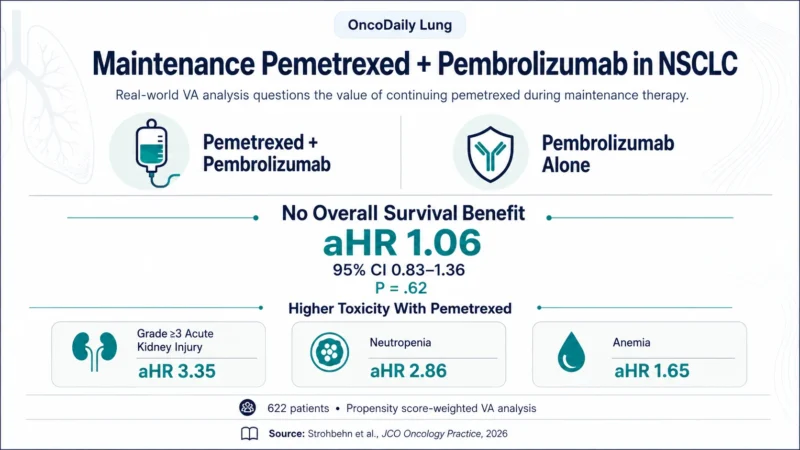
After propensity weighting, maintenance pemetrexed plus pembrolizumab was not associated with improved overall survival compared with pembrolizumab alone.
The adjusted hazard ratio for death was:
- aHR 1.06
- 95% CI, 0.83–1.36
- P = .62
This result suggests no observed survival advantage from continuing pemetrexed during maintenance in this real-world cohort.
The findings remained consistent in a sensitivity analysis excluding patients who crossed over from pembrolizumab alone to pemetrexed plus pembrolizumab.
Higher Toxicity With Pemetrexed Continuation
Although survival was not improved, maintenance pemetrexed was associated with greater toxicity.
Compared with maintenance pembrolizumab alone, pemetrexed plus pembrolizumab was associated with a higher risk of:
Grade 3 or higher acute kidney injury
- aHR 3.35
- 95% CI, 1.08–10.41
- P = .04
Neutropenia
- aHR 2.86
- 95% CI, 1.44–3.05
- P = .004
Anemia
- aHR 1.65
- 95% CI, 1.11–2.47
- P = .014
These findings are clinically relevant because maintenance therapy is intended to prolong disease control while preserving quality of life and minimizing treatment burden.
For some patients, continued chemotherapy-related toxicity may outweigh uncertain incremental benefit.
A Major Financial Burden
The study also examined public spending on maintenance pemetrexed.
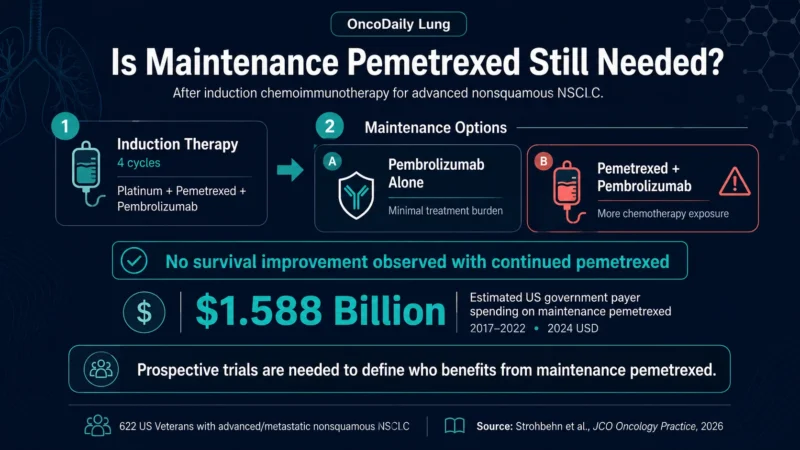
Estimated government payer spending across Veterans Affairs, Medicare Part B, and Medicaid totaled $1.588 billion in 2024 US dollars from 2017 to 2022.
This estimate highlights the potential system-level implications of maintenance chemotherapy that may not provide measurable survival benefit for all patients.
The authors noted that reassessing legacy chemotherapy components may improve both the safety and cost-effectiveness of cancer care.
What This Means for Clinical Practice
This study does not establish that pemetrexed should be stopped for every patient receiving maintenance pembrolizumab.
It is a retrospective observational analysis, not a randomized trial. Despite propensity weighting, residual confounding is possible. Patients selected for pembrolizumab monotherapy may have differed in ways that were not fully captured in the dataset.
Still, the results raise an important clinical question.
In the immunotherapy era, maintenance strategies inherited from earlier trial designs should be re-examined when their independent contribution is uncertain.
For patients with advanced nonsquamous NSCLC who have completed induction chemoimmunotherapy, the decision to continue pemetrexed may need to take into account:
- Renal function
- Hematologic toxicity
- Performance status
- Treatment preferences
- Infusion burden
- Financial toxicity
- Depth and duration of treatment response
The Need for Prospective Trials
The authors call for prospective evaluation of maintenance pemetrexed’s incremental value in NSCLC.
A randomized trial comparing maintenance pembrolizumab alone with pembrolizumab plus pemetrexed could help clarify whether continued chemotherapy improves survival, prolongs progression-free survival, or benefits specific clinical subgroups.
Such a study would also need to evaluate patient-reported outcomes, quality of life, toxicity, and healthcare costs.
The question is especially timely as lung cancer treatment becomes increasingly personalized. Not all patients may need the same duration or intensity of chemotherapy exposure after achieving disease control with induction chemoimmunotherapy.
Key Takeaway
In this propensity score-weighted real-world analysis of 622 US Veterans with advanced or metastatic nonsquamous NSCLC, maintenance pemetrexed plus pembrolizumab was not associated with improved overall survival compared with maintenance pembrolizumab alone.
However, continuing pemetrexed was associated with increased risks of grade 3 or higher acute kidney injury, neutropenia, and anemia.
The estimated US government payer spending on maintenance pemetrexed reached $1.588 billion from 2017 to 2022.
These findings support the need for prospective trials to determine whether maintenance pemetrexed provides sufficient incremental benefit to justify its toxicity and cost in the modern immunotherapy era.