
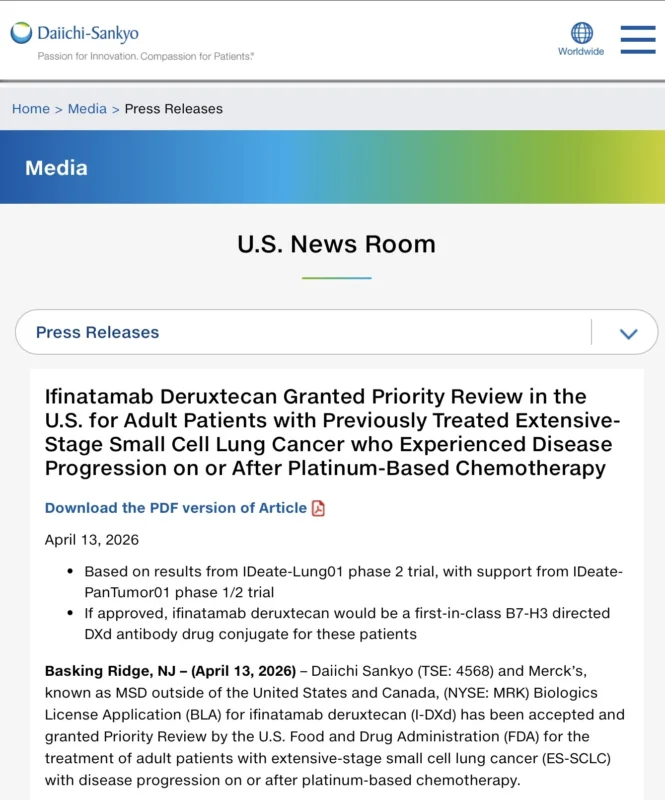
Small cell lung cancer remains one of the most aggressive thoracic malignancies, with rapid progression, early metastatic spread, and limited treatment options after platinum-based chemotherapy. In extensive-stage small cell lung cancer, the need for new post-platinum strategies remains especially urgent. Daiichi Sankyo and Merck have announced that the U.S. Food and Drug Administration has accepted and granted Priority Review to the Biologics License Application for ifinatamab deruxtecan in adult patients with extensive-stage small cell lung cancer who experienced disease progression on or after platinum-based chemotherapy (Daiichi Sankyo & Merck, 2026).
If approved, ifinatamab deruxtecan would become a potential first-in-class B7-H3-directed DXd antibody-drug conjugate for this patient population. The FDA has assigned a Prescription Drug User Fee Act action date of October 10, 2026. The application is also being reviewed under the FDA’s Real-Time Oncology Review program and Project Orbis, reflecting the regulatory interest in accelerating review for oncology therapies with potential clinical relevance across participating international partners (Daiichi Sankyo & Merck, 2026).
A New ADC Approach In A Difficult Disease
Small cell lung cancer accounts for a substantial global cancer burden, with approximately 250,000 patients diagnosed each year worldwide. In the United States, about 27,000 new cases of SCLC were estimated in 2025, representing nearly 12% of all lung cancer cases (Wang et al., 2023; National Cancer Institute, 2025; Centers for Disease Control and Prevention, 2025).
Extensive-stage disease is characterized by rapid clinical progression and a low five-year survival rate. Although platinum-based chemotherapy and immunotherapy-based first-line strategies have improved outcomes for some patients, therapeutic options remain limited after disease progression (Rudin et al., 2021; Liu et al., 2021; Paz-Ares et al., 2022). This is the setting in which ifinatamab deruxtecan is being evaluated.
What Is Ifinatamab Deruxtecan?
Ifinatamab deruxtecan is an investigational B7-H3-directed antibody-drug conjugate developed using Daiichi Sankyo’s DXd ADC technology. It consists of a humanized anti-B7-H3 IgG1 monoclonal antibody linked to topoisomerase I inhibitor payloads through tetrapeptide-based cleavable linkers (Daiichi Sankyo & Merck, 2026).
B7-H3 is a transmembrane protein from the B7 family and is overexpressed across several tumor types, including small cell lung cancer. Its overexpression has been associated with poor prognosis, making it a biologically relevant therapeutic target. At present, there are no B7-H3-directed medicines approved for cancer treatment (Zhao et al., 2022; Janakiram et al., 2017; Qiu et al., 2021; Picarda et al., 2016).
The Trials Supporting The FDA Review
The BLA is based primarily on results from IDeate-Lung01, with supportive data from IDeate-PanTumor01. Results from the primary analysis of IDeate-Lung01 were presented at the 2025 World Conference on Lung Cancer and published in the Journal of Clinical Oncology (Daiichi Sankyo & Merck, 2026).
IDeate-Lung01 is a global, multicenter, randomized, open-label, two-part phase 2 trial evaluating ifinatamab deruxtecan in patients with extensive-stage small cell lung cancer previously treated with at least one prior line of platinum-based chemotherapy and no more than three prior lines of therapy. Patients with asymptomatic brain metastases, either untreated or previously treated, were eligible.
In the dose-optimization part, patients were randomized 1:1 to receive ifinatamab deruxtecan at 8 mg/kg or 12 mg/kg intravenously once every three weeks. In the dose-expansion part, patients received 12 mg/kg every three weeks. The trial enrolled 187 patients across Asia, Europe, and North America (Daiichi Sankyo & Merck, 2026).
The primary endpoint was objective response rate by blinded independent central review according to RECIST v1.1. Secondary endpoints included duration of response, progression-free survival, disease control rate, time to response, overall survival, pharmacokinetics, and safety. Intracranial objective response rate was assessed as an exploratory endpoint.
IDeate-PanTumor01 is a global, multicenter, first-in-human, open-label phase 1/2 trial evaluating ifinatamab deruxtecan in advanced, unresectable, or metastatic solid tumors that are refractory or intolerable to standard treatment, or for which no standard treatment exists. The study includes dose escalation and dose expansion, with the recommended dose for expansion identified as 12 mg/kg. The trial is expected to enroll approximately 250 patients in Asia and North America (Daiichi Sankyo & Merck, 2026).
Regulatory Momentum For Ifinatamab Deruxtecan
Before the Priority Review decision, ifinatamab deruxtecan had already received Breakthrough Therapy Designation from the FDA in August 2025 for adult patients with extensive-stage small cell lung cancer whose disease progressed on or after platinum-based chemotherapy.
The agent has also received Orphan Drug Designation for small cell lung cancer from the U.S. FDA, European Commission, Japan Ministry of Health, Labour and Welfare, and Taiwan Food and Drug Administration. It has additionally received Orphan Drug Designation from the FDA for esophageal cancer (Daiichi Sankyo & Merck, 2026).
The broader clinical development program includes three phase 3 trials in advanced or metastatic disease: IDeate-Lung02 in small cell lung cancer, IDeate-Prostate01 in castration-resistant prostate cancer, and IDeate-Esophageal01 in esophageal squamous cell carcinoma.
What This Means Clinically
The FDA Priority Review does not mean that ifinatamab deruxtecan has been approved. It means the agency has accepted the BLA and will review it on an accelerated timeline because the therapy may offer an important improvement over available options if the data support approval.
For patients with extensive-stage small cell lung cancer after platinum-based chemotherapy, the clinical need remains high. This population often has limited durable treatment options, and new therapeutic classes are needed. If approved, ifinatamab deruxtecan would introduce a B7-H3-directed ADC strategy into the post-platinum ES-SCLC setting.
However, the press release does not provide detailed efficacy values, survival outcomes, or safety results from IDeate-Lung01. Interpretation of the clinical impact therefore depends on the full published trial data and the FDA’s review. Until approval is granted, ifinatamab deruxtecan remains investigational, and its safety and efficacy have not been established for any indication in any country (Daiichi Sankyo & Merck, 2026).
A Potential New Direction In SCLC Drug Development
The regulatory review of ifinatamab deruxtecan reflects the growing role of antibody-drug conjugates in thoracic oncology and the increasing interest in B7-H3 as a therapeutic target. In a disease where relapse after platinum-based therapy remains a major clinical challenge, a potential first-in-class B7-H3-directed ADC could represent an important development if confirmed by regulatory review and clinical data.
The coming FDA decision, expected by October 10, 2026, will clarify whether ifinatamab deruxtecan becomes a new option for adults with previously treated extensive-stage small cell lung cancer.